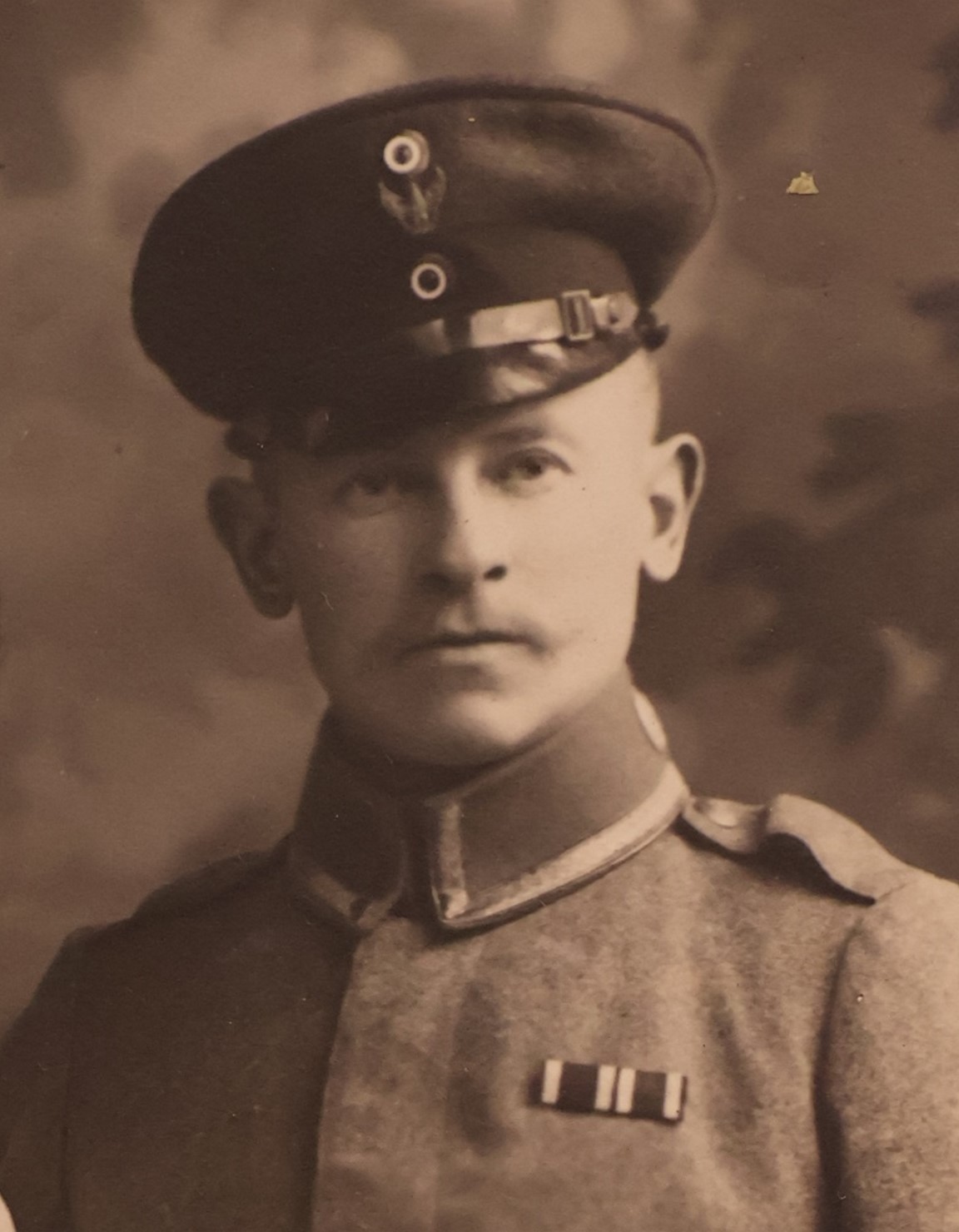
Otto Zoberbier
My Journey through the Orient
translated into English from Werner Zoberbier’s German edition (version “WZ“) of his father Otto Zoberbier’s handwritten version (“²OZ“, the so-called “Zweitschrift”)
Translation drafted with the help of DeepL and GPT (UiO), proof-read by Kathinka Zoberbier and Stephan Guth
Annotated by Stephan Guth
Epilogue (in lieu of a foreword)
<p0 “front matter”> Our delegation to Von der Goltz’s staff[0a] consisted of the following formations:
| Guard du Corps | 3 men |
| [1st Guard Uhlans | 2 men][0b] |
| 1st Guard Field Artillery | 2 men |
| 2nd Cuirassiers | 2 men |
| 9th Uhlans | 2 men |
| 2nd Dragoons | 3 men |
| 3rd Uhlans | 1 man |
| 3rd Hussars | 1 man |
| 12th Hussars | 5 men |
| 26th Dragoons | 2 men |
| Telephone operators | 2 men |
| Medics | 2 men |
| Gunsmiths | 1 man |
| Shoemakers | 1 man |
| Photographer | 1 man |
| 30 men |
<p1a> 1 Towards Constantinople[1]
After our command to Von der Goltz’s staff in Berlin was put together on foot from comrades of the entire German army in the barracks of the II. Garde Regiment, we received our tropical equipment in Schöneberg.[2] We spent a few more beautiful days in Berlin, and those who lived nearby were given a Sunday leave. The day of our departure arrived, and a proper farewell was celebrated beforehand. Everyone was in the best of moods.
On December 11, 1915, we went by car to the Schlesische Bahnhof, the station serving the Silesian area of Germany.[3] Our train was already waiting. Once we had distributed ourselves into the compartments – three men per compartment – we set off towards Breslau,[4] slowly and in the direction of the distant south, which kept us away from our dear homeland for a long time.
When we were woken up with heavy heads the next morning, we were in Sagan,[5] where we were offered coffee and sausages. We enjoyed them very much. After a short stay, we continued at a slow pace, and we arrived in Breslau at around 1 pm. There, we were provided with a lunch that was already quite warlike. We had a longer stay and bought various souvenirs and trinkets that we later discarded as unnecessary ballast.
We arrived in Oderberg[6] at around 7 pm. We were leaving our German homeland for a long time. We rode through Austria-Hungary via Prague and Budapest, where we got to know paprika soup thoroughly and gradually got enough of it. We had our first longer stay in the small town of Temeswar.[7] Here, we were able to make a small excursion into town to the city and indulge and strengthen ourselves with goulash and a beautiful glass of Hungarian wine.
We continued on through the Puszta towards the Romanian border. On the night of December 15, we arrived in Orsova.[8] Orsova was a border town at the three-country junction of Austria-Hungary, Romania, and Serbia, where our entire transport had to be reloaded. On the next morning, with the help of Russian prisoners of war,[9] the reloading onto Danube barges began very early. The work was hard. Cranes were not available, and the crates containing the French rifles were very heavy. But by the next morning, it was all done, and our equipment was stored on five barges. We soldiers also quartered ourselves on the barges and made ourselves comfortable. <p1b> We still had some time left to see the town for a few hours and have a decent lunch.
Around 1 pm, a tugboat arrived and began to tow our five barges towards Sistov,[10] Bulgaria. A few quiet days followed. Now a few quiet days began for us again. Our little convoy slowly drifted through the beautiful landscape. The mountains of Romania were on the left and the mountains of Serbia were on the right. On the first evening of our Danube trip, we anchored near the town of Kladovo,[11] where we went ashore. Kladovo was occupied by the Austrian Landsturm,[12] who warmly welcomed us and emptied many bottles of wine with us.
We continued on through the “Iron Gates”.[13] We had the misfortune that one of our five cargo barges ran aground and drifted away. On this occasion, comrade Schleussner, who was brushing his teeth at the time, lost his dentures. When our convoy had reorganized, we resumed our journey. In the evening, we arrived at the town of Lompalanka,[14] which was occupied by Bulgarians. Here, too, we went ashore and emptied a few bottles of wine with our Bulgarian comrades although we could hardly communicate with them.
The journey continued through the Romanian plain. During the day, the fog was often so thick that we had to anchor. On the fifth day of our journey, we arrived at our destination, Sistov,[15] Bulgaria, where we moored at the quay. This marked the end of our beautiful trip along the Danube.
The next morning, the reloading of the equipment into railway wagons began again. The port in Sistov was already more modern. It had cranes, and loading the heavy crates was child’s play. The crane loaded them directly with a hook into the railway wagons. Strong Bulgarian Askers (soldiers)[16] also helped, so there wasn’t much left for us to do. By the evening of December 23, everything was done, and we could take a look at the town, observe the life and bustle of the people, and enjoy ourselves for a few hours. On the evening of the next day, we could receive the gifts of love [care packages] that had arrived from home, and celebrate our Christmas Eve.
From here, the journey continued by train through European Turkey to Constantinople. The journey was very monotonous and uninteresting. We spent both days of Christmas on the train. In the night of December 27, we finally reached Constantinople.
As we strolled through the city the next morning, we attracted the interest of the inhabitants as German soldiers. We had spent the night in a mass quarters where we couldn’t sleep due to the abundance of bedbugs. <p2a> As quickly as possible, we sought out another quarters, which we soon found after asking around. There are more German shops and restaurants/inns in Constantinople than one might think. So we were lucky to find accommodation in a German pub. The man was a soldier in Germany, and his wife and 17-year-old son ran the inn in his place. The sailors of the cruisers “Göben”[17] and “Breslau,”[18] who enthusiastically celebrated our arrival, also frequented this place. Suddenly, we were the center of attention.
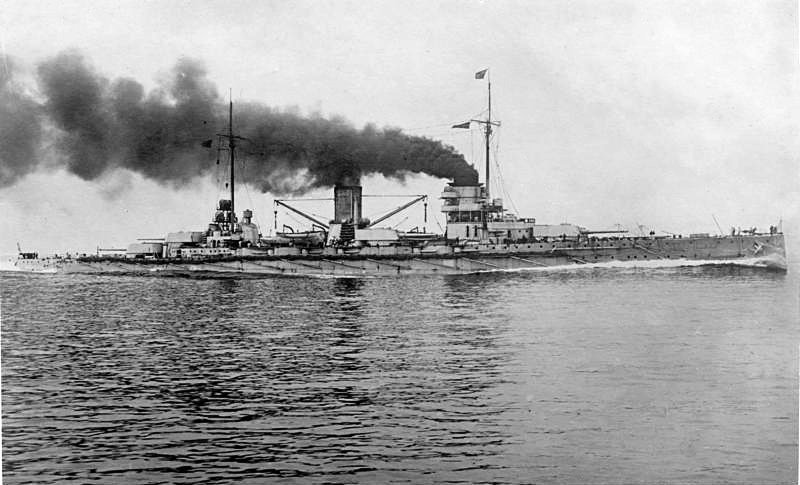
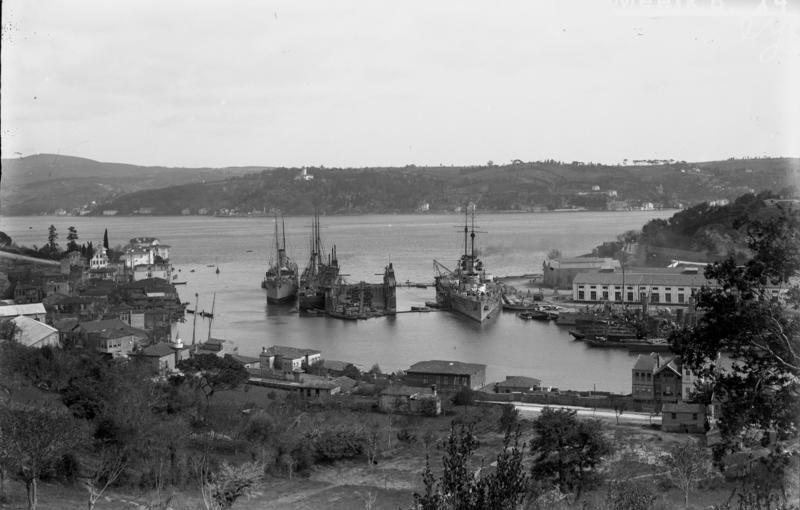
How we lived and regaled ourselves here! There was no duty. We just had to report daily back to the staging area, then had enough time to explore the city and admire its sights. The son of our landlady spoke perfect Turkish and was an indispensable companion and advisor to us. We visited the world-famous Hagia Sophia mosque, which we were only allowed to enter after removing our shoes. The sailors of the “Göben” and “Breslau” invited us to see their ships. We were picked up by the steam launch of the “Göben” and we sailed along the beautiful Bosphorus to Stenia,[19] where the two beautiful ships were anchored. We were shown everything there is to see on a warship. The “Göben” is a ship 186 m long. We were allowed to see the big gun turrets with their 28 cm guns. Everything that civilians would never get to see was shown and explained to us. For us soldiers, it was a unique experience.
The von der Goltz staff ◄ ► 2 Retreat
Notes to “front matter” and ch. 1
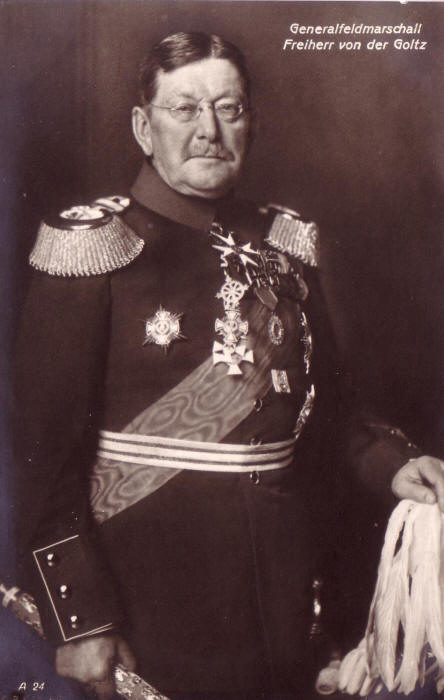
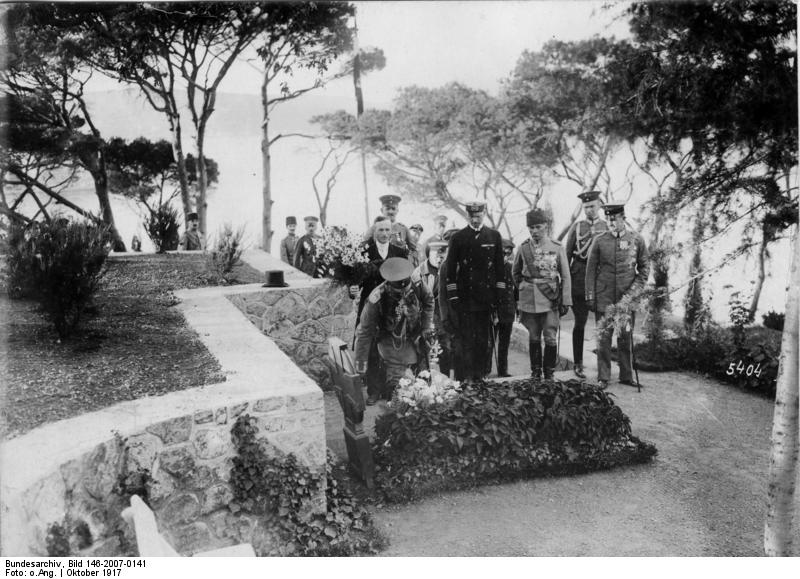
[0a] Also called the German “Orient group”, or the “Pasha Army” (see above, note 9), referring to von der Goltz “Pasha”. Wilhelm Leopold Colmar Freiherr von der Goltz (1843–1916) was a Prussian field marshal and military writer. Von der Goltz served in the Prussian infantry as a second lieutenant from 1861 to 1866, later in the general staff, where he also took part in the battles of Vionville and Gravelotte and in the siege of Metz. Since 1871, he was professor at the military school at Potsdam in 1871, promoted to captain, and placed in the historical section of the general staff. It was then that he wrote several memoirs that acquired the status of handbooks of military strategy and psychology (focusing, among other things, on the mobilisation of national will for a Volkskrieg ”War of the People”, later developed further into the idea of Das Volk in Waffen “The nation in arms” where the state would seek to mobilize the entire nation and its resources for war, what today might be called total war). In order to “lead military organization to ever greater perfection […] Goltz thought society needed to be militarized in peacetime on an unprecedented level, and what was required was ‘the full amalgamation of military and civilian life.’ Goltz was a militarist, Social Darwinist and ultra-nationalist who believed war was necessary, desirable and inevitable. In Goltz’s Social Darwinist perspective, just as ‘survival of the fittest’ prevailed in nature, the same principle applied to international relations with ‘strong’ nations rightfully devouring ‘weak’ nations. Goltz, who saw the carnage of war as the most beautiful thing in the world wrote: ‘It [war] is an expression of the energy and self-respect which a nation possesses…. Perpetual peace means perpetual death!’” / After the Ottomans’ defeat in the Russo-Turkish War (1877–1878), von der Goltz served for twelve years as a military advisor to the Sultan Abdülhamid II, helping to reorganize the Ottoman Army. / “Goltz achieved some reforms, such as lengthening the period of study at military schools and adding new curricula for staff courses at the War College. From 1883 to 1895, Goltz trained the so-called ‘Goltz generation’ of Ottoman officers, many of whom would go to play prominent roles in Ottoman military and political life. Goltz, who learned to speak fluent Turkish, was a much admired teacher, regarded as a ‘father figure’ by the cadets, who saw him as ‘an inspiration’. […] As a result, it was the Ottoman army rather the German army which first embraced Goltz’s ‘nation in arms’ theory as the basis of its understanding of war. After some years he was given the title Pasha.” / On his return to Germany in 1895 Goltz served in several leading positions, continuing also his career as a military writer. / “Goltz welcomed the Young Turk Revolution of 1908, which should come as no surprise given that most of the officers leading the revolution were men he had personally trained. […] / Following the 1911 manœuvres Goltz was promoted to Generalfeldmarschall (Field Marshal), and retired from active service in 1913.” When WW I broke out, however, he was soon recalled from retirement and first (1914–1915) served as military governor of Belgium, then (1915–1916) again in the Ottoman Empire, since mid-October 1915 in charge of the Sixth Army (to lead the “Mesopotamian campaign”). / “Goltz died on 19 April 1916 […] The official reason for his death was typhus, although apparently there were rumors that he had been poisoned. In accordance with his will, he was buried in the grounds of the German Consulate in Tarabya, Istanbul, overlooking the Bosporus [see Fig. 12]” – https://en.wikipedia.org/wiki/Colmar_Freiherr_von_der_Goltz (as of May 14, 2024).
[0b] This line is missing in WZ – an erroneous omission by the copyist, obviously, as the numbers given do not add up to “30” without the 2 Uhlans that we find in ²OZ after “Garducorts 3 Mann” as the second line.
[1] The division into numbered chapters and the chapter titles are Werner Zoberbier’s additions. The handwritten ²OZ version does not show any chapter or paragraph breaks at all, filling all available space on every single page from the beginning to the end.
[2] A borough of Berlin, to the south/southwest of the city centre.
[3] Today (as also between 1950 and 1987) named Ostbahnhof (“East railway station”). The name Schlesischer Bahnhof was in use between 1881 and 1950; from 1987 to 1998 the station was called Hauptbahnhof (“Main station”) – https://de.wikipedia.org/wiki/Berlin_Ostbahnhof (as of March 13, 2024).
[4] Today Wrocław in southern Poland, then still a province (Schlesien “Silesia”) of the German Kaiserreich (1871–1918).
[5] Today Żagań in western Poland, not far from the German border. Located ca. 140 km from Berlin, Sagan was a main railway junction on the Berlin–Breslau line, where the Niederschlesisch-Märkische Eisenbahn (Berlin–Wrocław railway) crossed and connected to several other lines of the railway net.
[6] Today Bohumín in south-eastern Czechia (district Moravia-Silesia) on the Polish border, another important railway junction through which several major lines passed (and still pass).
[7] In German also Temeschwar or Temeschburg, i.e., Timișoara (Hungarian Temesvár) in today’s Romania, the main economic, social and cultural centre in Western Romania and considered the informal capital of the Banat region. At the time, Temeswar/Timișoara still belonged to the Austrian-Hungarian Empire. Historically, the most numerous ethnic groups were the Swabian Germans, Jews and Hungarians – https://en.wikipedia.org/wiki/Timişoara (as of March 13, 2024).
[8] Today Orșova in southwestern Romania, a port city on the Danube river. “It is one of four localities in the Banat historical region situated just above the Iron Gates [see below, note 60] where the Cerna River meets the Danube” – https://en.wikipedia.org/wiki/Orşova (as of March 13, 2024). For the location, cf. also the description following in the main text above.
[9] Cf. also below, at note 112.
[10] See below, note 62.
[11] ²OZ 4 / WZ 1b “Kladowa”, i.e., Kladovo (Serbian Cyrillic: Кладово), a town and municipality in eastern Serbia, situated on the right bank of the Danube.
[12] “The Austro-Hungarian Landsturm was a reserve force that consisted of men aged 34 to 55. It was intended to provide replacements for the front line units and provide a militia for local defence. It was divided into the Austrian Imperial (Kaiserlich) Landsturm and the Hungarian Royal (Königlich) Népfelkelés. / During the First World War, the Austrian Landsturm formed 40 regiments totaling 136 battalions in Austria and the Hungarian Landsturm formed 32 regiments totaling 97 battalions. They provided 20 brigades who took to the field with the rest of the army” – https://en.wikipedia.org/wiki/Landsturm (as of March 13, 2024).
[13] “[A] gorge on the river Danube”, forming part (today) of the boundary between Serbia (to the south) and Romania (north). “In the broad sense it encompasses a route of 134 km (83 mi); in the narrow sense it only encompasses the last barrier on this route, just beyond the Romanian city of Orșova” (nowadays containing two hydroelectric dams, with two power stations). “At this point in the Danube, the river separates the southern Carpathian Mountains from the northwestern foothills of the Balkan Mountains” – https://en.wikipedia.org/wiki/Iron_Gates (as of March 18, 2024).
[14] I.e., Lom (Bulgarian Лом), a city in nordwestern Bulgaria, often also called Lom-Palanka, where Palanka refers to a place that is bigger than a village but smaller than a town – https://de.wikipedia.org/wiki/Lom_(Bulgarien) (as of March 18, 2024).
[15] Today Svishtov (Bulgarian Свищов) in northern Bulgaria, formerly Sistova, a port city on the Danube where the river reaches its southernmost point.
[16] Turkish asker, from Arabic ʿaskarī “soldier”. According to some, the word goes back to Latin exercitus “army”.
[17] SMS Goeben [see Fig. 13 and Fig. 14] was a huge “battlecruiser of the Imperial German Navy, launched in 1911 and named after the German Franco-Prussian War veteran General August Karl von Goeben. […] / Several months after her commissioning in 1912, Goeben, with the light cruiser Breslau [see next footnote], formed the German Mediterranean Division and patrolled there during the Balkan Wars. After the outbreak of World War I on 28 July 1914, Goeben and Breslau bombarded French positions in North Africa and then evaded British naval forces in the Mediterranean and reached Constantinople. The two ships were transferred to the Ottoman Empire on 16 August 1914, and Goeben became the flagship of the Ottoman Navy as Yavuz Sultan Selim, usually shortened to Yavuz. By bombarding Russian facilities in the Black Sea, she brought Turkey into World War I on the German side. The ship operated primarily against Russian forces in the Black Sea during the war, including several inconclusive engagements with Russian battleships. She made a sortie into the Aegean in January 1918 that resulted in the Battle of Imbros, where Yavuz sank a pair of British monitors but was herself badly damaged by mines. / In 1936 she was officially renamed TCG Yavuz (“Ship of the Turkish Republic Yavuz”); she carried the remains of Mustafa Kemal Atatürk from İstanbul to İzmit in 1938. Yavuz remained the flagship of the Turkish Navy until she was decommissioned in 1950. […] She was the last surviving ship built by the Imperial German Navy, and the longest-serving dreadnought-type ship in any navy” – https://en.wikipedia.org/wiki/SMS_Goeben (as of March 20, 2024).
[18] Like SMS Goeben (see preceding footnote), SMS Breslau was a large cruiser of the Imperial German Navy, “built in the early 1910s […]. Following her commissioning, Breslau and the battlecruiser Goeben were assigned to the Mittelmeerdivision (Mediterranean Division) in response to the Balkan Wars. […] Breslau and Goeben were transferred to the Ottoman Empire in August 1914, to entice the Ottomans to join the Central Powers in World War I. The two ships, along with several other Ottoman vessels, raided Russian ports in October 1914, prompting a Russian declaration of war. The ships were renamed Midilli and Yavûz Sultân Selîm, respectively, and saw extensive service with the Ottoman fleet, primarily in the Black Sea against the Russian Black Sea Fleet. / Midilli was active in laying minefields off the Russian coast, bombarding Russian ports and installations and, because of a shortage of Ottoman merchant ships, transporting troops and supplies to the Black Sea ports supplying Ottoman troops fighting in the Caucasus Campaign. She was lightly damaged several times by Russian ships, but the most serious damage was inflicted by a mine in 1915, which kept her out of service for half of a year. The ship was sunk by mines in January 1918 during the Battle of Imbros, with the loss of the vast majority of her crew” – https://en.wikipedia.org/wiki/SMS_Breslau (as of March 20, 2024).
[19] Today İstinye, a neighbourhood on the northwestern, European side of the Bosporus, between Emirgan and Yeniköy. “It is one of the finest seashore locations on the Bosporus where people walk around during the weekends. İstinye is famous for its cafés and seafood restaurants” – https://en.wikipedia.org/wiki/İstinye. The modern name goes back via Byzantine Greek Stenos or Stenia to Greek Sosthénion (Σωσθένιον), probably a corruption of an earlier place name, composed of σῶς “safe” and σθένος “strength, might, power,” referring to the goddess Athene and thus meaning something like “powerful Athene’s safe place”, perhaps due to its protected location in a bay with only a small opening to the Bosphorus – https://tr.wikipedia.org/wiki/İstinye (as of March 14, 2024).
 Sergeant Otto Zoberbier’s "Travels in the Orient: Persia and Arabia, 1915–1919"