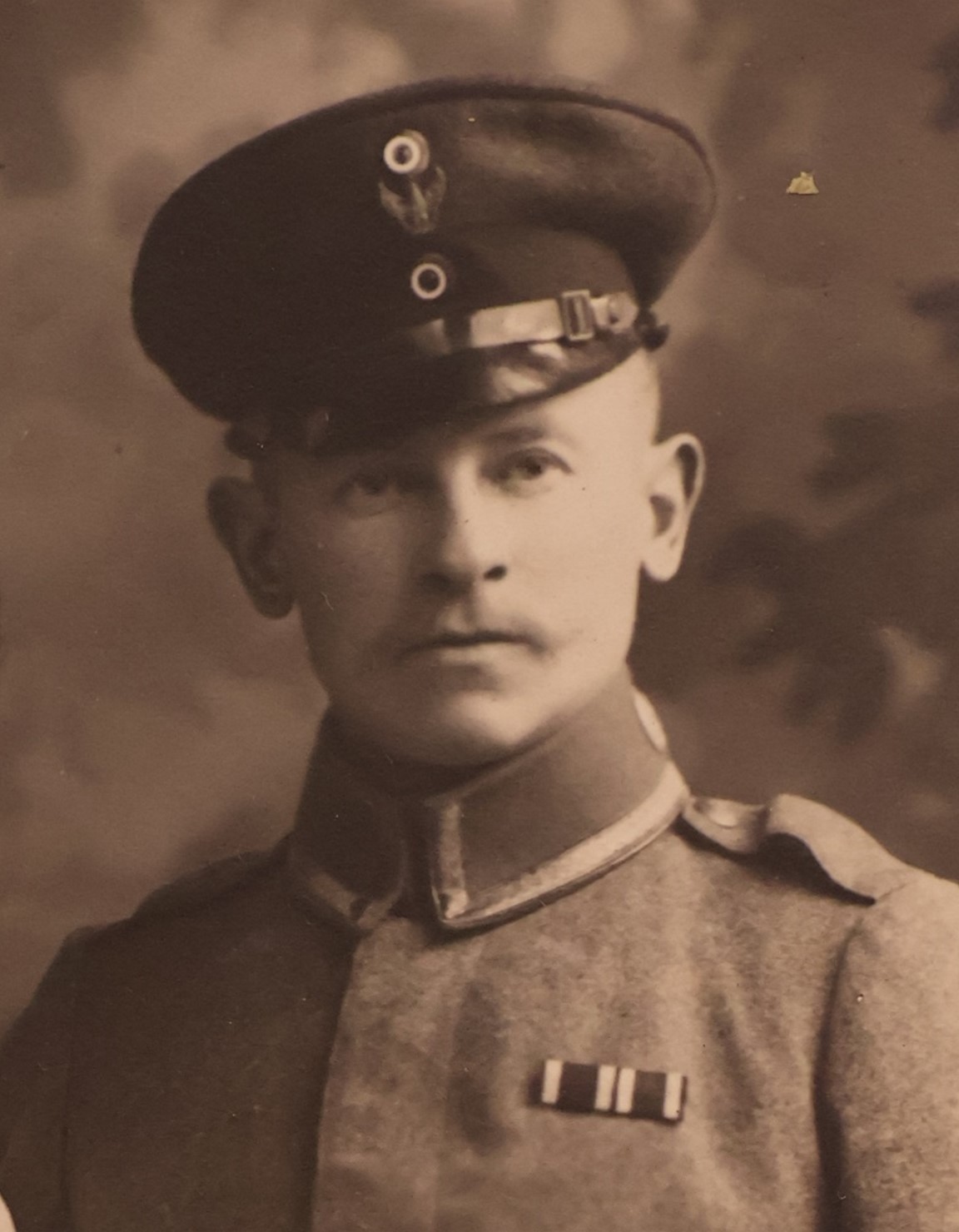
Otto Zoberbier’s
My Journey through the Orient
translated into English from Werner Zoberbier’s German edition (version “WZ“) of his father Otto Zoberbier’s handwritten version (“²OZ“, the so-called “Zweitschrift”)
Translation drafted with the help of DeepL and GPT (UiO), proof-read by Kathinka Zoberbier and Stephan Guth
Annotated by Stephan Guth
Epilogue (in lieu of a foreword)
<p16b> 10 Aleppo
When I arrived in Aleppo, I handed over my transport to the German back area there and learned that I had been assigned to the animal depot in Aleppo. It was there that I spent the best time during my stay in the Orient. The climate was bearable at only 50 degrees, and the city offered many diversions. The horse depot of the German back area was run by a German veterinarian. Our task was to buy horses and mules, which were delivered by an Arab buyer. Those that were good and fit were accepted. The animals were intended for the front and were collected by German soldiers when needed.
It was a good place to live. Five Germans were working in the depot. Each of us had his own riding horse, and in the evenings, when it was pleasantly cool, we went for our rides. Other German comrades couldn’t do that and envied us for it. We had our own kitchen, with our own cook. In our free time we enjoyed the city life. There were two concert gardens in the city. An Austrian ladies’ band[1] played in one of them, and an Arab ladies’ band[2] in the other. We often went there. But I soon realised that life here was much more expensive. There wasn’t anything we had to do without, but the money I had saved up during our transports through the desert was slowly dwindling. You could even buy German beer in the German back area, but it cost 2.60 marks a bottle. Even our tropical allowance of six marks was not enough to be able to enjoy it often.
Having lived in Aleppo for a while, I had met people in other departments posts too. A sergeant who was in charge of some sort of issuing office showed his appreciation when he was allowed occasionally to borrow one of our horses for a ride.
From time to time we were also invited by our Arabian animal buyer, who already had adopted a European lifestyle – we used knife and fork for eating. And we were even served alcohol to drink.
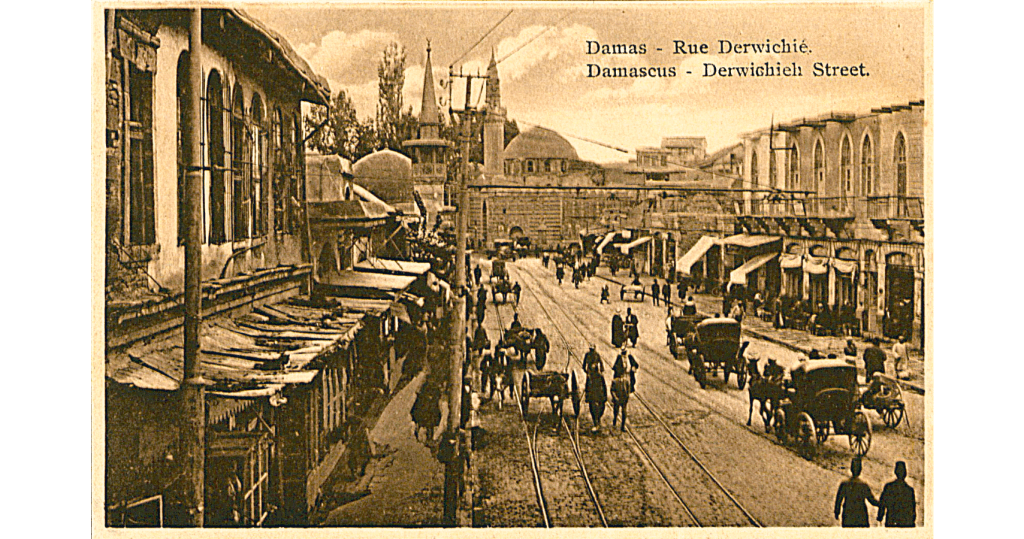
I wanted to take the opportunity to see Damascus [cf. Fig. 23]. So, when a horse transport was going to the Rajack[3] back area, from where the animals were taken to the front, I took charge of the transport. The route led past the ancient ruined city of Baalbeck[4] [cf. Fig. 22],
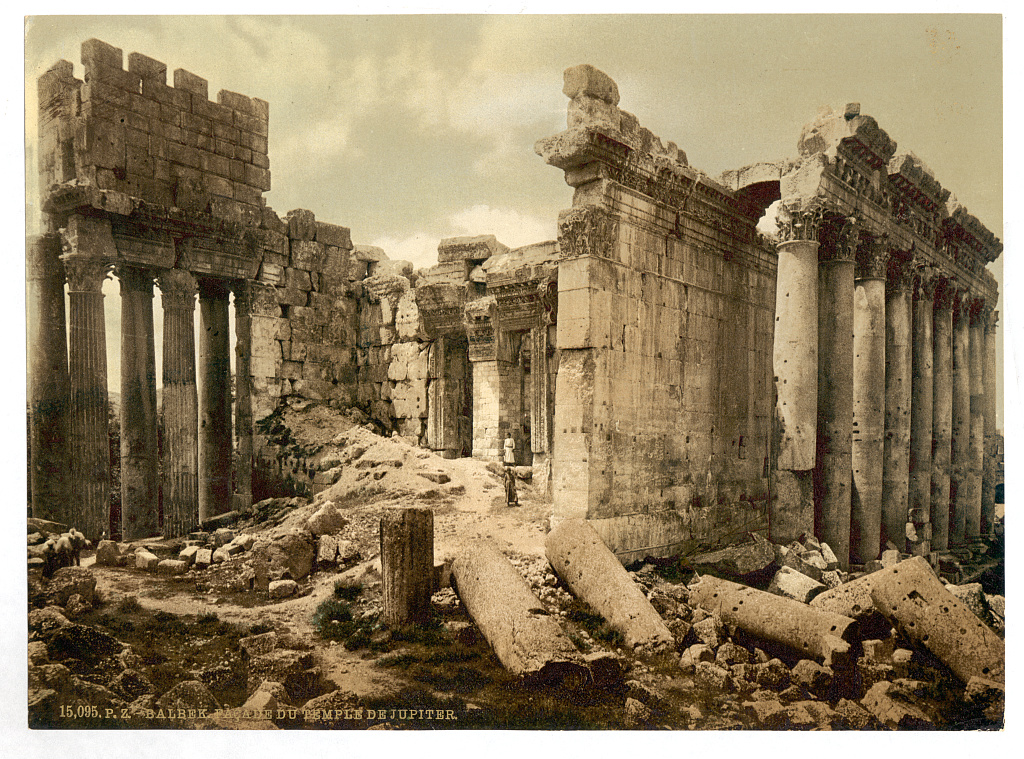
where you could still see antique columns and temples. Two days later, we stood at the gates of Damascus, and a dream of mine came true. At school I had written an essay: “Through thorny bushes and desert sand, the road leads to Canaan,” in which Damascus featured.
<p17a> In Aleppo life went on. We didn’t want for anything. In the evenings we went to the cinema or had someone drive us to the concert garden, where we drank a bottle of wine or the good and very cheap raki, and where we enjoyed ourselves with the girls from of the Austrian ladies’ band.[5] Raki is an intoxicating rice liquor[6] that turns milky cloudy when mixed with water.
Our horse depot was a sought-after place of work, and the hamale (workers)[7] employed by us were, by Turkish standards, treated very well. They were given food and good wages, and as a result everyone tried to place an abadash (friend)[8] with us. Among them were several deserted Turkish soldiers. So we had plenty of personnel and could, if necessary, delegate Zeises (grooms) to the transports that left in 1917–1918. Once again, a German formation had arrived that needed horses and pack animals, as well as the necessary grooms and also wanted to have the associated Zeises. I set off with 30 men to the formation, which camped 4 km away. We had chosen the 30 men well, and guarded them closely to make sure none of them ran away – we knew them too well! Towards evening, I set off with my little gang to deliver them personally. After an hour’s march a Zeis came up to me and asked for a rest, so I stopped, got off my horse and sat down by the roadside. It was already dark and everyone was lying on the ground, resting. All of a sudden there was a commotion, several jumped up and made off. When we finally arrived at the formation, nine men were missing.
New Job: Caravan Guide
Duty Leave
Notes on ch. 10
[1] See also next footnote, and below, at note 201.
[2] A “women’s orchestra” playing in a “concert garden” in Aleppo is mentioned also in Prüfer’s diaries (ed. Morrow 2018). We cannot know though which of the two featuring in Zoberbier’s memoirs it was; in any case, Prüfer found it “awful” (p. 156) while Zoberbier and his comrades enjoyed their performances.
[3] I.e., probably, al-Riyāq in the Beqāʿ valley, ca. 50 km southwest of Baʿalbakk (see next footnote) and 10 km east of Zaḥleh, appearing as “Rajak” several times in Liman von Sanders’ Five Years in Turkey. The place seems to have been of some importance at the time because “the gauge changed” here (Liman von Sanders 1927, 29).
[4] I.e., Baʿlabakk or Baʿalbakk (in English generally spelt Baalbek), a city in the northern part of Lebanon’s Biqāʿ (Beqaa) Valley, about 67 km northeast of Beirut. “Baalbek has a history that dates back at least 11,000 years, encompassing significant periods such as Prehistoric, Canaanite, Hellenistic, and Roman eras. […] In later periods, the city was sacked by the Mongols and faced a series of earthquakes, resulting in a decline in importance during the Ottoman and modern periods. The city is known for the ruins of the Baalbek temple complex from the Roman period, housing two of the largest and grandest Roman temples: the Temple of Bacchus and the Temple of Jupiter. It was inscribed in 1984 as an UNESCO World Heritage site” – https://en.wikipedia.org/wiki/Baalbek (as of April 6, 2024). – For Zoberbier’s eagerness to visit places like Baalbek or Damascus, see “Editor’s introduction”, pp. x ff. (the memoirs as ‘travel narrative’).
[5] See above (apud note 197).
[6] The explanation of rakı as “rice liquor” is wrong – see above, note 131.
[7] Turkish hamale, from Arabic ḥammāla, dial. pl. of ḥammāl “(load) carrier, porter, coolie”, from Ar. ḥamala “to carry, bear”; see also above, note 72.
[8] Sic in WZ, missing from ²OZ. Should probably be arka… instead of aba… (Turkish arkadaş “friend”), perhaps a misreading from *¹OZ.
New Job: Caravan Guide
Duty Leave
 Sergeant Otto Zoberbier’s "Travels in the Orient: Persia and Arabia, 1915–1919"