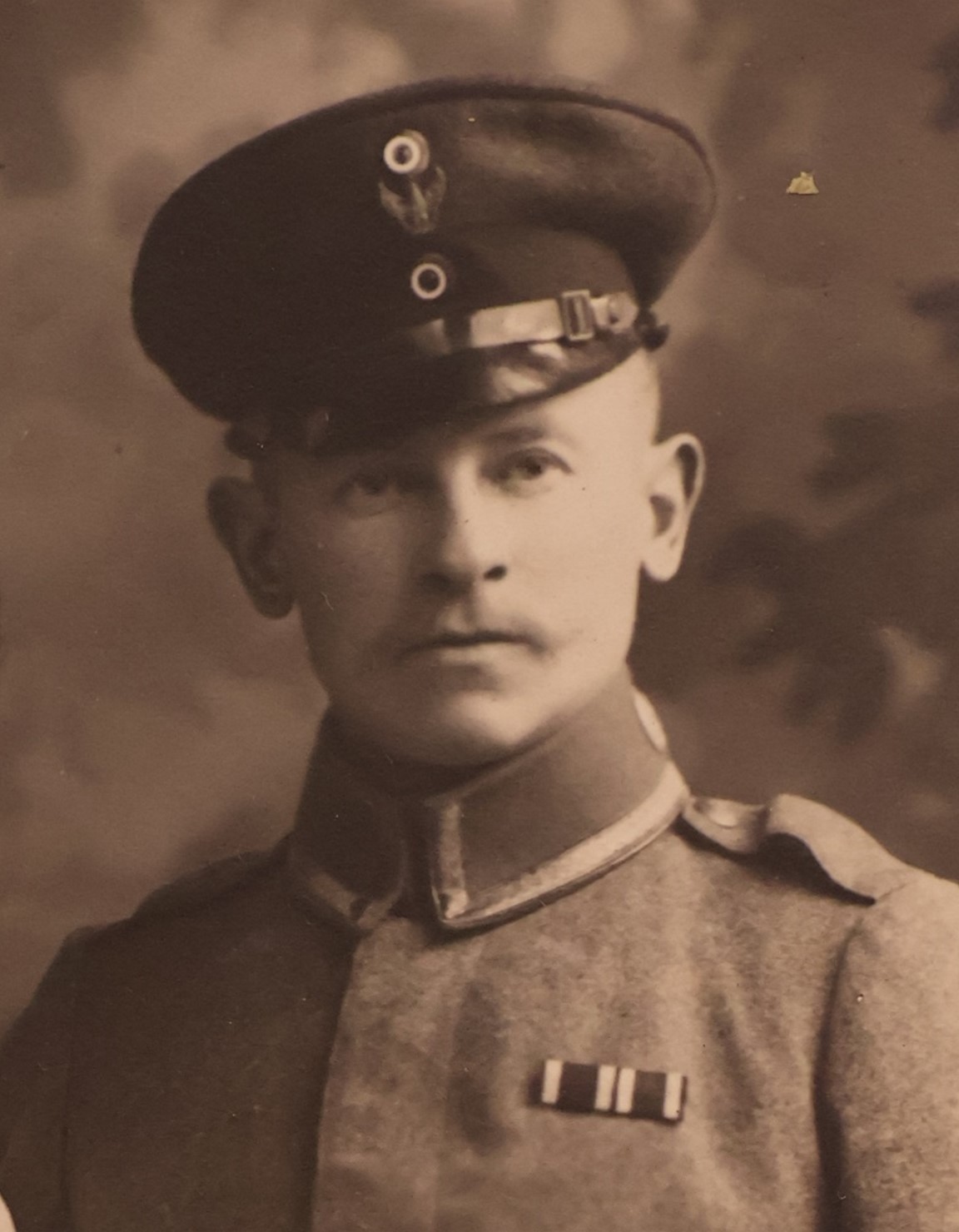
Otto Zoberbier’s
My Journey through the Orient
translated into English from Werner Zoberbier’s German edition (version “WZ“) of his father Otto Zoberbier’s handwritten version (“²OZ“, the so-called “Zweitschrift”)
Translation drafted with the help of DeepL and GPT (UiO), proof-read by Kathinka Zoberbier and Stephan Guth
Annotated by Stephan Guth
Epilogue (in lieu of a foreword)
11 Duty Leave
The year 1917 was nearing its end. I had not had any holidays for two years. I submitted a request for leave, and surprisingly the leave was granted immediately. I left Aleppo on 16 January 1918, and reached Gelebeck[1] the next morning. There I made the onward connection and continued to Pozanti[2] after only a short stay. The tunnels through the Amanus[3] and Taurus mountains had been completed in the meantime,[4] so that the train, pulled by diesel engines, arrived in Pozanti already the next evening. However, nobody in Pozanti knew when there would be a train to Constantinople. I prepared myself for a longer stay and went to the German soldiers’ hostel in Pozanti to finally get something warm to eat after my three-day journey. I had only just eaten my dinner when a messenger from the German back area came and told me and a few of my comrades to return to the station immediately as the train was leaving the same evening. Our group of holidaymakers now consisted of ten men in the meantime. At the station we were assigned an empty goods wagon on the train. We quickly got ourselves a tin barrel and fuel so that we could heat our wagon on the journey, as the winters in Anatolia are very cold. After six days, we arrived at Haidar-Pasha station[5] in Constantinople. The next morning, when we went to pick up our leave pass from the liaison officer in the German back area section, we were told that our leave had been cancelled in the meantime, and that we would have to wait.
Of course, we were not bored in Constantinople. Since we were not on duty, we had to pass the time in some other ways. We went on major excursions, took the steamer to the Black Sea, went to the cinema or theatre in the evenings. Here I saw the “Gypsy Baron,”[6] performed by an Austrian theatre company. We had our meals in the German soldiers’ hostel. If we didn’t like the food there, we sometimes ate in a restaurant, but that was expensive because the prices had risen considerably in the two years since I had been here.
Over time more and more soldiers were waiting for their leave pass at the commandant’s office. At last, the time came. My leave pass was for six weeks, 14 days of which were for the journey home and back. The Orient Express, on which a regimental comrade and I were to travel, would cover the distance to Berlin in three days,[7] so that we could be home for five weeks. At the station, the would-be holidaymakers who had been stopped by the holiday ban during the past three weeks were milling around. People stood in long lines in front of a luggage check and waited their turn. The checks were carried out by Turkish officers. Once the luggage had been searched, and everything was in order, a control tag was stuck on the luggage and you could pass. By now I was getting restless because the departure time was getting closer and closer. When it was finally my turn and I presented my open suitcase, the inspector suddenly turned away and left without properly checking my luggage. I quickly grabbed my suitcase, but the Turkish Asker (soldier) at the barrier would not let me through without a control tag, but a Schausch standing by said, “Taman, taman”[8] (done), and I was allowed through. In the train compartment, a comrade took the control tag off his backpack and stuck it on my suitcase, <p18a> in case there was another check later on.
Now we were all set. The train was about to leave, so I had just made it in time. The checks en route were only superficial. In Sofia we had a two-hour stopover, which we used to grab some food. In Nisch we had to change trains again and wait for the train from Üsküb.[9] But the train was two hours late. For the train to Belgrade, we had to leave our main luggage in the luggage van, labelled with our names and addresses. We were only allowed to take the bare necessities into the compartment. All I saw of Belgrade was when I changed trains at five in the morning. There was one more change of trains, and then we would travel all the way to Dresden. Towards the evening of the second day we reached Vienna, where the engine was changed. We continued our journey right away, without seeing anything of the city. In the evening of the third day we arrived in Berlin, but unfortunately our luggage didn’t. We were able to pick it up the next day.
Finally back home. After such a long time, the reunion was particularly cordial.[10] First with my close relatives, and then the visits to other relatives and acquaintances, for there was much to tell, and we were talking about many a soldier who would not be returning. The few weeks went by far too quickly. I would have liked to stay at home even longer, and tried to apply for additional leave by telegraphing to Constantinople. Someone had said that this was possible. On the penultimate day of my regular leave, I went to the theatre in Berlin with my bride and my relatives. On the last day before I had to leave, I had not yet heard about my the additional leave. I was already on my way to Berlin when the telegram granting the extension finally arrived at my parents’ house. My parents quickly sent a message to the station in Berlin where I was about to depart, and fortunately the message reached me just in time. I had 14 more days, and I enjoyed them thouroughly.
At the end of March, I finally had to make the return journey. On 31 March 1918, after seven weeks’ leave, I travelled from Baruth[11] to Dresden, where I boarded the Orient Express, which took me to Constantinople in three days. There I met a comrade from my animal depot. He had also returned from leave and was waiting for the train to Aleppo. In Constantinople I was given the task of accompanying a Turkish battalion to Aleppo. The journey began at Haidar-Pasha station. On the second day, a Turkish soldier reported sick with typhus. The next day, the whole battalion was unloaded in Konia, and my comrade and I had to join them. Everyone, including us, was now tested for typhus. But apparently we <p18b> weren’t infected yet, because the next day, after being deloused, we were allowed to continue our journey on the next train. In Karabunar[12] they were surprised that I arrived without the Turkish battalion, because preparations had already been made here to feed the Askers. A diesel engine was harnessed to the front of our train, and the journey through the large tunnels, 8 km long, could begin. After five days we were finally in Aleppo, after I had been away for four months.
Aleppo
Retreat and End of War
Notes on ch. 11
[1] Cf. note 85.
[2] Cf. note 69.
[3] Cf. note 83.
[4] Cf. above, p. 211 (note 74) and p. 214 (note 84) where Zoberbier reported that work on the tunnels was still not completed, equipment therefore had to be reloaded and the journey continued off-rail.
[5] Cf. note 67.
[6] The Gypsy Baron (German: Der Zigeunerbaron) is an operetta in three acts by Johann Strauss II which premiered at the Theater an der Wien on 24 October 1885. Its German libretto by Ignaz Schnitzer is based on the unpublished 1883 story Saffi by Mór Jókai” – https://en.wikipedia.org/wiki/The_Gypsy_Baron (as of March 25, 2024). – German private Georg Steinbach saw The Gypsy Princess (Die Csárdásfürstin, composed 1915 by Emmerich Kálmán), according to Gallé (ed. 2017, p. 22, note 27), another “war-time hit”, in the Taksim Gardens.
[7] Berlin was not on the Orient Express line proper, but connected to it via Munich, Vienna, or Budapest. “The Orient Express was a long-distance passenger luxury train service created in 1883 […]. The train traveled the length of continental Europe, with terminal stations in Paris in the northwest and Istanbul in the southeast […]” – https://en.wikipedia.org/wiki/Orient_Express (as of March 27, 2024).
[8] I.e., Turkish tamam, tamam “alright, o.k.”, from Arabic tamām “dto.”, properly a verbal noun of tamma “to complete, finish”.
[9] I.e., Skopje, today capital of Northern Macedonia.
[10] According to Werner Zoberbier (interviewed by Manfred Zoberbier and Susanne Mortier), his father Otto reported to have spent this holiday mostly on the family’s farm in Zesch, Mark Brandenburg, now managed by his sister. On this occasion, so Werner, his father also met his future wife (see “Editor’s introduction”), and the two got engaged – a few lines further down he remembers to have gone to a theatre in Berlin not only with his relatives but also “with my bride” (my emphasis, S.G.). If Werner is right, then it seems a bit strange that neither the first meeting nor the engagement are mentioned in his memoires. Werner assumes this may be due to the fact that his father thought private issues would probably not match the overall character of the memoirs, where the focus was on the “Orient” experiences. – See above, “Open questions”, p. xiii.
[11] I.e., Baruth/Mark, a town in the Teltow-Fläming district of Brandenburg, 24 km east of Luckenwalde, and 53 km south of Berlin. According to Werner (interviewed by Manfred Zoberbier and Susanne Mortier, Easter 2024), Baruth was the closest railway station to Otto Zoberbier’s home village Zesch (see preceding footnote and “Editor’s introduction”) where he spent most of his leave.
[12] WZ “Karabunar”, ²OZ “Karabünar”, i.e. (probably) Karapınar, formerly known as Barta, a municipality and district of Konya Province (where the volcanic Karapınar Field is located nearby” – https://en.wikipedia.org/wiki/Karapınar (as of March 28, 2024).
Aleppo
Retreat and End of War
 Sergeant Otto Zoberbier’s "Travels in the Orient: Persia and Arabia, 1915–1919"