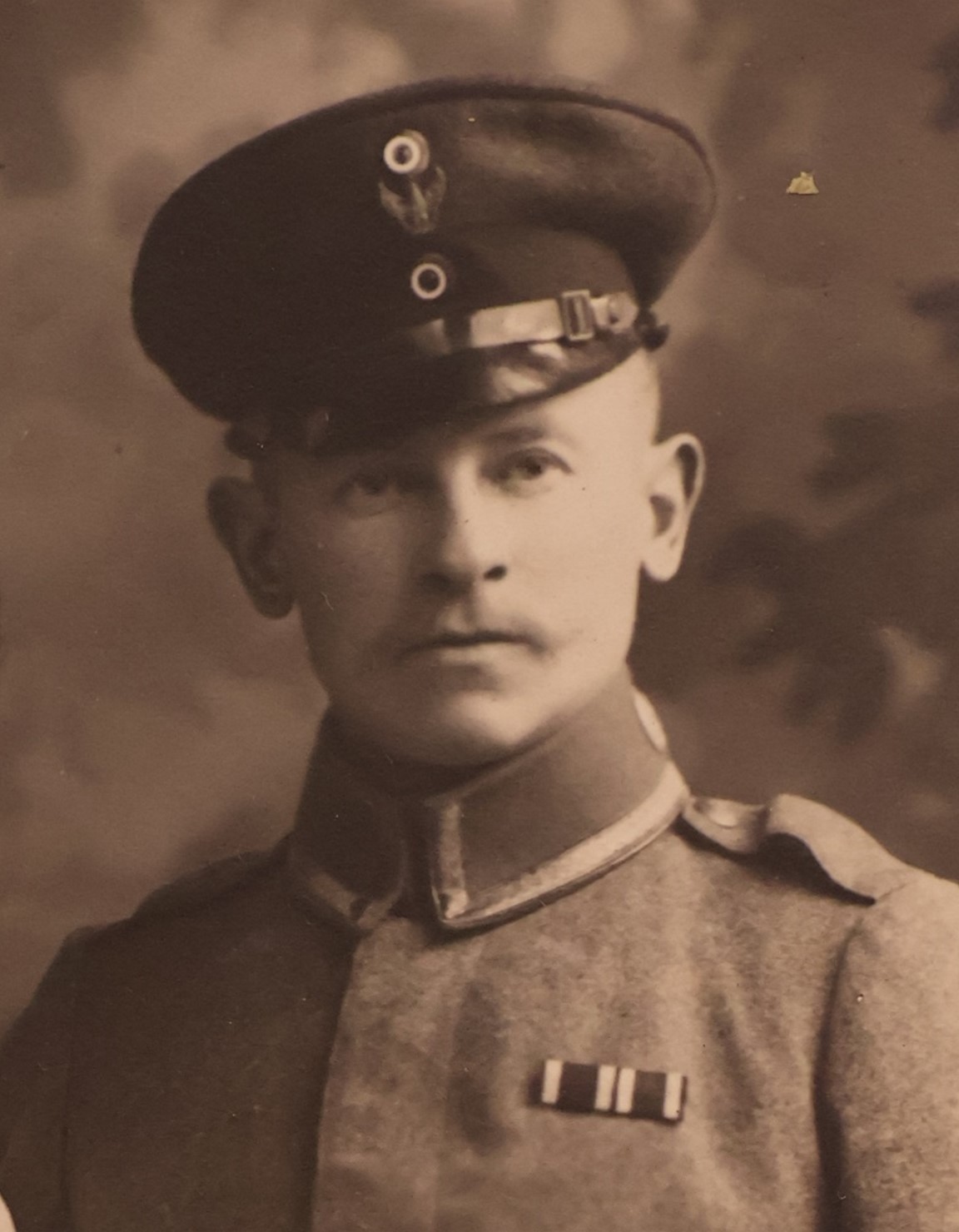
Otto Zoberbier’s
My Journey through the Orient
translated into English from Werner Zoberbier’s German edition (version “WZ“) of his father Otto Zoberbier’s handwritten version (“²OZ“, the so-called “Zweitschrift”)
Translation drafted with the help of DeepL and GPT (UiO), proof-read by Kathinka Zoberbier and Stephan Guth
Annotated by Stephan Guth
Epilogue (in lieu of a foreword)
12 Retreat and End of the War
When I reappeared unexpectedly at the animal depot, there was a big celebration. I resumed my duties as before, had my old job, and everything continued as before. But the untroubled calm of four months ago no longer existed. The Turks had to retreat on all fronts. And by the end of September, the British were at the gates of Aleppo. Aleppo is the junction of the Palestine and Baghdad Railways, which was now hotly embattled. In recent years, a great many German troops had come to Aleppo, including whole formations. Unfortunately, very many couldn’t cope with the climate, and there were more soldiers in hospital than on duty. Many also died, among them my old squadron mate, with whom I had served actively, and who had been detached with me to the von der Goltz staff.[1] In February, we were both still on leave in Berlin, he had made it through those three years, and now we had to lay him to rest far from home.
The soldiers from the Damascus back area had already begun their retreat and spent the night in our animal depot in order to continue to Asia Minor the next day. On 14 October, we also packed our things. Means of transport were available, as we had our horses and wagons. The sick and wounded from the military hospital could also be transported by horse and cart, but the healthy soldiers had to walk. In addition, there were more and more Bedouin raids. All expendable men were assigned to the fighting units. The wounded and sick who could not be transported were handed over to the English in Aleppo. On 6 October we were able to post mail one last time; then we were cut off from home for half a year.
<p19a> On 16 October,[2] our small column, consisting of four wagons, a vet and four men, also left Aleppo. We took everything we possibly could, but much we had to leave behind. Our small convoy travelled along the coast of the Mediterranean, via Adana, through the Amanus and Taurus mountains to Pozanti.[3] We covered the whole distance in 16 days without any incident. By now it was the end of October. In Pozanti there was a big Turkish depot where we had to hand in all our equipment. We were left only with our weapons. Our loyal servants, old Anatolians, said goodbye to us with tears in their eyes. We gave them a last nice baksheesh, then we Germans were on our own. We lived here in tents, and it was cold at night. After 10 long days, we could finally go on by train. Our destination was Constantinople. The journey was slow, there was a lengthy stay at every major station as the line was only single-track and oncoming trains had to be let through. There were also plenty of other traffic disruptions. Thank God, we did not have to suffer from hunger. When we stopped somewhere for any length of time, people came and offered us fruit, food and roasted chicken. When the train was in Izmid[4] station, there was suddenly a strong bump. This happened often, but this time a man in our wagon cried out, because he had hit his head on the front wall of the wagon and was slightly injured. Nothing serious had happened, but the next morning we saw the mess. Our train had gone too far into a switch, and the train from Constantinople had rammed it and derailed. It was pushed against a rock face and was badly damaged. Thank God the collision was not too serious. Although each of the wagons was occupied by ten men, only four were injured. Towards evening, a relief train arrived to repair the tracks and take away the injured.
The next morning we arrived at Haidar-Pasha, on the Asian side of Constantinople. What we could see from the station was incredible. The whole gulf was full of warships [see Fig. 24 and Fig. 25].
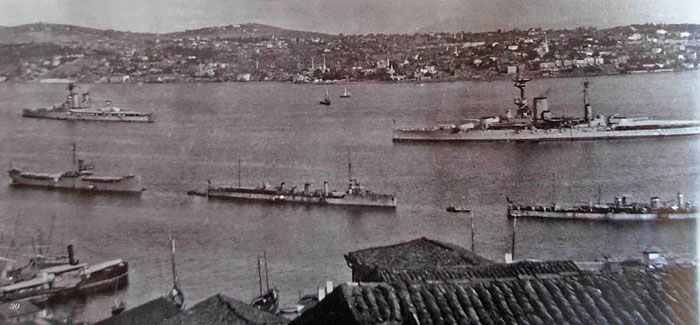
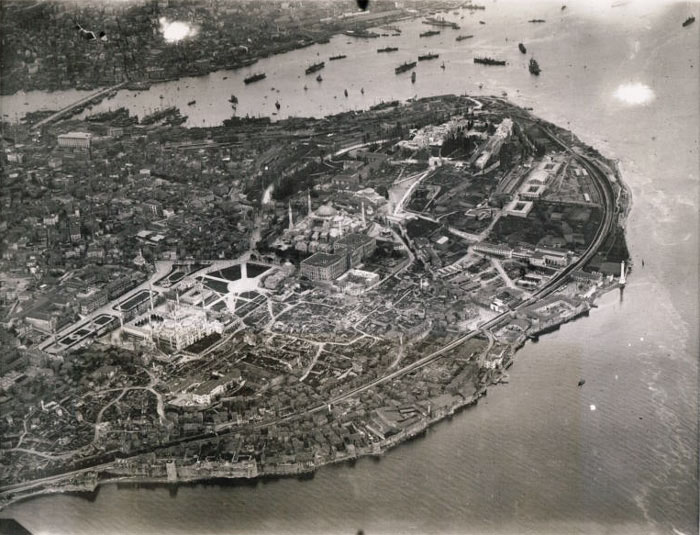
The English, French and Italians had apparently gathered their fleets and lined them up as if for a parade.
That was on 18 November. Haidar-Pasha was occupied by the French, who apprehended us immediately. We had to stay on the train during the day and night, until the next morning when we were taken to a tent camp that had been erected quickly in [K]atteko[e].[5] Here we stayed until Boxing Day. We were assigned to a zone where we could move around freely and even do some shopping. Our weapons had been taken away from us, but the officers and <p19b> non-commissioned officers were allowed to keep their sabres and sidearms.
In the negotiations with the Allies, we were granted free retreat, but we lacked means of transport, so that we could not meet the deadline set for us to leave by 28 November. The deadline was extended again by four weeks, and the plan was to cross the Black Sea to Odessa and reach Germany from there. But there weren’t any suitable ships either. There were smallish boxes, but these were too risky to use on the open sea. The Black Sea was stormy at that time of year, and the boats that did try quickly returned. The only large ship that could have been used was the “General,” but that was full of wounded and sick soldiers and was bound for Genoa. A few of the non-wounded managed to smuggle themselves onto the ship and leave that way.
In Russia, the revolution had broken out in Russia, and had by now reached Odessa, so that the way there was blocked as well, and the second deadline also passed. Now we were being interned. We were still in [K]atteko[e],[6] could move around freely and also do our shopping, so things were not so bad for us. But we had no idea what would happen next. German ships arrived from the Black Sea ports to be repaired and refitted in Constantinople, and perhaps they were intended for us. On Boxing Day, we were finally able to leave our tents and move onto the steamer “Akdenis”.[7] But the joy was short-lived: the ship’s boiler was not working properly and had to be repaired first. The “Akdenis” was a passenger steamer and nicely furnished, and we would have liked to stay on it.
Instead, we were to travel on the cargo steamer “Patmos”,[8] which was to take us to Hamburg [see Fig. 26, p. 255]. It was fitted with lots of partitions and platforms, which were to serve as our beds. We had no money left, so in order to improve our situation and our supply of food, we sought to take out a loan from the officers, non-commissioned officers and enlisted men, which would then be repaid immediately on our arrival in Hamburg. And that is what happened. Even before we reached the German coast, our steamer was met in the North Sea by a torpedo boat, which had been summoned by radio, and this brought the necessary money and also our outstanding wages.
Duty Leave
Coming Home
Notes on ch. 12
[1] See above, note 46.
[2] ²OZ 100: “Am vierzehnten” (On the fourteenth) | WZ 19a: “Am 16.” (On the sixteenth).
[3] Cf. above, apud notes 83 and 207 (for Amanus Mts), and 69 and 206 (for Pozantı).
[4] I.e., İzmit (in modern Turkish orthography). – ²OZ 101 erroneously has “Ismir”.
[5] WZ 19a (and also 19b) “Hottekoc”, misread from ²OZ 103 “Kattekoe”, i.e., Kadıköy, nowadays an administrative district of İstanbul, on the Asian side of the city.
[6] See preceding note.
[7] The oldest ship I found with this name was built in 1955 and can therefore not be this Akdeniz. No further information available.
[8] According to a certain Sebastian (pseud.) on shipsnostalgia.com, the Patmos was a “German cargo steamer […] launched in late 1901 by the Neptunwerft A.G., Rostock, […] and completed in March 1902 for the Deutsche Levante-Linie A.G., Hamburg. […] / With the beginning of WW 1 in Aug. 1914 the Patmos was trapped in the Sea of Marmora and saw no chance of breaking through the British blockade in the Mediterranean Sea. She was laid up in Constantinople but in early Nov. 1914 placed into service by the Turkish Sea transport division after Turkey entered the war as an ally to Germany. Owned by Osmanli Seyrisefain Idaresi. / On Sept. 15th, 1916 the Patmos struck a Russian destroyer-laid mine and was beached east of Kara Burnu to prevent sinking. Subsequently refloated and repaired, and in 1917 placed anew into service. / In 1919 allocated to Great Britain and owned by The Shipping Controller (Mrgs. J. Cormack & Co.)” – Sebastian (pseud.), Jul 11, 2012, https://www.shipsnostalgia.com/media/patmos-arriving-at-hamburg.283946/ (as of March 29, 2024).
Duty Leave
Coming Home
 Sergeant Otto Zoberbier’s "Travels in the Orient: Persia and Arabia, 1915–1919"