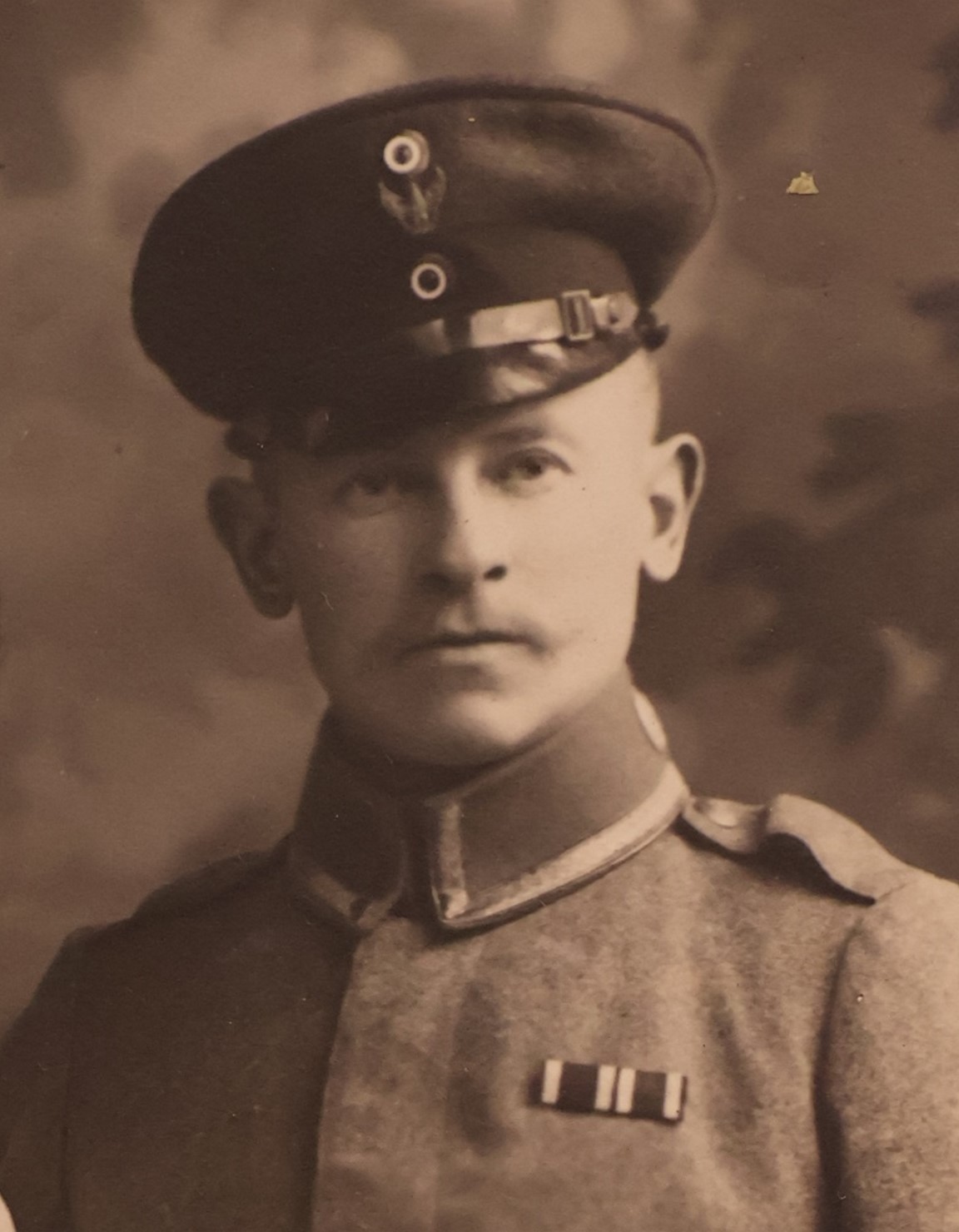
Otto Zoberbier’s
My Journey through the Orient
translated into English from Werner Zoberbier’s German edition (version “WZ“) of his father Otto Zoberbier’s handwritten version (“²OZ“, the so-called “Zweitschrift”)
Translation drafted with the help of DeepL and GPT (UiO), proof-read by Kathinka Zoberbier and Stephan Guth
Annotated by Stephan Guth
Epilogue (in lieu of a foreword)
<p20a> 13 Coming Home
All those who could not be accommodated on the ships moored here were transported to the islands of Halki[1] and Princepo,[2] while those of us who had been admitted continued to stay in Haidar-Pasha. Christmas and New Year passed. Again and again we were told then and then we would leave, but nothing happened. The days passed. We spent most of the time playing skat. There were no more messages from home either. We hadn’t received any mail for three months. At last we learned that we were to sail on 28 January 1919. The steamer had already loaded coal, water and provisions, and so was ready to sail. An English military commission inspected and overhauled the ship, and now it looked as if we were going to set sail after all. One day earlier, the first German ship to leave the harbour had been the passenger steamer “Eta Rickmers”[3] with General Liman von Sanders[4] on board. We were full of hope.
But things turned out differently. The “Eta Rickmers” had to call at Malta and drop anchor there. In the meantime the situation had changed again. We continued to stay in Haidar-Pasha and no longer believed any slogans. When we were told, after a month, that the time had finally come and we were to sail on 28 February, we remained sceptical, because we had been disappointed too often. But apparently this time things were really happening. Our relatively light steamer had in the meantime loaded sand as ballast so we had the necessary draft, as well as coal, water, and food, and we even had live oxen and pigs on board.
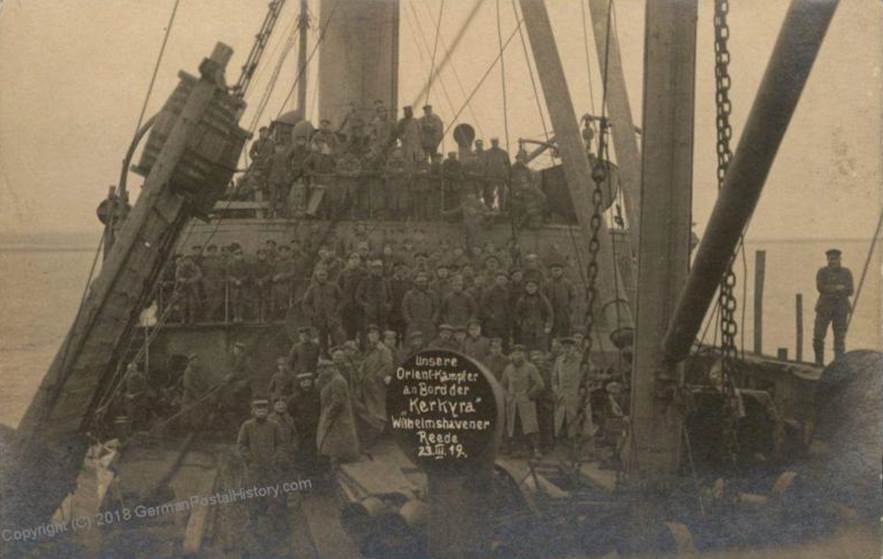
On 28 February 1919, the “Patmos” [Fig. 26, see below] weighed anchor, and we left the port of Haidar-Pasha together with another cargo steamer, the “Kerküra”[5] [see Fig. 27].
Our ship, with its captain and 1150 men on board, was under the command of an English captain. We stood on deck for a long time, looking across the Bosporus to Constantinople, until the last lights disappeared in the distance. The next morning, in glorious weather, we sailed through the Dardanelles, and we could see where the Allies had, unsuccessfully, tried to force their way through the strait in the spring of 1915.[6] The brave Turks, with the support of the German cruisers “Göben” and “Breslau,”[7] had managed to sink several of the enemy warships whose mastheads were now still sticking out of the water. The Dardanelles are quite narrow and in some places barely 100 metres wide.
Towards evening we entered the Aegean Sea. While the last few days we had <p20b> beautiful weather all the time, this changed abruptly. A storm came up and the ship lurched and pitched so that at times the propeller came out of the water. We stood on deck and held on to the ropes. Meanwhile, everything was flying about, the railings almost touched the water. A sailor now climbed the mast and set a sail at the top to prevent the ship from rolling from side to side. The captain also changed the course so that the waves now only swept over us from the front. Almost everyone was seasick and lay in their bunks. Plates and cups flew around, but nobody felt like doing anything about it. When we entered the Mediterranean the next morning, the storm had abated. The most beautiful weather awaited us. The “Kerküra,” with which we had left Heidar-Pasha, was faster and far ahead of us. We sat on deck all day and played skat as ever. From time to time we met other ships.
On the eleventh day we reached Gibraltar. A magnificent piece of land, the high rock and the near coast of Africa. The “Kerküra” had already left Gibraltar in the morning and was now already a day ahead of us. We stayed in Gibraltar for a whole day and loaded water, coal and provisions on board. A comrade was unlucky and fell into the water between the quay wall and the ship, and he drowned.
Our English captain, a really nice man, disembarked and went shopping for our ship. He returned with a two-wheeled cart loaded with fruit, oranges, corned beef and cigarettes, which we gladly paid him for. Whenever he met a German soldier, he saluted him. And we were happy to see him as our guest at every concert of our shipboard band, which consisted of a ship’s piano, harmonicas and a ladder fiddle.
Towards evening we set sail again. For six days we rocked in the Bay of Biscay. It was nowhere near as bad as in the Aegean, although the ship’s propeller was again lifted out of the water from time to time, and so we made only two knots of speed. We witnessed a unique spectacle one morning when we turned around the north-west coast of France into the English Channel. A whale surfaced a hundred metres from our ship, blew its spout into the air and then came out of the water with its whole back.
In Dover, our English captain left us. Our board shipboard band played him a farewell song, and the bandmaster, a Hamburg bricklayer, had dressed up especially for the occasion. An English pilot came on board in the captain’s place, and he guided us through the minefields to the mouth of the Thames, where he disembarked.
<p21a> From now on we were masters of the ship ourselves again. After five months, we were finally able to send telegrams to our relatives by radio, even if they had to be very short: “Will probably arrive in Hamburg on the 26th.” A heavy storm started on the high seas, and our captain decided to call at Rotterdam. This was because we had been blown off course by the snowstorm, and he particularly feared the mines with which the North Sea was contaminated. When we arrived in Rotterdam, our major, who commanded us soldiers, tried to contact the Dutch Ministry of War, asking for a train transport to take us to Germany. This seemed to be successful but we were to stay on board until Monday. In the meantime, the storm had abated. On Sunday towards evening, we were suddenly ordered to leave the harbour immediately. So we had to sail into the North Sea again at night. In the morning we saw the first floating mine. Our ship bypassed the mine in a hundred-metre wide arc, and we tried to explode the mine using the rifles we had on board, but we did not succeed. Eventually it sank without exploding.
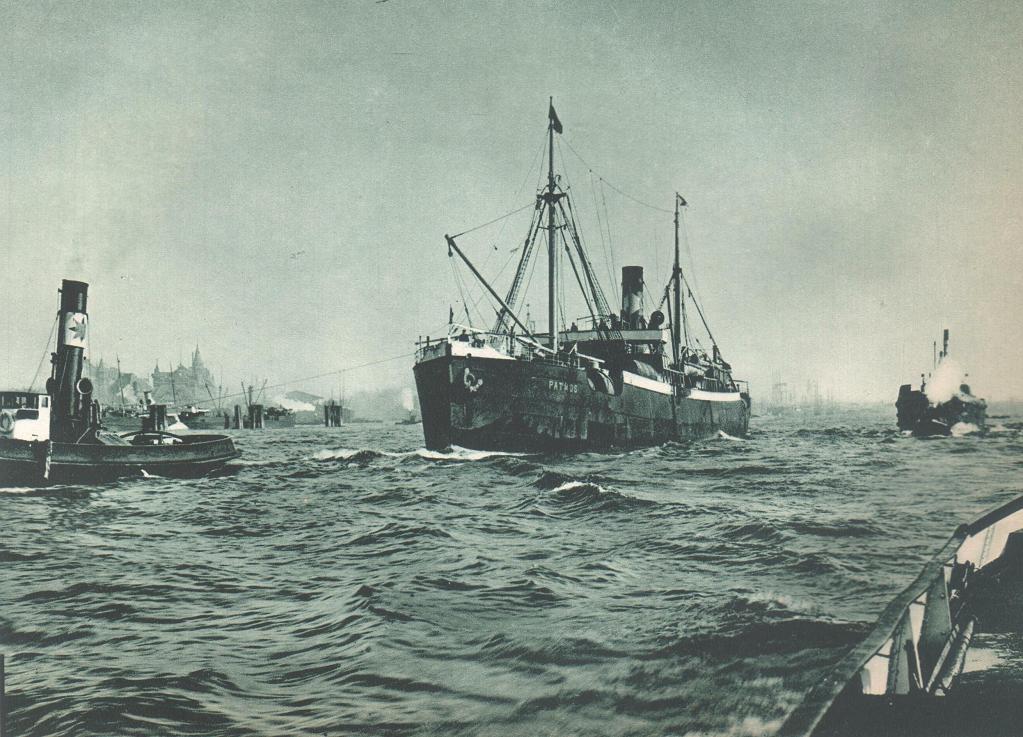
On 26 March 1919 we arrived in Brunsbüttelkoog.[8] As we had several sick soldiers on board, we had to remain in quarantine for two more days. Finally, early on 28 March, a navy band on a motorboat appeared and accompanied us with music to the landing quay. People stood on the banks of the Elbe,[9] waving scarves and cheering, because ours was the first ship transporting prisoners of war to dock in Hamburg after the end of the war [Fig. 26]. The “Eta Rickmers”[10] and the “Kerküra”[11] [Fig. 27], which were ahead of us, had called at Bremerhaven.
A large grandstand had been erected on the quay in Hamburg. A band welcomed us with the song: “Nach der Heimat möcht’ ich wieder…”.[12] There were welcoming speeches, and we were received warmly. Then we were allowed to leave the “Patmos,”[13] which had been our home for three months [lit., a quarter of a year].
A hostel with beds had been set up for us in the old “Hannoversche Bahnhof”. After we had eaten and rested a bit, we went for a bath and to the delousing centre. There our military clothes we exchanged for tatty civilian clothing. For our embellishment we had to buy our own collars and ties. We would have liked to see more of Hamburg, especially the Reeperbahn and Hamburg by night, but we were not given the time. Our passports had been issued in the meantime. The next morning they gave us coffee and bread and then distributed our passports. We said goodbye to our comrades who were not going via Berlin, because our train was already leaving for Berlin at <p21b> half past five in the morning. We had already informed our relatives by telegraph that we would arrive in Berlin at seven in the evening. In Wittenberge we stopped a bit longer for a hot lunch. In Berlin, the train arrived on time at Lehrter Bahnhof, and here too we were greeted by a military band playing the song: “Nach der Heimat möcht’ ich wieder…”.[14] One more goodbye to the other comrades, and a handshake, and then we were in the arms of our loved ones who had turned up for the reception.
The End
Duty Leave
Coming Home
Notes on ch. 13
[1] I.e., Halki (Greek Χάλκη Khálkē), the second largest of the so-called “Princes’ Islands”, an archipelago 13–25 km off the coast of southeastern Istanbul in the Sea of Marmara. Halki/Khálkē’s modern Turkish name is Heybeliada (“Saddlebag Island”). – See also next footnote.
[2] I.e., Princepo (Greek Πρίγκηπος Prínkēpos), now mostly known by its Turkish name, Büyükada (meaning “Big Island”, is the largest of the “Princes’ Islands” (see preceding footnote). These islands have their name from the fact that under Byzantine rule, “out-of-favour princes and other royalty were [often] exiled [there]. After 1453, members of the Ottoman sultans’ family were exiled there too. […] During the nineteenth century, the islands became a popular resort for Istanbul’s wealthy, and Victorian-era cottages and houses are still preserved on [Büyükada/Prinkipo]” – https://en.wikipedia.org/wiki/Princes’_Islands (as of April 6, 2024).
[3] I.e., the Etha Rickmers, a steamer mentioned also in Liman von Sanders’ memoirs (see note 228), together with the Lillie Rickmers, the Patmos (cf. note 224), the Kerkyra (cf. note 229), and the Akdenis (cf. note 223); see Liman von Sanders 1927, 324.
[4] I.e., Otto Viktor Karl Liman von Sanders (1855–1929), “an Imperial German Army general who served as a military adviser to the Ottoman Army during the First World War. In 1918 he commanded an Ottoman army during the Sinai and Palestine Campaign. On the whole Sanders provided only limited help to the Ottoman forces. […] In 1927 he published Fünf Jahre Türkei (tr. Five Years in Turkey), a book he had written in captivity in Malta about his experiences before and during the war [available at https://archive.org/details/in.ernet.dli.2015.24341/page/n3/mode/2up]” – https://en.wikipedia.org/wiki/Otto_Liman_von_Sanders (as of March 29, 2024).
[5] Spelt Kerkyra on the few photos that can be found on the Internet, e.g.,“Germany WWI Turkey Navy Cover RPPC Dampfer Steamer Kerkyra”, https://www.hippostcard.com/listing/germany-wwi-turkey-navy-cover-rppc-dampfer-steamer-kerkyra-83762/43203268 (as of March 29, 2024). No further information available. There seems to have been another “D/S Kerkyra” (alias Cefira), but this is said to have been torpedoed on June 19, 1917, by K. & K. submarine (https://wrecksite.eu/wreck.aspx?58572” and can therefore hardly be the “Kerküra” on which another group of Germans were sent back, alongside with Zoberbier’s ship, the Patmos. However, the Kerkyra in question is mentioned in Liman von Sanders’ memoirs (1927, 324), together with most of the other steamers whose names feature in Zoberbier’s memoirs (see above, note 227).
[6] “The Gallipoli campaign, the Dardanelles campaign, the Defence of Gallipoli, or the Battle of Gallipoli (Turkish: Gelibolu Muharebesi, Çanakkale Muharebeleri or Çanakkale Savaşı), was a military campaign in the First World War on the Gallipoli peninsula (now Gelibolu) from 19 February 1915 to 9 January 1916. The Entente powers, Britain, France and the Russian Empire, sought to weaken the Ottoman Empire […] by taking control of the Ottoman straits. […] / In February 1915 the Entente fleet failed when it tried to force a passage through the Dardanelles. [This is the defeat Zoberbier is alluding to in his memoirs above.] The naval action was followed by an amphibious landing on the Gallipoli peninsula in April 1915. In January 1916, after eight months’ fighting, with approximately 250,000 casualties on each side, the land campaign was abandoned and the invasion force was withdrawn. It was a costly campaign for the Entente powers and the Ottoman Empire as well as for the sponsors of the expedition, especially the First Lord of the Admiralty (1911–1915), Winston Churchill. The campaign was considered a great Ottoman victory [cf. Zoberbier’s follow-up sentence starting with “The brave Turks…”]. In Turkey, it is regarded as a defining moment in the history of the state […]. The struggle formed the basis for the Turkish War of Independence and the declaration of the Republic of Turkey eight years later, with Mustafa Kemal Atatürk, who rose to prominence as a commander at Gallipoli, as founder and president” https://en.wikipedia.org/wiki/Gallipoli_campaign (as of April 7, 2024). – The Gallipoli Campaign assumed importance also for other countries: “The campaign is often considered to be the beginning of Australian and New Zealand national consciousness. The anniversary of the landings, 25 April, is known as Anzac Day, the most significant commemoration of military casualties and veterans in the two countries, surpassing Remembrance Day (Armistice Day)” – ibid.
[7] See above, p. 207 (with notes 64 and 65).
[8] Today Brunsbüttel (after administrative reform 1948 and unification of earlier Brunsbüttelkoog with several smaller villages), located at the mouth of the Elbe river (see next footnote), near the North Sea.
[9] The Elbe “is one of the major rivers of Western Europe. It rises in the Giant Mountains [German: Riesengebirge] of the northern Czech Republic before traversing much of Bohemia (western half of the Czech Republic), then Germany and flowing into the North Sea at Cuxhaven, 110 kilometres (68 miles) northwest of Hamburg” – https://en.wikipedia.org/wiki/Elbe (as of March 29, 2024).
[10] See above, note 227.
[11] See above, note 229.
[12] “I want to return home …”, a patriotic song, with lyrics authored either (in 1885) by a certain Karl Kromer (en vogue mostly during the German Kaiserreich, but still quite popular even in our days) or, with the same first line, (in 1828) by a certain Karl Beils. Full text of Kromer’s version: “[1] Nach der Heimat möcht ich wieder, / nach dem teuren Vaterort, / wo man singt die frohen Lieder, / wo man spricht ein trautes Wort. / [Chorus:] Sei gegrüßt in weiter Ferne, / teure Heimat, sei gegrüßt. // [2] Deine Täler, deine Höhen, / deiner heilgen Wälder Grün, / o, die möcht ich wiedersehen, / dorthin, dorthin möcht ich ziehn! / [Chorus] // [3] Doch mein Schicksal will es nimmer, / durch die Welt ich wandern muß. / Trautes Heim, dein denk ich immer, / trautes Heim, dir gilt mein Gruß. / [Chorus]” [English: “(1) I would like to return to my homeland, / to my dear father’s place, / where one sings happy songs, / where one speaks a familiar word. / [Chorus:] Greetings from afar, / dear homeland, greetings. // (2) Your valleys, your heights, / the green of your sacred forests, / oh, I would like to see them again, / there, there I would like to go! / [Chorus] // [3] But my fate never wills it, / through the world I must wander. / My dear home, I always think of you, / My dear home, I salute you. / [Chorus]”) – https://www.volksliederarchiv.de/nach-der-heimat-moecht-ich-wieder-1885/ (as of March 12, 2024).
[13] See above, note 224.
[14] Cf. note 236.
Duty Leave
Coming Home
 Sergeant Otto Zoberbier’s "Travels in the Orient: Persia and Arabia, 1915–1919"