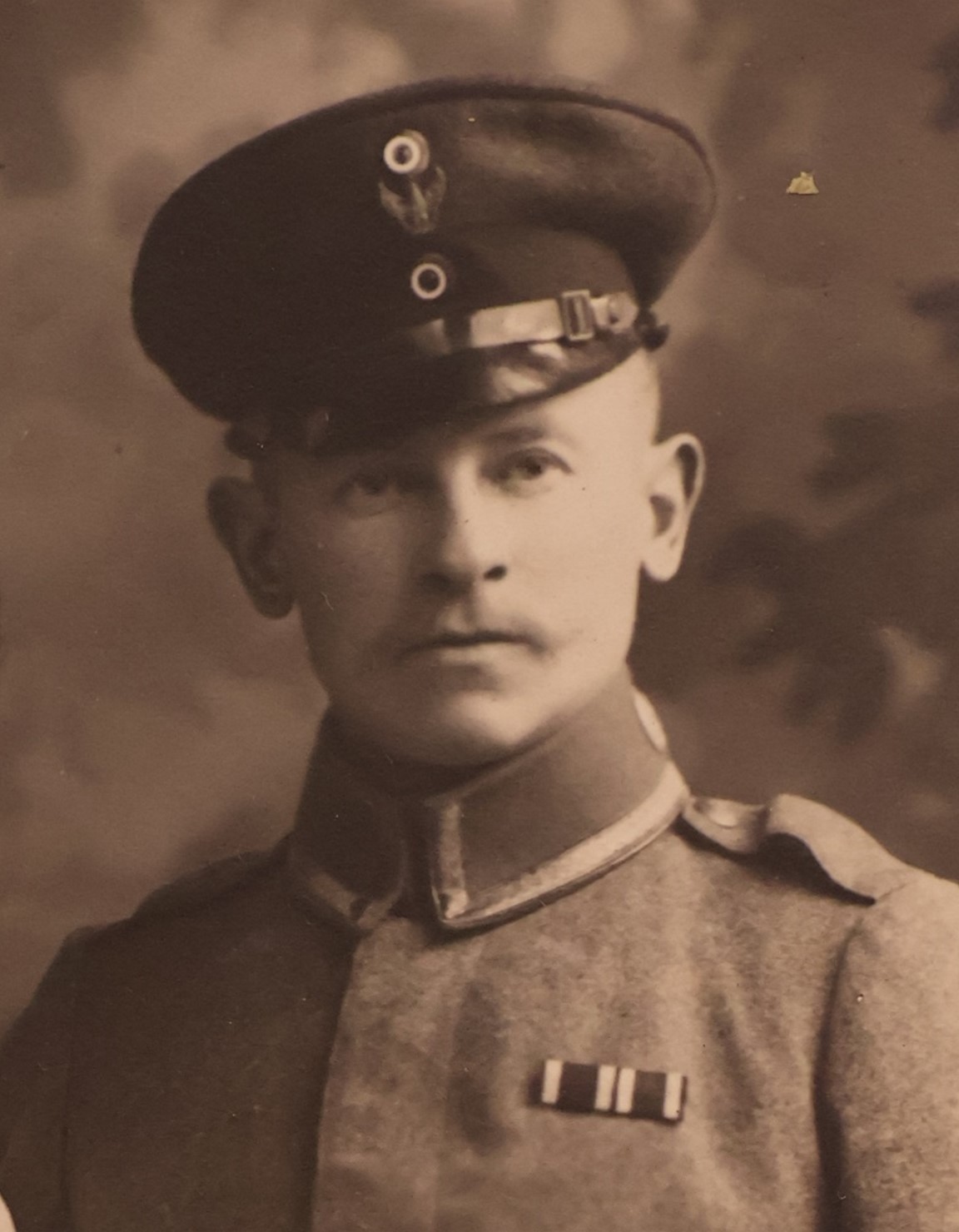
Otto Zoberbier’s
My Journey through the Orient
translated into English from Werner Zoberbier’s German edition (version “WZ“) of his father Otto Zoberbier’s handwritten version (“²OZ“, the so-called “Zweitschrift”)
Translation drafted with the help of DeepL and GPT (UiO), proof-read by Kathinka Zoberbier and Stephan Guth
Annotated by Stephan Guth
Epilogue (in lieu of a foreword)
2 Across the Taurus Mountains
In this way the days passed by. One comrade after another left Constantinople with convoys on the long journey. And the day of farewell also came for me when my beautiful time in Constantinople came to an end, and I had to embark on my long journey with a convoy. Each of us was sent off individually with a convoy. My convoy consisted of two wagons of rifles. On January 16, 1916, it was my turn. I was well-provided with food and drinks. My landlady insisted on giving me a bottle of wine and other food items.
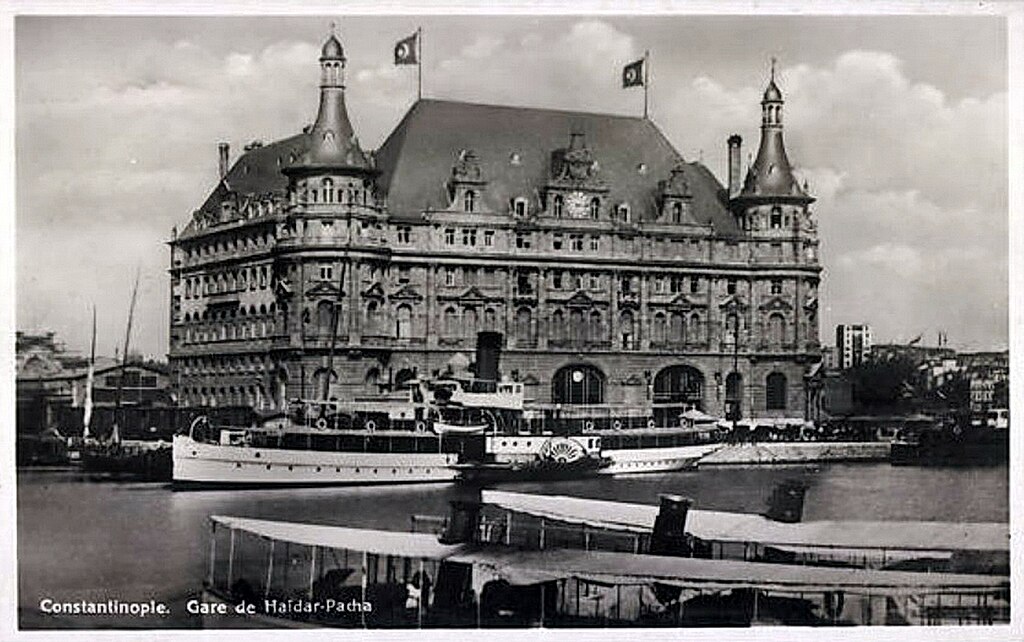
My convoy departed from Haidar-Pasha[20] [Fig. 15]. Haidar-Pasha is on the Asian side of Constantinople and is reached by ferry across the Bosphorus. Now I was completely on my own. I began to make my home in one of the wagons. I set up <p2b> my camp bed, put together a few crates as a table and chair, and my living room was ready. So there I sat, well-equipped and provided with everything, but no one to talk to. And how was I supposed to make conversation with my few words of Turkish?
The journey began. During a longer stop at a station, a Turkish military doctor who spoke German very well approached me. He was on his way to the front with a Turkish formation. He liked my living room better than his compartment in the railway carriage, and so he moved in with me with all his luggage. Now I had company, and at the same time learned a few more Turkish words!
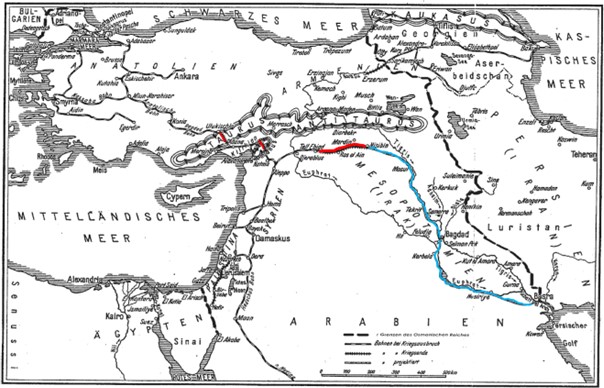
The trip took us along the Gulf of Izmit, through all of Asia Minor, through tunnel after tunnel tunnels and tunnels in the mountains, via Izmit, Eskisehir,[21] Karahisar, Konya to Pozanti.[22] On the third day, we reached our first stop. Here, a German back area[23] had been established, with a captain, a lance corporal, and a Persian interpreter who spoke German very well. There was no more work for German soldiers now. What needed to be done was done by Turkish soldiers (Askers)[24] and hamals.[25] After handing over the equipment the next morning, I was free for a few days. My comrade, the interpreter, and myself used the time to buy eggs and chickens in the surrounding villages. Pozanti is surrounded by high mountains and the houses in the villages are stuck to the rocks like swallows’ nests. The people are very hospitable, their dwellings primitively furnished. They do not know tables and chairs. Our interpreter had already prepared us for this and informed us about the [local] customs and traditions. He urged us not to decline anything our hosts offered. Whenever we came to a house to buy something, we were invited in and had to take a seat. The men and children marvelled at us, and they were particularly interested in our rifles. Again and again we heard the question: “Kach grush?”[26] – “How much is that?” Our boots and clothing were also fingered and admired. The three of us had taken a seat in the hut, our legs crossed, and already we were being served. The tablecloth was a sheet on the ground, they didn’t know fork and knife. There was bread (flat bread like potato pancakes), honey and various sauces. We tore the bread into pieces with our hands, dipped it into the sauces and brought it to our mouths. – The next day we went on an excursion to another village. The teacher had invited us to visit the Turkish school. First he introduced us to his pupils, then he had them sing several songs. The pupils were surprised to hear that we came from Germany to fight together as friends with the Turkish soldiers.
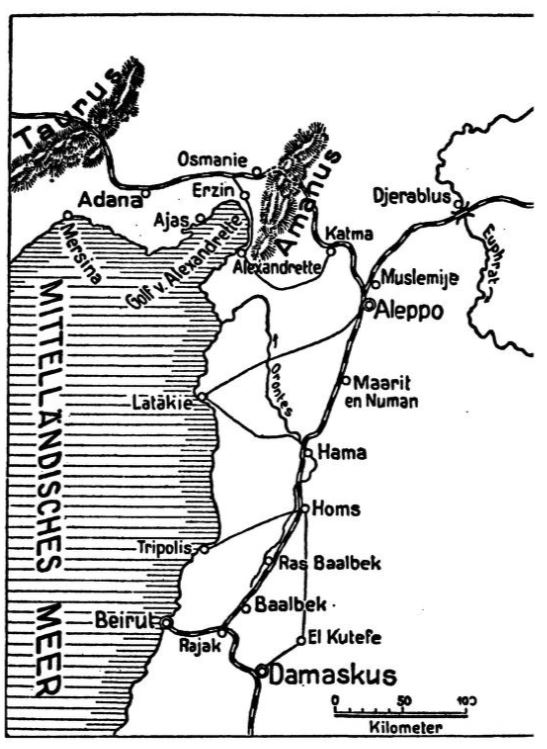
<p3a> Because the tunnel through the Taurus Mountains was not yet finished,[27] our belongings had to be transported on from Pozanti by ox cart. Our transport consisted of 23 ox carts. At 10 a.m. everything was ready and we could start moving, slowly as ox teams. The gradient in the mountains was considerable. In the afternoon, around 4 o’clock, we took a rest in the ice and snow. The oxen were tired. The teamsters – Turkish soldiers – fed the oxen and also had to rest. The road became steeper and steeper, and the oxen refused to go any further and lay down across in front of the wagons. It was already getting dark and the road was getting worse. In places where the water ran over the road, there was ice, so that the wagons had to be pushed over the icy spots one by one. We had reached the crest of the mountains, but the road to the han[28] (hostel) was still far.
Night had fallen and it was no longer possible to continue. We took shelter in a dilapidated ruin next to the road, unhitched the oxen, herded them together and fed them. On the way, the Askers, the Turkish soldiers, had already been collecting wood, now they built a fire in our ruin, which consisted only of the four walls. Sitting around the fire we ate our evening meal, tinned meat and bread. I had made my camp on one of the open wagons, no roof over my head, and the moon was bright in the sky. I only had a blanket and it was so cold that sleeping was out of the question. I hoped I could warm myself up by the Askers’ fire in the ruins, but that was a fallacy. It was warmer, but the fire smoked terribly. The Askers did not let the fire go out, and one by one they warmed themselves by it. After a while I lay down again on my camp in my wagon. Again, it was too cold, so I sought refuge again by the fire of the Askers in the ruin. Then again I walked back and forth along the wagon train just to get a little warm.
I was happy when the morning dawned and our little column started moving again. We continued with fresh energy. We had reached the summit and the path was now level. A good hour later we arrived at the han where we had planned to spend the night. We only had a short rest, drank a nice cup of hot tea and then felt comfortable and warmed up. The worst was over. The path was now level, but led along 100 m deep ravines. Then it went downhill in serpentine lines, and still past steep mountain walls and deep ravines – scary.
<p3b> On the second day, we reached our intended destination early. It was a nice hostel by oriental standards. The Askers and also the oxen were well housed. The Turkish soldiers are very undemanding. They are happy with a piece of bread, a handful of dates and some tobacco for a few hand-rolled cigarettes. The next day we started our last day’s leg over the Taurus Mountains after having had our tea in the morning. Man and beast were rested and had recovered well. It was now almost always downhill. Towards noon, we could look out over the vast plain, and in the distance we could see the Mediterranean Sea. But the path would not and would not come to an end. We could already see the lights of Güleck station, but it was still very late before we reached this destination.
The disappointment was great. Expecting to find a back area here in Gülek,[29] we only saw a few Turkish Askers squatting around. I had the wagons brought up together and stationed guards. Together with the Turkish Shaoush[30] (sergeant), who was also part of our column, I marched to Tarsus, 3 km away, hoping to find the German stage officer there. I had been told to contact the German owner of a large cotton plantation called [F]arnow,[31] whom everyone in the village knew and who would also know where the home of the stage officer was. It was late by the time I reached the town with the Shaoush. There was no hope of finding [F]arnow now, and we crawled into the first best hostel without our luggage, which we had left with the column. All sorts of riffraff had already found shelter here, but it was warm and we were tired and still slept well.
Early the next morning, I set off in search of the owner of the cotton plantation. I had had a quick glass of hot milk in the bazaar. We walked around the town because it still seemed too early to go and see Mr [F]arnow. But first we had to find out where he lived. We asked people on the street if they knew [F]arnow’s house. Around 8 o’clock we got lucky. When we arrived at [F]arnow’s place, we were told that the ladies and gentlemen of the house were still asleep and that I should come back an hour later. Once again we took a walk through the bazaar.
Exactly one hour later I was there again. Now everything was suddenly quite simple. I was met by Mr. [F]arnow, who gave me a messenger who took me to the back area officer to whom I had to report my transport. It was a German first lieutenant who led the stage together with a corporal. In the afternoon, <p4a> the first lieutenant wanted to go with me to Güleck to inspect the transport. In the meantime I was to go to my new quarters, the Hotel Stambul,[32] where the German corporal took me and where I could live as a real human being again. Staying in the same hotel were also two Austrian comrades who had escaped from Russian captivity[33] in Siberia and marched through the whole of Persia on foot were also staying in the same hotel. Now they were waiting to be transported home. We had lunch in a good restaurant in the neighbourhood, and the lieutenant bought me half a bottle of wine. As a result, I slept through the appointment in the afternoon and, our transport handover had to be postponed until the next morning.
Here in Tarsus we celebrated the Emperor’s birthday[34] with the [F]arnow family. It was warm and in the garden I marvelled at the first palm trees I ever saw. The area is beautiful, with the Mediterranean Sea to the south and the snow-covered peaks of the Taurus Mountains to the north.
On 28 January, I travelled back to Pozanti with the two Austrian comrades, this time in a carriage drawn by four horses. We went uphill and downhill at a brisk trot and only on very steep inclines we drove at a walk. After just one day, we had covered the 85 km distance. The Austrians continued from here by train, while I was to accompany another transport to Güleck. In the meantime, several transports had already arrived in Pozanti, including a motorcade. Travelling to Güleck by car was quite different from jogging along in an ox cart. We reached Güleck in five hours.
Towards Constantinople
On the Way to Baghdad
Notes on ch. 2
[20] Modern Turkish spelling: Haydarpaşa. The station was built in 1871 by order of Sultan ʿAbdülʿazīz and saw its first regular passenger service (daily train from/to İzmit) in 1890. “Since the station was built right beside the Bosphorus, freight trains could unload at Haydarpaşa and the freight could be transferred straight to ships. […] Haydarpaşa was chosen as the northern terminus for the Baghdad Railway [see below, note 87] and the Hejaz Railway [see note 88] in 1904, and, with rail traffic increasing, a larger building was required. The Anatolian Railway hired two German architects, Otto Ritter and Helmut Conu, to build the new building. They chose a Neo-classical design and construction started in 1906. […] German and Italian stonemasons crafted the decoration of the exterior. The work was completed on land reclaimed from the sea on 19 August 1909 and the new terminal was inaugurated on 4 November 1909 for the birthday of Mehmed V. While the work was in progress the community of German engineers and craftsmen established a small German neighbourhood with its own school in the Yeldeğirmeni quarter of Kadıköy. [… – Towards the end of WW I] Haydarpaşa fell under British military control during the occupation [see below, p. 251 with fn. 221 as well as Fig. 24 and Fig. 25]” – https://en.wikipedia.org/wiki/Haydarpaşa_railway_station (as of March 21, 2024).
[21] I.e., Eskişehir.
[22] I.e., Pozantı, a town “at the entrance to a pass across the Taurus Mountains, […] strategically important as the gateway between the high plain of Anatolia and the low plain of Cilicia or Çukurova and the Middle East beyond” – https://en.wikipedia.org/wiki/Pozantı (as of March 21, 2024). According to https://de.wikipedia.org/wiki/Bagdadbahn (as of March 30, 2024), Pozantı is 780 m above sea level and at at a distance of km 281,6 from Konya on the Baghdad railway.
[23] German Etappe. In the following, our rendering of the German term will vary from “back stage” to “back area”, “post”, “supply stage”, etc.
[24] See above, note 63.
[25] Tu hamal “porter”, from Arabic ḥammāl “dto.”, noun coined on the FaʕʕāL pattern from ḥamala “to carry, bear”; so also below, note 203.
[26] I.e., in modern Turkish spelling, kaç kuruş? While kaç signifies “how much, how many”, kuruş goes back to Ottoman ġurūş, usually translated as “piasters”. The word is probably a borrowing (via a Slavonic language) from (esp. Austrian) German Groschen, a coin in use in the Austrian Empire. The word also went into Arabic, as qurūsh, felt by native speakers to be a plural (formed on a FuʕūL pattern), hence the back-formation of a singular form, qirsh.
[27] See below, note 87, with further information about the Bagdadbahn (Baghdad railway). At a later stage, the tunnel was completed, which made traveling much easier and shortened the duration of the journey considerably (see below, p. 247, with note 208).
[28] Arabic khān, Turkish han, “caravanserai, tavern”, from Persian khān “house”, from Middle Persian kandak “house (dug into the ground)”, from kandan “to dig (a ditch)”, akin to Avesta kan “to dig up the earth and make a pile” – Rolland 2014, s.v.
[29] Spelt “Güleck” in WZ, but “Gülek” in ²OZ (as in modern Turkish), “a neighbourhood in the municipality and district of Tarsus, […] situated along a valley on the Taurus Mountains. The main pass of these mountains, which is known as Gülek Pass (ancient Cilician Gates), is just east of the town” – https://en.wikipedia.org/wiki/Gülek (as of March 21, 2024).
[30] I.e., Turkish çavuş. Zoberbier’s translation as “serjeant” is correct. The Turkish word has also gone into Arabic as shāwush, šāwīsh, or jāwīsh.
[31] WZ has “Tarnow” throughout; in ²OZ it is rather “Farnow”.
[32] No further information on Gülek and this hotel available.
[33] Cf. also below, note 129.
[34] German Kaisers Geburtstag. During the German Kaiserreich, the sitting Emperor’s birthday was not an official holiday but used to be celebrated in various ways. Under Wilhelm II (r. 1889–1918), the birthday fell on the 27th of January.
Towards Constantinople
On the Way to Baghdad
 Sergeant Otto Zoberbier’s "Travels in the Orient: Persia and Arabia, 1915–1919"