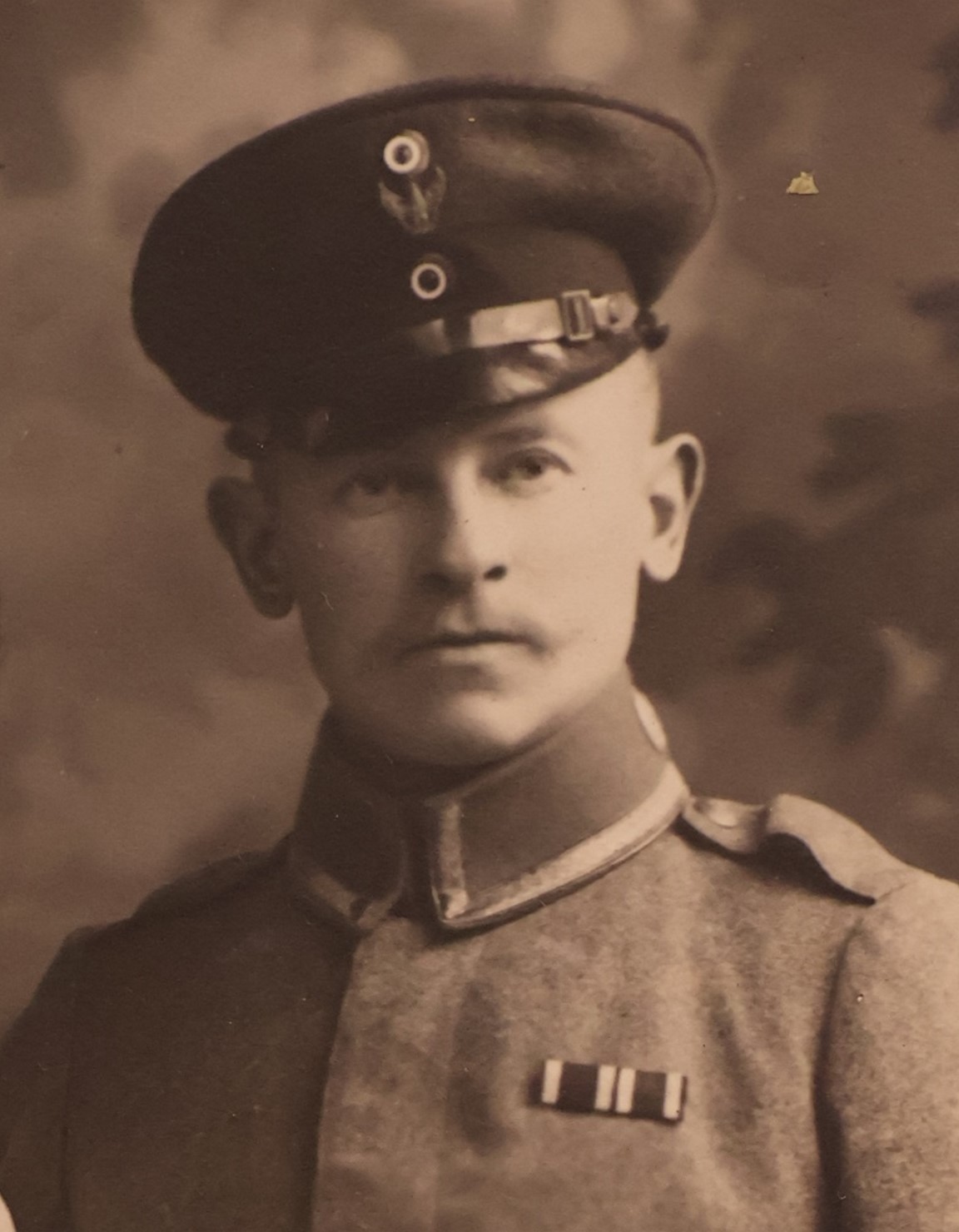
Otto Zoberbier’s
My Journey through the Orient
translated into English from Werner Zoberbier’s German edition (version “WZ“) of his father Otto Zoberbier’s handwritten version (“²OZ“, the so-called “Zweitschrift”)
Translation drafted with the help of DeepL and GPT (UiO), proof-read by Kathinka Zoberbier and Stephan Guth
Annotated by Stephan Guth
Epilogue (in lieu of a foreword)
3 On the Way to Baghdad
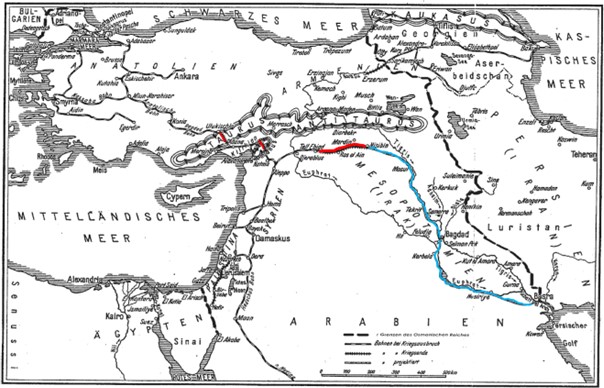
From Güleck we continued by train to Mamore. After a nine-hour journey, it was the end of the line again. Mamore[35] lies at the foot of the Amanus Mountains[36] [see Fig. 16] and the equipment had to be reloaded because the railway line ended here. The new railway tunnel was still being diligently worked on.[37] With horse-drawn carts we were supposed to get to Gelebek,[38] the new railway terminus on the other side of the Amanus Mountains. After two days we were there, and from there we travelled comfortably by train to Aleppo.[39] <p4b> Aleppo is a major railway junction where the Baghdad Railway[40] branches off to Baghdad and the Hej[az][41] Railway branches off to Jerusalem via Damascus. In Aleppo, I met up again with some of the comrades with whom I had come from Germany and who had been detached before me. Together we waited for our respective onward transport. There were two German hotels there [in Aleppo]. Hotel Hagenlocher[42] was billeted with German officers, while we enlisted men were accommodated in the Hotel Frank.[43] It was an excellent place to live, with good food and good wine.
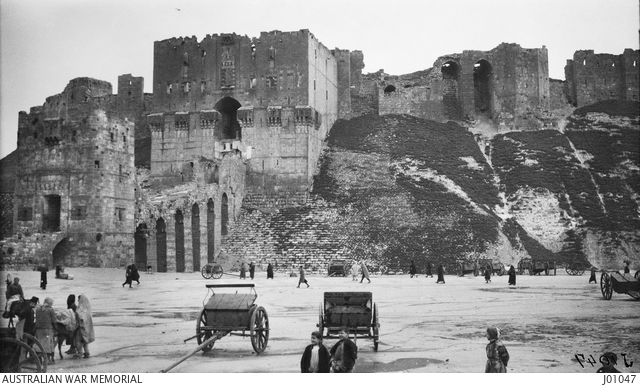
We met many Germans who were employed by the Baghdad Railway or who worked here as teachers. Aleppo is a beautiful city, with 50,000 inhabitants, a German school, a cinema and a beautiful bazaar. We were often invited by Germans living there, and there was no end to the celebrations.
The day came when I and three of my comrades had to leave Aleppo to make the long journey to Baghdad. On 25 [Febr]uary,[45] we celebrated our farewells with wine and liqueur, because we had enough money. In Turkey, we received 5 marks per day as a tropical allowance in addition to our wages, from which, however, a certain amount was deducted for food and accommodation. Food was very cheap by German standards, especially as there were times when we had no opportunity to spend money at all.
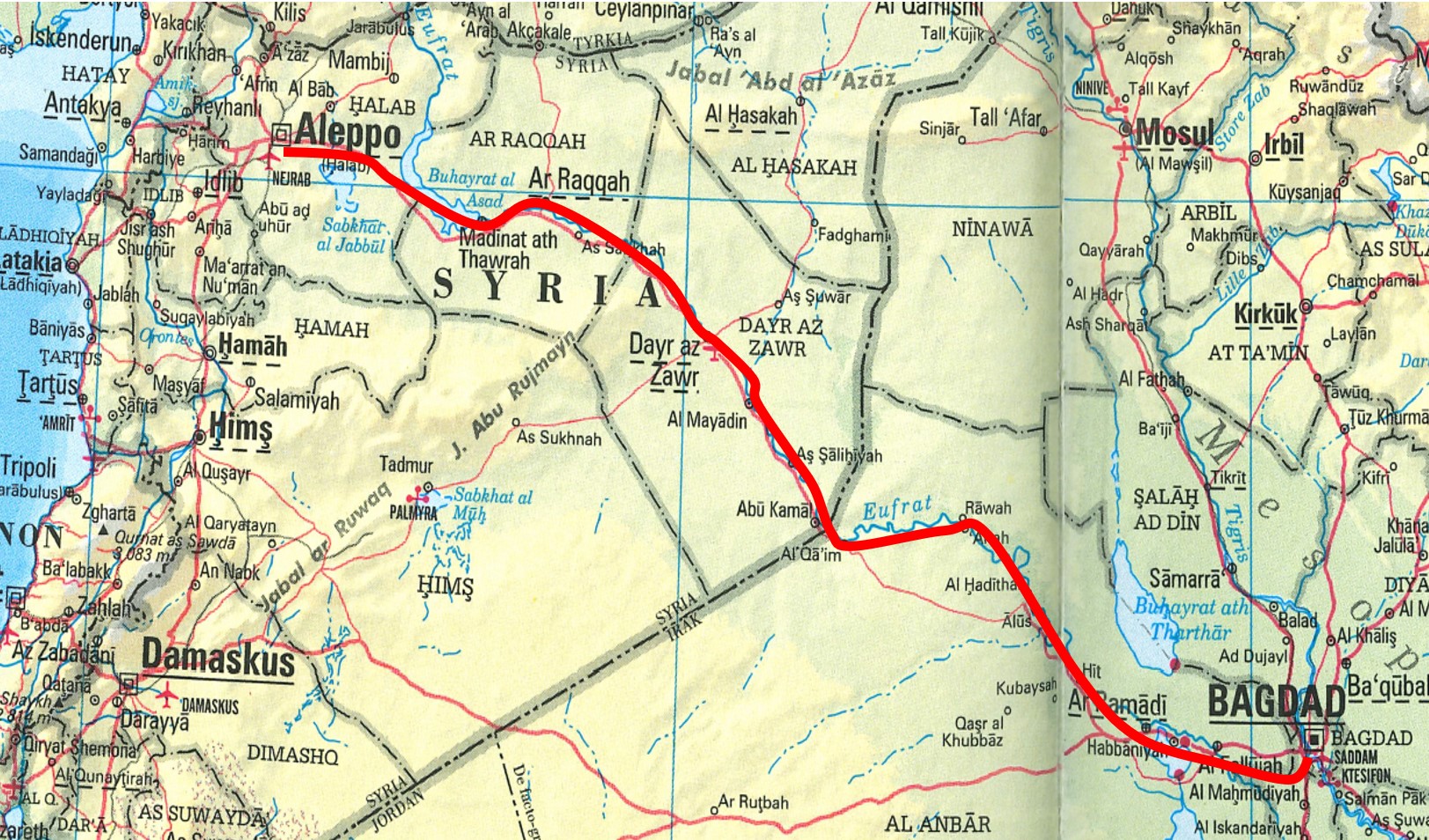
On 26 [Febr]uary,[46] our small caravan, consisting of 7 wagons, 3 geili[47] (covered wagons) and 4 trucks, left Aleppo in the pouring rain. Each wagon was harnessed with four horses. The geili were both our living and sleeping cars. The captain of our transport occupied one geili, while we crews shared the other two geili in pairs. I shared mine with a Palestine German who had come from the front and now served us as an interpreter. His ancestors had come from Swabia at some point, and he was born in Haifa and spoke perfect Turkish and Arabic.[48]
We were meant to go to Baghdad as quickly as possible because, among other things, we had to transport a crate of gold lira. We reached our back area after only five hours. The asabachi[49] (coachman) made sure that the journey was quick. He is the Effendi (master) and has a Hamal (servant) who has to do the actual work. The hamal hitched and unhitched the horses and did all the other jobs. We stayed overnight in a small place, unpacked our things and started cooking and frying. Our evening meals usually consisted only of egg dishes, which could be prepared quickly. Occasionally we would treat ourselves to a chicken if we had a little more time. We could buy chickens very cheaply from the Arabs in the desert. A chicken <p5a> cost 2-2½ piasters,[50] which was 40-50 Pfg in German money, and 6 eggs we got for 1 piaster-(20 Pfg). Our captain had his own cook to look after him, and he took great care of his health, and only washed with filtered water, for which he had his own filter.
For our trip to Aleppo, we had stocked up with plenty of food – rice, bacon, oranges – which we had bought cheaply beforehand. The whole box of oranges cost 1 medshid[51] (4 marks). We rarely left our wagons during the day. When we did stop, we also took our meals in the wagon, which usually consisted only of bread and canned food. If we reached a watering hole or a han early in the afternoon, a hot meal of chicken and rice was prepared, which I liked very much. In the morning we set off very early, at noon we had an hour’s rest to feed the horses, and then we continued on to the next hostel or watering hole. We often covered up to 85 km in one day.
On the third day we reached the Euphrates. From then on, we travelled along the river. However, we shortened the path of the river bends. Along the Euphrates we saw Armenians in their camps. They had been driven out of their homeland by the Turks and would most likely die in the desert. The sight was terrible.
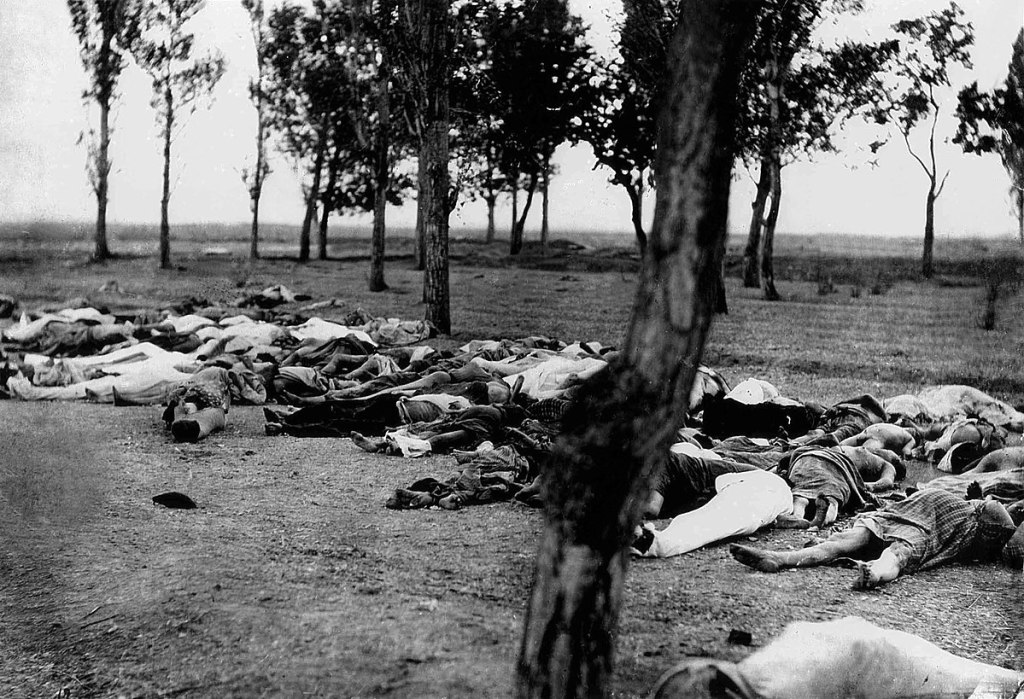
Half-starved skeletons wrapped in rags begged us for a piece of bread, but they were mercilessly chased away by the Turkish gendarmes. As far as we could help, we gave what we could spare, but we also had to remember to economize, for we still had a very long journey ahead of us. Here our path literally led over corpses. They lay everywhere, stripped and gnawed on by the hyenas and jackals.[53]
Two days later we reached the first town, D[e]r es Sor.[54] Here we had to leave behind the first sick man, an asabaji.[55] It was not until the next morning that we continued. It was a day like any other. We hardly met any people, and the ones we did meet were Bedouins moving through the desert with their herds. On the 9th day, we could see the beautiful town of Ana,[56] an oasis, from afar. It is beautifully situated on the river, surrounded by palm trees, fig trees and orange trees. After all the exertions, this seemed like paradise to us. The women sat under the trees and weaved, the huts under the palm trees looked like large beehives with neither windows nor doors. The entrance was only covered by a blanket. We were received very hospitably by the inhabitants. They farm and raise cattle and also fish in the nearby river. We watched the men standing naked in the water with spears, poking <p5b> at fish, and pulling fish up to half a metre long out of the water.
Now we frequently encountered Bedouins camping with their herds at the waterholes. The Bedouins are nomads, living only in tents and moving with their herds from waterhole to waterhole. The Turks say they are thieving and devious, but in their area you would be safe and you could spend the night with them in their tent. But if you leave their district, you can easily expect to be pursued and robbed by them.
As soon as we had reached a village or a watering hole and had a rest, we were surrounded by women offering us their products, especially eggs and chickens. The men and children would marvel at us and admire our equipment. For weapons are the pride of every Bedouin and Arab, and everyone has a revolver in his belt and a breech-loader over his shoulder. Even the children already have their daggers. So our modern rifles were of particular interest to them, and again and again we heard their “Kach grush?” (How much is that?)[57] to buy our rifles from us. – The Bedouins only ride mares, the stallions are sold. For riding, the horses are only harnessed with a halter.
On the tenth day of our journey, the leader of our transport fell ill with typhus, although he had been so careful and allowed only filtered water to come into contact with his body, and now this. There was no doctor and certainly no hospital. So we had to take him in his car for seven more days, without medical care, until Baghdad. There we delivered him to the German military hospital.[58] We were lucky to have our comrade, the Palestine German, with us. Without him interpreting for us and without understanding with the inhabitants, we would have been helpless.[59] – We passed the oasis of Hit[60] on the Euphrates, which was remarkable for the hot asphalt was oozing out of the earth here.[61] – We continued our journey via Baghdadi,[62] Romadi[63] and Feludja.[64] There we left the Euphrates to start the last leg to Baghdad, 65 km away.
Across the Taurus Mountains
Baghdad
Notes on ch. 3
[35] ²OZ 19 “Mamora”, “Mammora”, WZ 4a “Mamore”. – According to the distances chart given in the German Wikipedia entry, Mamure (Turkish spelling) is situated at a (railway) distance of km 466,8 from Konya. While the section from Adana to Mamure seems to have been in function since 1912 already, the Amanus (Nur) mountains transversal (see note 84) was not opened until in August 1917 – https://de.wikipedia.org/wiki/Bagdadbahn (as of April 2, 2024).
[36] Ancient name (Greek Ἀμανός) of the mountain range in today’s Hatay province of south-central Turkey, formerly also known as Alma-Dağ, today as Nur Mountains (Turkish Nur Dağları, “Mountains of Holy Light”). “It begins south of the Taurus Mountains and the Ceyhan river, runs roughly parallel to the Gulf of İskenderun, and ends on the Mediterranean coast between the Gulf of İskenderun and the Orontes (Asi) river mouth. / The range is around […] 200 kilometers in length and reaches a maximum elevation of 2,240 m […]. It divides the coastal region of Cilicia from Antioch and inland Syria, making a natural border between Asia Minor (Anatolia) in the southeast region and the rest of Southwest Asia. Its highest peak is Bozdağ Dağı” – https://en.wikipedia.org/wiki/Nur_Mountains (as of March 23, 2024).
[37] Like the tunnel through the Taurus mountains mentioned above (p. 211 with note 74), the one projected through the Amanus mountains was still not completed. For further information about the Bagdadbahn see below, note 87. Later in Zoberbier’s report the tunnels are reported to have opened for traffic (see below, p. 247, with note 208).
[38] According to https://de.wikipedia.org/wiki/Bagdadbahn (as of March 30, 2024), there is a “Kelebek” at km 315,3 on the Baghdad railway from Konya, but this cannot be the “Gelebek” mentioned by Zoberbier. None of the names of the stops indicated on the detailed railway chart given in the above entry in the vicinity of Mamure shows any resemblance to “Gelebek”. I assume that either Zoberbier made a mistake here, or the location does not exist any longer due to flooding (there are some dams in the regions now).
[39] Aleppo is a city in northern Syria with a rich history dating back over 8,000 years. During World War I, the city was still part of the Ottoman Empire (occupied by British and Arab forces only in 1918). Aleppo’s position made it a strategic hub (at 649,9 km from Konya) along the Baghdad railway – as also Zoberbier writes at the beginning of the next section.
[40] Also Berlin–Baghdad railway (German Bagdadbahn) [see Fig. 17]. The project “was started in 1903 to connect Berlin with the then Ottoman city of Baghdad, from where the Germans wanted to establish a port on the Persian Gulf, with a 1,600-km […] line through modern-day Turkey, Syria, and Iraq. / The line was completed only in 1940. By the outbreak of World War I, the railway was still 960 km […] away from its intended objective. The last stretch to Baghdad was built in the late 1930s and the first train to travel from Istanbul to Baghdad departed in 1940. / Funding, engineering and construction were mainly provided by the German Empire through Deutsche Bank and the Philipp Holzmann company, which in the 1890s had built the Anatolian Railway (Anatolische Eisenbahn) connecting Istanbul, Ankara and Konya. The Ottoman Empire wished to maintain its control of the Arabian Peninsula and to expand its influence across the Red Sea into the nominally Ottoman (until 1914) Khedivate of Egypt, which had been under British military control since the Urabi Revolt in 1882. If the railway had been completed, the Germans would have gained access to suspected oil fields in Mesopotamia, as well as a connection to the port of Basra on the Persian Gulf. The latter would have provided access to the eastern parts of the German colonial empire, and avoided the Suez Canal, which was controlled by British and French interests. / The railway became a source of international disputes during the years immediately preceding World War I. […] Technical difficulties in the remote Taurus Mountains [see above, note 74] and diplomatic delays meant that by 1915 the railway was still 480 kilometres […] short of completion, severely limiting its use during the war in which Baghdad was captured by the British while the Hejaz railway in the south [see below, note 88] was attacked by guerrilla forces led by T. E. Lawrence. Construction resumed in the 1930s and was completed in 1940. […] / Had it been completed earlier, the Berlin-Baghdad (ultimately a Hamburg to Basra) railway would have enabled transport and trade from a port in Germany through a port on the Persian Gulf, from which trade goods and supplies could be exchanged directly with the farthest of the German colonies, and the world. The journey home to Germany would have given German industry a direct supply of oil. This access to resources, with trade less affected by British control of shipping, would have been beneficial to German economic interests in industry and trade, and threatening to British economic dominance in colonial trade. / […] The process of constructing a rail line from Istanbul to Baghdad began during 1888 when […] a concession [was obtained] from Turkish leaders to extend the Haydarpaşa–İzmit railway to Ankara. Thus, came into existence the Anatolian Railway Company (SCFOA, or ARC). / After the line to Ankara was completed during December 1892, railway workshops were built in Eskişehir and permission was obtained to construct a railway line from Eskişehir to Konya; that line was completed in July 1896. These two lines were the first two sections of the Baghdad railway. […] / The Ottoman Empire chose to place the line outside the range of the guns of the British Navy. Therefore, the coastal way from Alexandretta to Aleppo was avoided. The line had to cross the Amanus Mountains [see above, note 83] inland at the cost of expensive engineering including an 8 km tunnel between Ayran station and Fevzipaşa. […] / There was concern in Russia, France, and Britain after 1903 as the implications of the German scheme to construct a great Berlin-Baghdad railway became apparent. […]. The railway might eventually have strengthened the Ottoman Empire and its ties to Germany and might have shifted the balance of power in the region. / The railway passed through the following towns and places, NW to SE: Konya − Anatolian table lands − Karaman − Ereğli − The foothills of Taurus − Cilician Gates − Çukurova plain − Yenice − Adana − Amanus range − Rajo − Aleppo − Tell Abyad − Nusaybin − Mosul − Baghdad − Basra. / […] By 1915, the railway ended some 80 kilometres […] east of Diyarbakır. Another spur, heading east from Aleppo, ended at Nusaybin [see below, note 196]. Additionally some rail was laid starting in Baghdad reaching north to Tikrit and south to Kut. This left a gap of some 480 kilometres […] between the railway lines. Additionally, there were three mountains which the railway was going to go through, but the tunnels through these three mountains were not complete [one of these was the Taurus, another the Amanus mountain range, see notes 74 and 84]. So the railway was, in fact, broken into four different sections at the start of the war [cf. also below, p. 247, with note 208, where Zoberbier reports that in early 1918 the tunnels were functioning]. The total time to get from Istanbul to Baghdad during the war was 22 days. […] / The breaks in the railway meant that the Ottoman government had significant difficulties in sending supplies and reinforcements to the Mesopotamian Front. The fighting in Mesopotamia remained somewhat isolated from the rest of the war. During the conflict, Turkish and German workers, together with allied prisoners of war, laboured to complete the railway for military purposes but with limited manpower and so many more important things to spend money on, only two of the gaps were closed. / The first use of railways for genocide [see below, p. Error! Bookmark not defined. with note 100] occurred in early 1915 when Armenian women and children from Zeitun were deported on trains to Konya and later marched into the Syrian Desert. Many Armenians were deported via the railways and later killed in the course of the Armenian genocide” – https://en.wikipedia.org/wiki/Berlin−Baghdad_railway (as of March 23, 2024).
[41] WZ 4b has “Hedschra” here, which, however, is misread for ²OZ 20 “Hedjas”. Thus, it should be Hejaz, not Hejrah.
[42] This hotel is mentioned also in Prüfer/Morrow 2018, 155 (diary entry for May 29, 1917).
[43] Not mentioned elsewhere in the sources I was able to consult.
[44] Cf. also Veltzke 2014, 291 (two German lieutenants on top of the Aleppo citadel tower, 1914), 297 (view of the citadel, December 1914).
[45] ²OZ 21/22 has correct “Februar”, while WZ erroneously ‘corrected’ this into “Januar” (or took it from the lose *¹OZ ?).
[46] Dto., see preceding note.
[47] The spelling is unambiguous in both, WZ 4b and ²OZ 21/22, but I was unable to find out what may be the origin of this obviously foreign term. English “covered wagons” translates German Planwagen which ²OZ and WZ give as an explanation in parentheses.
[48] See also below, notes 106, 140 and 195. – For more about this group, who had been active in Palestine for several decades already, cf., e.g., https://deutsche-kolonisten.de/palaestina/ (authored by a certain “Boris Clever”, pseud.; last accessed March 13, 2024). The blogg provides a historical overview of the presence and influence of German colonizers in Palestine, particularly in the 19th and 20th centuries. The colonizers mainly comprised members of the “Templer” sect, a German Protestant group that had formed itself in protest against the official church in Württemberg (southern Germany). The Templers aimed to realize their Christian eschatological expectations in the Holy Land, while strictly adhering to the Bible’s teachings. The colonisation gained momentum, after earlier setbacks, with the settlement of a group of emigrants in Haifa and the building of their first community house there in September 1869. In Jaffa, another group started the cultivation of oranges, a product that later, since the early 1880s, became a major source of income. The Templer communities introduced progressive agricultural techniques and established key infrastructure projects. The Sarona colony (founded in 1871), for example, became famous for their production of high-quality wine. The community also had their own schools, drugstores, banks, etc., and maintained relations with other pietist groups in America and Southern Russia (Caucasus). Towards the end of the 19th century they had become so influential that the German Emperor paid them a visit in 1898 in Jerusalem on his trip to the Middle East. In the course of the First World War, British troups occupied the Templer settlements in 1917.
[49] WZ 4b wrongly has “Asabatschi”, probably misread while copying from ²OZ 22 which shows more correct “Arabatschi”, i.e., Turkish arabacı, from araba “carriage, car” (< Arabic ʿaraba) with profession suffix ‑cı (var. ‑ci, ‑cu, ‑cü).
[50] The term “piaster” usually renders the Turkish kuruş or Arabic qirsh, pl. qurūsh (see above, note 73). The principal currency of the Ottoman Empire was the Ottoman pound, lira, which equalled 100 kuruş. Another subunit was the mecidi(ye) (medjidi, medjidiye) = 20 kuruş.
[51] See preceding note.
[52] Original description: “THOSE WHO FELL BY THE WAYSIDE. Scenes like this were common all over the Armenian provinces, in the spring and summer months of 1915. Death in its several forms – massacre, starvation, exhaustion – destroyed the larger part of the refugees. The Turkish policy was that of extermination under the guise of deportation.” – For detailed attribution, see “List of Illustrations (Acknowledgments)”, below.
[53] Otto Zoberbier thus became an eyewitness of parts of the Armenian genocide. “At the orders of Talaat Pasha, an estimated 800,000 to 1.2 million Armenians were sent on death marches to the Syrian Desert in 1915 and 1916. Driven forward by paramilitary escorts, the deportees were deprived of food and water and subjected to robbery, rape, and massacres. In the Syrian Desert, the survivors were dispersed into concentration camps.” Deir ez-Zor was the largest deportation concentration and annihilation centre. – https://en.wikipedia.org/wiki/Armenian_genocide (as of April 1, 2024). – See also below, p. 237 (at note 170). – Zoberbier’s report is quite typical of the way German soldiers who witnessed the genocide experienced it and reported about it, cf. Reichmann’s analysis of several other such documents: “it is undisputed that German soldiers and officers in the Orient learnt of the brutal actions against the Armenians and that some even became eyewitnesses, as the massacres were not limited to the remote Caucasus regions. From a German perspective, the events were ‘unimaginable’ [unvorstellbar] or – in the case of eyewitnesses – ‘cruel murder’ [grausames Morden]. However, in addition to the horrors of the bloody persecutions, the Germans also had to recognise their limited ability to influence events. The ‘resettlement measures’ were largely carried out by Jandarma troops, which, as is well known, were paramilitary police forces under the control of the Ottoman Ministry of the Interior. This meant that they were officially removed from the sphere of influence of the Ministry of War and the military mission. However, this did not mean that a German / commander or chief of staff of an Ottoman army could not have reacted to such events in his area of command. Liman von Sanders, for example [see below, note 228], prevented expulsions in Smyrna in the autumn of 1916 by protesting strongly and threatening to use armed force against the police officers carrying them out. However, the German head of mission had an exceptional position due to his function and the fact that he was considered a ‘difficult personality’ by the Turkish leadership. Baron von der Goltz, for example [see pp. 203, 237 and 249, with notes 46, 166 and 217, respectively], who was able to prevent a similar action in Mosul by threatening to resign, was made very clear by the Ottoman Ministry of War that he had thereby exceeded his authority and that a repetition of such interference would not be tolerated. The Sublime Porte clearly rejected the attempts of the allied officers to exert influence on ‘internal Turkish affairs’ and expected them to confine themselves to their official duties. Although the German military leadership had given their soldiers precisely this instruction, it hardly implied approval or even support for massacres of the civilian population. For the German officers, a contradiction of the officially sanctioned measures would therefore have meant a violation of the Emperor’s order, although this would have been within their discretionary powers. However, effective intervention would have required a much stronger position of power for German military reformers in the Ottoman Empire. The successful interventions of outstanding personalities such as Liman and Goltz are exceptions that document an influence that only very few German officers possessed” – Reichmann 2009, 329–30 (my translation).
[54] ²OZ 25 “Der es Soor”, WZ 5a “Dar es Sor”, i.e., (in Wikipedia’s English spelling) Deir ez-Zor (standard Arabic: Dayr al-Zawr, from Syriac dayrā zʿōrtā “small habitation”), “the largest city in eastern Syria and the seventh largest in the country”, “located on the banks of the Euphrates River 450 km […] to the northeast of the capital Damascus”. “Many different romanizations are used, including Deir Ezzor, Deir Al-Zor, Deir-al-Zour, Dayr Al-Zawr, Der Ezzor, Deir Azzor, Der Zor, and Deirazzor” – https://en.wikipedia.org/wiki/Deir_ez-Zor (as of March 27, 2024). – See also below, note 165 (²OZ 70 “Der-es-sor”, WZ “Deressor”).
[55] Same as above, cf. note 96 (WZ 5a “Asabadschi”, ²OZ 25 “Arabatschi”).
[56] I.e., ʿĀna on the Euphrates, roughly halfway between Dayr al-Zawr and Ramādī. – See also below, p. 236 with note 163.
[57] Cf. above, note 73.
[58] Hospitals are mentioned throughout also in Prüfer 2018, e.g., one in Mosul (p. 283, n.53) (but not particularly the one in Baghdad). Reichmann states that German soldiers suffered severely from the heat, especially during the summer months, and that in some units, the sickness rate reached 28%; “by end of 1917, there was hardly any German soldier who had not spent some time in hospital, despite the required ‘tropical service fitness’, the criteria for which obviously did not meet the real requirements” – Reichmann2009, 195. – Further down in Zoberbier’s report, we will also hear quite often about wounded or sick soldiers (among them Zoberbier himself) who had to be transported back to military hospitals (“Lazarette”), most of which were far behind the front (cf. ibid., 254). – We may imagine the degree of hospitalisation also from reports about the corresponding British side where it is said – in the context of fightings in Iraq in spring 1917, for example – that “37,000 British soldiers had to be treated in military hospitals between mid-March and mid-April because of the heat or illness. This was more than double the losses during the actual fighting, which were estimated at 18,000 men” – Reichmann 2009, 191-2 (referring to Barker, Neglected War, 1967, 411f.].
[59] Cf. above, note 95, and below, notes 140 and 195.
[60] I.e., Hīt, northwest of al-Ramādī. “In ancient times, the town was known for its bitumen wells; bitumen from the wells was used in the construction of Babylon over 3000 years ago, and for tasks such as caulking” – https://en.wikipedia.org/wiki/Hit_Iraq (as of March 26, 2024). – See also below, p. 236 with note 163.
[61] Cf. preceding footnote.
[62] Sic (in both ²OZ and WZ); probably modern Khān al-Baghdādī, northwest of Hīt. – For the role of the town at a later stage, see below, p. 236 with note 163.
[63] I.e., al-Ramādī in central Iraq, about 110 km west of Baghdad and 50 km west of Fallujah. “Ramadi is located in a fertile, irrigated, alluvial plain, within Iraq’s Sunni Triangle. [… While an earlier settlement already existed in the area, the] modern city was founded in 1869 by Midhat Pasha, the Ottoman Wali (Governor) of Baghdad. The Ottomans sought to control the previously nomadic Dulaim tribe [cf. Fig. 21, p. 239] in the region as part of a programme of settling the Bedouin tribes of Iraq through the use of land grants, in the belief that this would bind them more closely to the state and make them easier to control.” – “Ramadi occupies a highly strategic site on the Euphrates and the road west into Syria and Jordan. This has made it a hub for trade and traffic, from which the city gained significant prosperity. Its position has meant that it has been fought over several times, during the two World Wars and again during the Iraq War and Iraqi insurgency.” – “Ramadi was twice fought over during the Mesopotamian Campaign of World War I [see below, Chapter 8, with note 162]” – https://en.wikipedia.org/wiki/Ramadi.
[64] I.e., al-Fallūja (English Wiki: Fallujah).
Across the Taurus Mountains
Baghdad
 Sergeant Otto Zoberbier’s "Travels in the Orient: Persia and Arabia, 1915–1919"