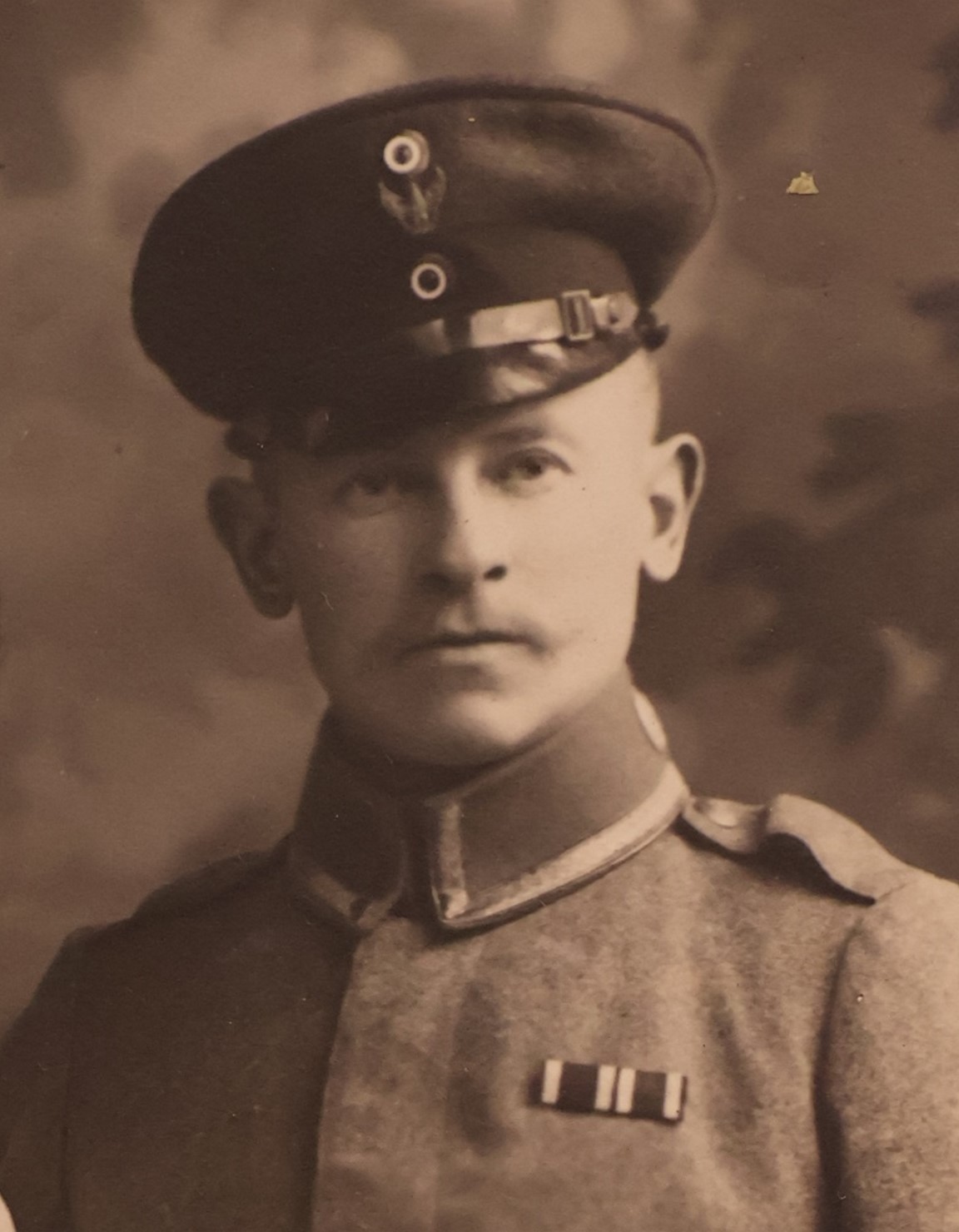
Otto Zoberbier’s
My Journey through the Orient
translated into English from Werner Zoberbier’s German edition (version “WZ“) of his father Otto Zoberbier’s handwritten version (“²OZ“, the so-called “Zweitschrift”)
Translation drafted with the help of DeepL and GPT (UiO), proof-read by Kathinka Zoberbier and Stephan Guth
Annotated by Stephan Guth
Epilogue (in lieu of a foreword)
<p9b> 6 Back to Baghdad
I woke around noon. I ate a lunch I hadn’t enjoyed in two months. Then I slept again, as I had a lot of catching up to do. In the evening, I asked at the back area if the caravan had arrived yet but it hadn’t. Now I had to report this to the stage officer in charge, a Bavarian lieutenant. His greeting was not exactly friendly, and he ordered me to saddle my horse immediately and not to return without the caravan. I turned around and made myself scarce. The night before had been enough for me and I first needed some rest. I had dinner and caught up on yesterday’s and today’s sleep.
In the morning I had a good breakfast, then I saddled my horse and rode back to Benisat[1] the same way as I had come the night before. There was no sign of the caravan. I searched the whole village and found only one other caravan, which also came from Persia, and which was accompanied by an old comrade. He invited me to share the lunch he had just cooked, chicken with rice. I waited until the worst of the heat had passed and headed back. My host wanted to travel on in the evening. By sunset, I was back in Baghdad. At the back area, I found out that my caravan had bypassed the flooded area, and had already arrived in the morning shortly after my departure. Like this we could not meet each other.
At the beginning of June, the heat became more and more oppressive. The temperature exceeded 60 degrees, and for us Central Europeans it was almost more than we could bear. It was too hot to live and too hot to die. And then there was the malaria. I was again in a fever for three days and had to swallow quinine diligently. When the fever subsided and I could lift my head again, I wandered through the bazaar in the cool of the evening to do some shopping. By chance, I met Captain Jordan,[2] who knew me from [K]asersherin in Persia. He was urgently looking for people because almost all of his men were in hospital, and he asked me if I would like to ride with him to Hanekin to bring back the materials that were still stored there. I agreed.
The very next evening we set off with a mule caravan. We made the 66 km to Benisat that night. During the day, sleep was out of the question, it was far too hot. We didn’t even enjoy our food. Towards evening we set off again and rode through to Sharaban,[3] which we reached quite early. But there was no rest in the heat. We were consumed <p10a> by thirst, and I still had a fever. On the fourth day we came to Chissorobat.[4] Here the rest of my strength left me and we had to take a day to rest. Fortunately, the next day a caravan came from Hanekin, headed for Baghdad, and I asked my captain to allow me to join it, which he agreed to, because lying down on the way would have meant certain death. We marched to Baghdad during the day in a heat of almost 70 degrees. Not a breath of cool air, a hot wind like from a furnace. We had to erect a windbreak on the side from which the hot wind came. We couldn’t drink from our canteen either because the aluminium opening of the canteen was too hot. All we could do was endure and resist lying down. There was no doctor or paramedic, and it was still 110 kilometres to Baghdad. When we arrived in Sharaban, we just fed the animals and immediately continued to Bakuba. One forced march followed the other. In Bakuba we had a very short rest. We continued towards Baghdad. We still had 66 kilometres to cover. The thirst became more and more unbearable. There was a buzzing in my head so that I could no longer hear anything. Finally we were in Baghdad.
We had covered the distance from Sharaban to Baghdad in 27 hours. We had arrived on the first day of Pentecost. The transport was only casually handed over to the back area. In the first-aid room, a doctor immediately ordered my transfer to the military hospital. The military hospital had been set up in the Baghdad railway station. The staff doctor was a German who had lived in the Orient and who was familiar with tropical diseases. He took great care of me and I think I owe my life to him. The military hospital was situated in a magnificent palm grove, directly on the banks of the Tigris. The windows were covered with green mats. The stone floor was constantly doused with water to cool it, and yet the temperature in the rooms never dropped below 40 degrees. Add to that a high fever every day. In the mornings I had a fever of 38.8 degrees, which then rose to over 40 degrees by the evening. I didn’t enjoy my food either. It was very good, and I could have had anything I wanted, but I couldn’t eat a thing. Again and again the staff doctor urged me, “Go ahead and eat, even if you don’t like it.” I was consumed by thirst. There was an earthenware jug of tea next to my the bed, but the tea was always warm and began to smell after a while when it stood longer. Disgusting! We sat on our beds in just our shirts, a handkerchief in one hand, a fan in the other to waft for fresh air.
I was a mystery to the staff doctor. Each of the new doctors coming in had to examine me <p10b> and give an opinion. This went on for four weeks. The high fever remained and I was physically completely run down. I was so weak that I fell asleep during a conversation. Eventually the fever began to drop noticeably. I started to enjoy my food again, and I was allowed to eat whatever I wanted. I could now walk to the Tigris in the evenings, when the heat had eased a bit, and rent a boat with my comrades. You weren’t allowed to swim because of the danger of sharks.[5] The mosquitos were a nuisance. We often sat on the shore and watched the locals operate their primitive but functional irrigation systems which supplied their palm groves, orchards and vegetable gardens with water.
I spent ten weeks in the hospital. The staff doctor would have liked to keep me there and to train me as a medic. But first I had to report back to the commandant’s office as healthy. There, by chance, I met the captain with whom I had come to Baghdad from Aleppo, and whom we had transported through the desert sick for 10 days. He was happy to see me again and kept me there right away. I became the caretaker of the commandant’s office. I had four hamale[6] (workers) [working for me,] and had to make sure that everything was clean, especially the lavatories, and that fresh water was available everywhere. This did not really keep me busy, and I was bored and didn’t know what to do with myself. Sometimes I sat in the office and typed away on a typewriter.
New Destination: Persia
On the Euphrates
Notes on ch. 6
[1] See above, note 116.
[2] No further information on this person available.
[3] See above, note 119.
[4] On one modern map, I found a town named “Khosrowvi” to the east of Khānaqīn, exactly on the Iraq-Iran border. However, if Zoberbier’s data are correct this cannot be the same as his “Chissorobat”, as the latter must be somewhere on the way between Sharabān (modern al-Miqdādiyya) and Khānaqīn. Thus, “Chissorobat” could be either modern Manṣūriyyat al-Jabal, or al-Saʿdiyya, or Jalawlāʾ (Jalūlāʾ). The third of these three was the centre of the Sasanian Shādh Qobādh province; so, is “Chissorobat” perhaps a (contaminated, Arabicized?) form of Shādh-qobādh? – On a map found in Liman von Sanders’ (see note 228) war memoirs, Five years in Turkey (1927), there is a place named “Kyzylrobat”, ca. 30 km to the southwest of Khānaqīn.
[5] One may be surprised to find Zoberbier mentioning sharks as a danger for swimmers in the Tigris, as sharks are known as marine fish. Cf., however, Blaschke 2018, 44, who confirms that sharks seem to have been a not too unfamiliar phenomenon in the region since ancient times, as the annual flooding provided a favorable habitat, especially for bull sharks (German: “Stier- oder Bullhaie”), a species that is used to “warm, shallow brackish and freshwater systems including estuaries and (usually) lower reaches of rivers” (https://en.wikipedia.org/wiki/Bull_shark, as of April 21, 2024). Due to the construction of dams along the rivers, the migration of fish is now generally restricted. Before that, however, sharks could be observed several hundred kilometers upstream, and there are “various reports of shark attacks in the Shaṭṭ al-ʿArab and Qārūn, but also in the Tigris up to the region north of Baghdad” – Blaschke 2018, ibid. (my translation).
[6] See above, note 72.
New Destination: Persia
On the Euphrates
 Sergeant Otto Zoberbier’s "Travels in the Orient: Persia and Arabia, 1915–1919"