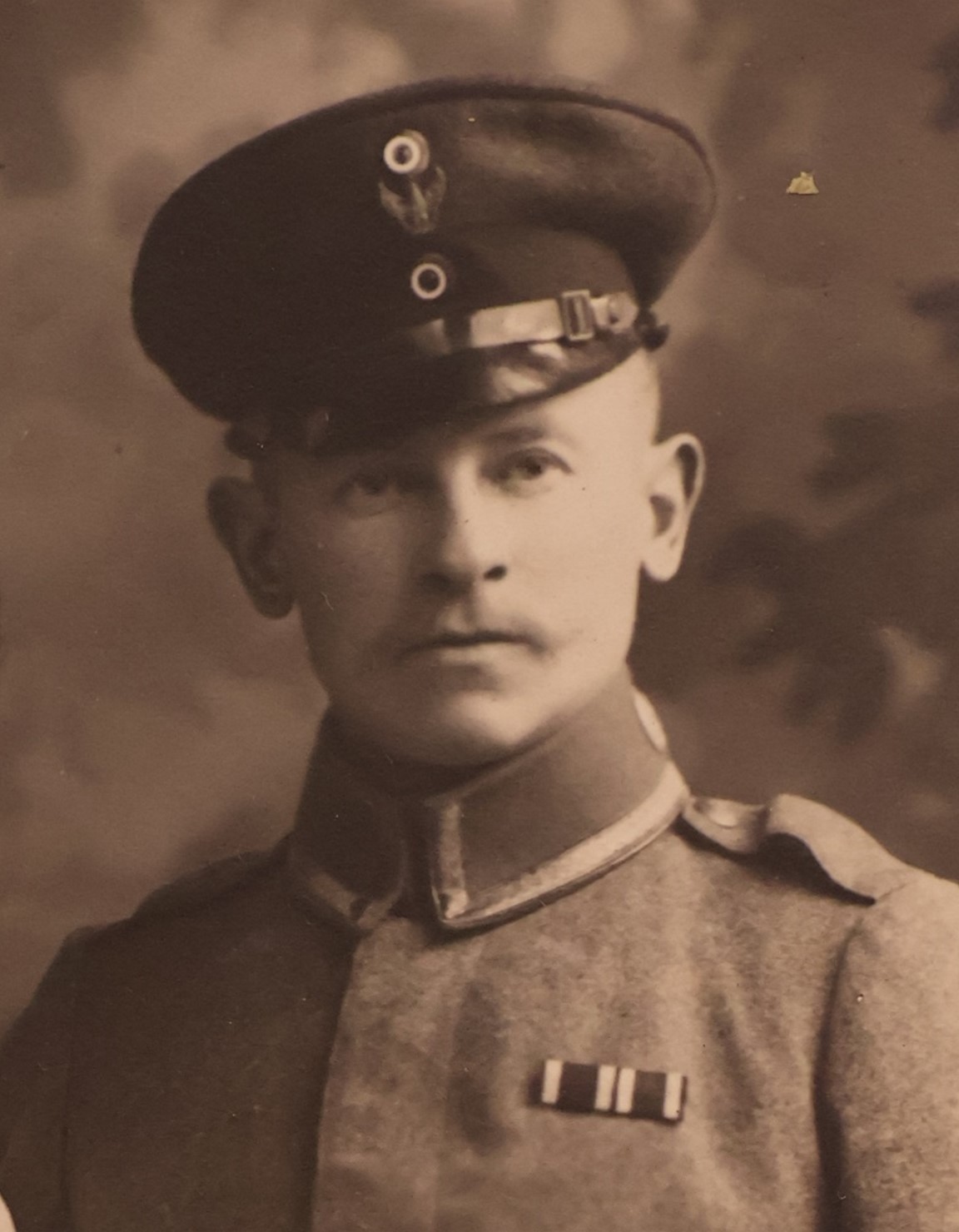
Otto Zoberbier’s
My Journey through the Orient
translated into English from Werner Zoberbier’s German edition (version “WZ“) of his father Otto Zoberbier’s handwritten version (“²OZ“, the so-called “Zweitschrift”)
Translation drafted with the help of DeepL and GPT (UiO), proof-read by Kathinka Zoberbier and Stephan Guth
Annotated by Stephan Guth
Epilogue (in lieu of a foreword)
7 On the Euphrates
In the course of the spring and summer, all kinds of troops, especially technical formations, had come down the Euphrates from the mountains on barges. The barges were to be unloaded in Redwanje[1] and transported on to Baghdad on a newly built narrow-gauge railway. For this purpose, it was planned to set up a new back area in Redwanje. Turkish Askers (soldiers) were to push the trolleys the 40 km distance to Baghdad. My friend, the 12th Hussar, and I reported there and, as a result, we were hired. The climate was much more pleasant in Redwanje, but there were more mosquitoes and other pests that you couldn’t escape in the evenings. At first we lived here in a tent made of <p11a> reed mats, not woven tightly enough to keep out the rain and sandstorm. In the evenings, there was a finger-thick layer of sand on our beds.
In a few months, the rainy season would begin and we thought about what we could do to build another, more solid shelter. From the planks of the many shakhtoors[2] we could build something that was certainly better suited for a shelter than our present tents. We felt that the shakhtoors belonged to us, and the two of us began dismantling them into their component parts. However, we did not know that the shakhtoors were considered, and probably were indeed, property of the Turkish army. The Turkish back area officer very quickly forbade us to continue tearing the barges apart and set up posts to stop us from doing so. But we chased the Turkish guards away and carried on. This was followed by a complaint to the highest authority. The result was that a German officer, a lieutenant, was transferred to the back area, my friend was sent back to Baghdad, but I stayed. I had already met the German lieutenant from Peitack in Persia.[3]
Now we started to build a permanent house. We had permission from the commandant’s office. We were provided with hamale[4] (workers) who began forming and drying bricks from clay right there and then, which were then to be used to build our house. Arabs came from all over the area to earn some money. Adults were hired for 5 piasters a day, and children also wanted or were expected to work. They got 3.60 piasters a day. The regular working hours were from 6 am to 12 noon, and from 1 am to 6 pm, with one hour’s break in between. The adults shaped the clay bricks, and the children then laid them out to dry. In three to four days’ time, the bricks had hardened. Between 40 and 50 men were employed in this way. When the construction of the house began, the adults carried the bricks while the children carried clay in small baskets on their heads. A few “bricklayers” then laid the bricks on top of each other, but all without spirit level and plumb.
My job was to supervise the construction. When I wasn’t looking for a few minutes, our workers would sit behind a pile of stones, smoking their cigarettes or clay pipes. In time, I was able to tell the hard-working from the “less” hard-working. There was a trick: You came early, handed in your work chit and disappeared again in a quiet moment. After I found out, I had everyone line up from time to time, and whoever wasn’t there was dismissed and didn’t get any more money. Wages were paid at the end of the week. From <p11b> now on I could trust my people more, and my supervision became a little easier.[5]
Arabs are very undemanding. During the lunch break, they sat together, ate a handful of dates and some flatbread. When the days began to get shorter and, as a result, also the working day got shorter by two hours, I thought I could cut their wages by 1.20 piasters. But they didn’t put up with that and went on strike. The next morning at seven they all showed up, but no one did any work. They all just stood around. Those who wanted to work were prevented from doing so by the others. All the coaxing did not help. We asked the ringleaders to leave the site, but they firmly refused. We were finally able to drive the ringleaders away at gunpoint, but the others still refused to work. When our interpreter made it clear to them that in another village, from another tribe, people were just waiting to take over, they started working again. In revenge, they then trampled on our fresh mud bricks that had been laid out to dry during the night.
Before the rainy season[6] started, we were able to finish the construction of our house. We had a dry place now, and there was no more dust on our beds. The European winter is the rainy season here. At the end of October the first clouds appear in the sky, and in the first days of November it starts raining until the end of April. After that the sky is cloudless again. – At this time I also witnessed how two neighbouring villages fought regular battles against each other. There was a lot of shooting, and we were so close that we could hear the bullets whistling past us. And people there were not only wounded, but also killed.
Now a quiet time began for me. Two transports at most arrived every week, and they were dispatched relatively quickly. So I had plenty of time to go hunting. I had hardly left the back area when several Arabs, both old and young, joined me. There were many foxes and jackals. The foxes are somewhat smaller and lighter in colour than the German foxes, but immensely tough and very hard to kill. Although I was a good shot, and almost every shot hit its target, they still ran off. At the spot where I had hit them, I then found a large pool of blood. I followed the trail of blood until I found the dying animal in a hollow bump about 100 metres away and was able to give it the finishing shot. The jackals’ fur is almost worthless, that of the foxes is worth more. The animals were skinned by my young Arab friend Ibrahim, who often accompanied me. Now and then I gave him a few piasters, and since then he had become very attached to me. “Barshaoush, Arab shock fenna,”[7] he said to me (sergeant, Arab very bad).
We had an excellent cook who had previously been employed by a teacher’s family. If a <p12a> transport arrived, we fed them right away, for 5 piastres (1 mark) per person. The more people there were in a caravan, the more profitable our cook was. Meat and rice were cheap, so we could cover our expenses and sometimes even made a small profit. After two days they were always gone, and we could sit back.
One day I was walking with Ibrahim along the canal: an old, almost completely silted-up connection between the Euphrates and the Tigris, in which the water was at most half a metre high. Suddenly I saw a dark spot in the distance, which I thought was a jackal. Cautiously I descended from the dyke, crept closer and watched the target on the other side of the canal. I saw it sitting on the other bank and took a shot, but the animal was gone in an instant. Ibrahim saw it swimming in the canal directly afterwards, raced down the embankment and fetched it out of the water. “Afferim. Benzun Barre”[8] (Very good. Wild cat). I did not know what I had shot. The head was that of a cat, the fur was striped, and it had a strange tail. When my friend was stripping the animal in the back area, I learned from the lieutenant that I had shot a lynx, and that its fur was much more precious than that of a jackal. In Baghdad you would get three to four medshid[9] (12 to 16[10] marks) for it, while for a fox skin you would only get two to 2½ piasters (40 to 50 Pfg.). Ibrahim rubbed the skins with ash and hung them up to dry nailed to a board. When we had to retreat I put all my skins in a sack, and since not all of them were dry, they were all ruined when I unpacked in Mosul them four weeks later.
In autumn, ducks often rested on the Euphrates. As soon as the Arabs saw any, they came up to me: “Barshaoush, bott, bott!”[11] (Sergeant, ducks, ducks!) Accompanied by a bevy of Arabs, I went to the Euphrates. There I saw the ducks almost swimming in circles. I took a shot, and two were killed, while the others got away. That was a great success: two ducks with one bullet. The Arab boys immediately rushed into the water, as they knew a baksheesh awaited them for delivering the prey to me. The Euphrates is 500 m to 600 m[12] wide here. From our back area we had a view of the river in front of us. In our house we had six large rooms, kitchen and bathroom. Very comfortable by local standards. The work was bearable, and once a transport had been dispatched, I rode to Baghdad to do some necessary shopping, and to fetch the wages for the workers. We bought eggs and chickens from our Arabs, and if when a larger transport arrived, we slaughtered a calf.
New Destination: Persia
On the Euphrates
Notes on ch. 7
[1] I was unable to identify this “Redwanje” on the maps at my disposal. If Zoberbier’s description is right, it should be some 40 km away from Baghdad, located on the Euphrates (²OZ 57 has “41”, WZ 10b made this into “40”). There is the homonymous suburb of the capital, close to the modern airport, where Ṣaddām Ḥusayn used to live in one of his ‘castles’, Qaṣr al-Rāya, and which was one of the first quarters entered by the invading US army in 2003, cf. https://ar.wikipedia.org/wiki/الرضوانية (as of April 6, 2024). This suburb is located to the southwest of the city centre, i.e., in the direction of the Euphrates – but not farther away from the city than 15-20 km, and definitively not on the Euphrates.
[2] Arabic shakhtūr, pl. shakhātīr (also with emphatic ṭ), “large, flat-bottomed (wooden) barge; punt” – Wehr/Cowan 1976. – Veltzke 2014, 298, has a nice picture of (covered, houseboat-like) shakhātīr that were used by another (earlier, December 1914) German expedition on the Euphrates. The ones Zoberbier is talking about in the memoirs were probably simple open barks in use by the local fishermen.
[3] See above, note 126.
[4] See above, note 72.
[5] Zoberbier’s view of ‘the Arabs’ reflects an attitude that seems to have been quite common among the German soldiers who were serving in the Orient. Reichmann who, in his dissertation of 2009, analyzed “letters, memoirs and also official reports” of Germans like Zoberbier showed that the soldiers not only “had to deal with an unfamiliar environment and the ‘oriental mindset’” but also often “had difficulties to cope with their own prejudices or to adapt their ideal of service to local particularities” (English abstract at
urn:nbn:de:hbz:6-19489572774). A typical distinction made between Turks and Arabs is summarized in the title of Reichmann’s study: „Tapfere Askers” und „Feige Araber”, i.e., “‘Brave (Turkish) Askers’ and ‘Cowardly Arabs’”, cf. esp. Chapter IV. 2, pp. 238–266. While Ottoman officers often were regarded as lazy and incompetent, the Anatolian soldier was generally “praised for his ability to suffer, his forbearance and his obedience under the extreme conditions of the various fronts of the oriental theatre of war. Practically without rations, sufficient equipment and ammunition, efficient support from other branches of the armed forces or medical services, home leave, pay and treated with harshness, if not contempt, by his own officers, he fought and died uncomplainingly” – ibid., 401 (my translation). The Germans’ view of other ethnic groups, like the Arabs, seems to have been biased by the widespread Ottoman prejudices. “The parts of the population of Arab origin who were called up for service in regular units were regarded by Germans as unreliable at best and, at worst, as cowards, thieves or a danger to their own side. Here, too, the general conditions were deliberately ignored” – ibid., 402 (dto.).
[6] See above, note 139.
[7] I.e., Turkish çok fena “very bad”. – Strangely enough, the “young Arab friend” talks Turkish here, and expresses a negative opinion about his own ethnic group. The passage is lacking from ²OZ. – Both ²OZ and WZ have “barschausch”, probably wrongly picked up by Zoberbier (unless corrupted in the “young Arab friend”‘s pronunciation). The underlying rank name is (in modern Turkish spelling) baş-çavuş “sergeant-major”. The only Ottoman (< Persian) word I was able find with an r after initial b, Berşaveş, means “(astr). Perseus” and can hardly be what Zoberbier heard.
[8] I.e., (Iraqi) Arabic āfarīn, bazzūn barrī “Bravo, a wild cat”. Āfarīn is of Persian origin (the ‑m instead on ‑n could be a Kurdism). According to Behnstedt and Woidich 2011, bazzūn is “typisch irakisch” for “cat”. Barrī “wild (of plants and animals)” is the nisba adjective coined from barr “open country, wilderness” – Wehr/Cowan 1976.
[9] See above, note 97.
[10] ²OZ has “12–15”.
[11] In ²OZ 64 I tend to read “batt batt” rather than “bott bott” (as WZ 12a has it). In any case, the underlying Arabic is baṭṭ “duck(s)”. – For “barshaoush”, see above, note 153.
[12] ²OZ 65: “mindesten 500 Meter” (at least 500 m).
New Destination: Persia
On the Euphrates
 Sergeant Otto Zoberbier’s "Travels in the Orient: Persia and Arabia, 1915–1919"