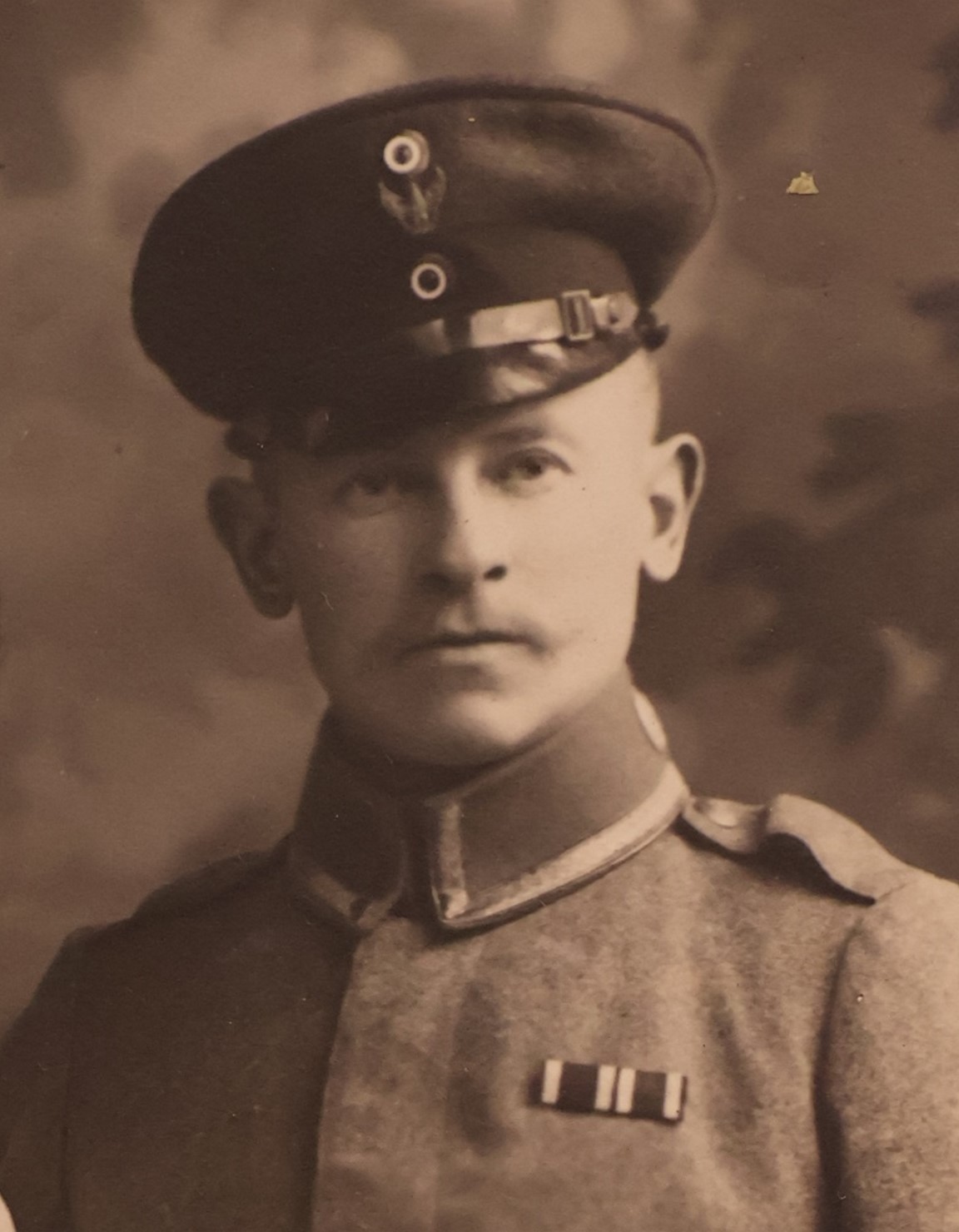
Otto Zoberbier’s
My Journey through the Orient
translated into English from Werner Zoberbier’s German edition (version “WZ“) of his father Otto Zoberbier’s handwritten version (“²OZ“, the so-called “Zweitschrift”)
Translation drafted with the help of DeepL and GPT (UiO), proof-read by Kathinka Zoberbier and Stephan Guth
Annotated by Stephan Guth
Epilogue (in lieu of a foreword)
9 New Job: Caravan Guide
My new job was to accompany caravans from Mosul. I found this was very interesting and varied. With 4-5 men accompanying us, depending on what the situation was like regarding security, we started our journeys, which usually lasted 12 to 14 days. Sometimes I accompanied a caravan only together with my faithful batman, a Turkish soldier. On one of these transports we had to go to Kerkuk in Persia,[1] and our route took us through Kurdish territory, which we were warned about as the Kurds were considered dangerous. No sooner had we reached a place than we were surrounded by men and children. As always, they were interested in our rifles, because they only knew their muzzle-loaders. To satisfy their curiosity, we <p14b> shot a few times in the air, and then they could see how the rifles were reloaded to. “Kach grush, how much are they?” they kept asking.[2]
We had taken our supplies for the journey from Mosul, mainly rice, and barley for my horse and the mule. Fresh food, like chickens and eggs, were bought by my batman on the way. – But we had to keep an eye on our camel drivers. They stole from us wherever they could. When our backs were turned, they cut open the camels’ saddlebags, held a sack under them and quickly sewed the slit shut with needle and thread, so skilfully that we didn’t notice anything at first. After we had found out what they did they tried another method. One evening we stopped at a waterhole to spend the night. I was already lying on my camp bed, and my horse was eating from his nose bag when one of the drovers tried to steal the nose bag. I jumped up, stopped him and finally drove him away with a few strokes of my riding crop. The other drovers had seen this. They surrounded me and took up an unpleasantly threatening posture. Fortunately, my batman appeared right away and chased the grumbling drovers away, with his rifle at the ready. The situation was serious, as we had to get on with them until Kerkuk. When we arrived in Kerkuk they demanded an advance payment from the local back area, but they were refused. Now they came to me and asked me for it. I wanted peace with them again and gave them 1 Lera (20 Marks). This mended the rift, and we were friends again.
On the way back, two wild geese flew low over us and sat down 50 metres away. I quickly jumped off my horse, took aim and shot. One of the two wild geese spun around and then stayed put. The other one flew on, startled, but only for 100 metres. I crept closer, my horse slowly following me. With the second shot I killed the other wild goose. One goose was given to the camel drovers, who were thrilled, and the other one was roasted by my batman, and I never knew wild geese could taste so good.
When I came back from a transport, I had a few days off and could see to my mail and do some necessary shopping. After I had been reasonably successful in hunting it was important to get a shotgun. There were many sandgrouse in the desert, which are a bit bigger than our partridges. With one shotgun blast I managed to kill up to five[3] sandgrouse.
An interesting trip took me to the Sindjar Mountains.[4] Together with five companions and my batman, I had to lead a caravan of 93 camels to Sindjar to fetch barley. The <p15a> Sindjarnese people are fire-worshippers.[5] Unlike the Arabs, they are blond. They are constantly at war with their neighbouring Bedouins. On the first afternoon we stopped at a place on the Tigris where an old Arab welcomed us at the edge of the village. We were supposed to be his guests, and he cleared a nice room in his house for us, and entertained us lavishly. Still, he was very grateful for a baksheesh the next morning.
We continued through derelict villages and ruins, overgrown with weeds and bushes, where foxes and hares lived. We went hunting for the hares immediately, and as soon as we had spotted one it was already in the bag. I then hit one Reseni[6] (fox), the others escaped to the desert. The local hares are a bit smaller than ours. From now on we had to be more careful. We were now entering the insurgency area where a Turkish gendarme patrol had recently been massacred. We did not know this, however, and pitched our tents at a waterhole to spend the night in the open. The night passed quietly, and we remained unmolested. In the morning, we set off early to reach a Turkish gendarmerie as the next stage in time. On the way we met neither Arabs nor Sin[d]jarnese.[7] Around sunset we reached our destination, the gendarmerie station. Here we spent the night in safety, but fortunately nothing had happened to us so far. The next day we started the ascent into the mountains. Sindjar[8] is halfway up the mountain, and the houses of the town are stuck to the slopes like swallows’ nests. We allowed ourselves a day of rest and didn’t load our barley until a day later. On the third day, we set off, fully loaded, towards Mosul, as far as another Turkish gendarmerie station, where we spent the night. It was still in the dark when we set off early the next morning to leave the perilous stretch behind us before evening. The Turkish commander gave us three more gendarmes to accompany us to Telhalief.[9]
At dawn our caravan moved on languidly. The escorts had swarmed out left and right to look for huntable game, as there were plenty of hares and gazelles here at the foot of the mountains. And before sunrise we were able to bag a gazelle. Shortly afterwards, one of the Turkish gendarmes rode up to me and shouted excitedly, “Barshaoush,[10] Arab, Arab!” (Sergeant, Arabs), turned his horse around and fled, never to return. In the distance, on a hill, I saw several horsemen coming towards us. I had already unlocked my rifle and was ready to fire. The horsemen greeted us in Arabic, “Maraba, maraba!,”[11] and rode on, not paying any attention to us, just but talking to <p15b> one of our camel drovers. In the meantime, the hill was swarming with people who started moving and rushed towards us with daggers in their hands and war cries of “Hullala, Hulala”.[12] We were at a loss now, because we could not use our rifles. And what could we have done with our six rifles against 100 Arabs, even if they only had daggers and muzzle-loaders. Maybe we could have saved ourselves by riding into the desert, but then the caravan would be lost. At least we adopted a menacing stance. Already the head of the group were approaching. They greeted us in Arabic, paid little attention to us, and quietly passed by. They asked our camel drovers where we were from and where we were heading. Finally, another horseman approached, then rode briskly past us. Suddenly he tried to snatch the 88-rifle from my batman, who was riding at the rear of the caravan. We raced back, and when the Arab saw our rifles he disappeared as fast as he could.
By then, our camel drovers were getting frightened. We avoided spending the night at the next waterhole and moved on to the next village, which we were lucky to reach before sunset. After the fright, and after the exertion of the last days, a day of rest would have been bitterly needed. As nearly always in the places we passed we were again surrounded by the local men, who marvelled at our equipment and weapons. And then the haggling for our rifles started again, of course unsuccessfully. In Tehofa[13] the next day, the Hanshi (innkeeper)[14] greeted us warmly, as this was the fourth time I was staying with him. He never missed the opportunity to take care of our physical well-being himself. Then he went into the kitchen and prepared our food. Thus refreshed, we wanted to make the long journey to Mosul in one day.
I had been living in the Orient for two years now. I had become somewhat used to the climate, so that we now marched during the day when we went on a transport. We set out before sunrise, rode until ten, half past ten, and then pitched our tent. When we folded up the side walls, the wind blew pleasantly through the tent, and the tent roof protected us from the sun’s rays. On the way, we had collected dried camel dung for the fire over which our food was then prepared. After a few hours we continued on our march.
The summer ended without another bout of malaria. In September 1917, I was put in charge of a caravan to Aleppo. It consisted of 52 horses, 27 mules and eleven donkeys. The Zeises (grooms)[15] who travelled with us were almost all strangers to us. As we realised later, most of them travelled with us only to get closer to their home, <p16a> and then to leave us secretly at some point. Some of the few old coachmen we had known for a long time, and we knew them to be reliable. We had picked up the Zeises on the road, hungry and without money, and they immediately demanded an advance payment, which we were neither allowed nor wanted to give them, because most likely otherwise they would have disappeared already in Mosul. We promised them that they would get their wages every evening. We set off, with the Sindjar Mountains to the northwest and the Caucasus Mountains[16] to the north.
The area was particularly notorious – because a motorcade had recently been attacked here. The Bedouins here were even so brazen as to dare to attack a Turkish military formation. It did not go down well with them. From time to time, one of our grooms would disappear. We now had to reckon with raids. Even though after each raid an aeroplane was sent to observe the raiders, reconnoitre their camp, and then, as a successful punitive measure, some trucks equipped with machine guns were sent to the desert, we nevertheless preferred to ride at night. At the next back area, a German one, we then stayed during the next day. So far I had always been lucky, my transports had never been raided. Another, much larger caravan was attacked near Tigkrit,[17] and the cousin of our interpreter, also a Palestine German, was killed.[18] After Nisi[b]in,[19] at the junction of the Baghdad railway, we had nothing more to fear. From here we were going to be transported by train. We arrived in Aleppo after two days, travelling in two railway trains. The journey did not go entirely smoothly. The locomotives of the Baghdad Railway were set to burn wood because coal was scarce and therefore more urgently needed for shipping. It happened that smouldering pieces of wood were blown along the train. We had left the sliding doors of the wagons open because of the pleasant draught of air, and then it happened: a fist-sized piece of glowing wood was blown into the carriage onto my camp bed, which was in the middle aisle, and set my beautiful mattress on fire. The gust of wind immediately ignited a large fire flame. I tried to put out the flames with the water from my water bag, but there was far too little water. I had no choice but to quickly grab the burning mattress and throw it out of the train. Afterwards, we could see the burn marks all over the running boards of the railway carriages, but what was much worse, I had lost my beautiful mattress.
Retreat
Aleppo
Notes on ch. 9
[1] I.e., Kirkūk, today a city in northern Iraq, some 240 km north of Baghdad. Kirkūk had come under Ottoman control in 1851 and was occupied by the British towards the end of WW I, in May 1918. When Zoberbier speaks of “Persia” here, he must mean Kurdistan.
[2] Cf. above, note 210.
[3] ²OZ 79: “bis zu acht” (up to eight) | WZ 14b: “bis zu fünf” (up to five).
[4] I.e., the Jabal Sinjār, a 100-km-long mountain range “that runs east to west, rising above the surrounding alluvial steppe plains in northwestern Iraq to an elevation of 1,463 meters […]. The highest segment of these mountains, about 75 km […] long, lies in the Nineveh Governorate. The western and lower segment of these mountains lies in Syria and is about 25 km […] long. The city of Sinjār is just south of the range. These mountains are regarded as sacred by the Yazīdīs [see next footnote]” – https://en.wikipedia.org/wiki/Sinjar_Mountains (as of March 29, 2024). – In August 2014, the city of Sinjār was the site of what came to be known as the genocide of Yazidis by the Islamic State. “In the course of their second Northern Iraq offensive […], the Islamic State of Iraq and the Levant (ISIL) took over large areas of Nineveh province. Following the withdrawal of the Kurdish Peshmerga they captured the city of Sinjar on 3 August. During the following days, IS militants perpetrated the Sinjar massacre, killing 2,000 Yazidi men and taking Yazidi women into slavery, leading to a mass exodus of Yazidi residents. According to a United Nations report, 5,000 Yazidi civilians were killed during ISIL’s August offensive” – https://en.wikipedia.org/wiki/Sinjar (as of March 29, 2024).
[5] I.e., Yazīdīs. Yazidis, also Yezidis or (Kurmanji:) Êzîdî, “are a mostly Kurmanji-speaking ethnic-religious group […] whose original main settlement areas are in northern Iraq, northern Syria and south-eastern Turkey. The Yazidis consider themselves partly as ethnic Kurds, partly as an independent ethnic group. The latter applies in particular to the Yazidis in Armenia and in the northern Iraqi Sinjar region, as well as to the Yazidis in the European diaspora. […] – Yazidis practise endogamy. Yazidism is a monotheistic, syncretic religion that is not based on a holy scripture. Membership is exclusively by birth if both parents are of Yazidi descent. Marriage between Yazidis (of both sexes) and non-Yazidis results in exclusion […]. Melek Taus (‘Angel Peacock’), Sheikh ʿAdī ibn Musāfir (around 1073–1163) and the seven mysteries are at the centre of the Yazidi faith. The tomb of Sheikh ʿAdī in Iraq’s Lalish Valley is the main shrine of Jizidism and the destination of an annual pilgrimage in autumn” – https://de.wikipedia.org/wiki/Jesiden (as of March 24, 2024; my translation, S.G.).
[6] WZ only, no corresponding term in ²OZ. The source of this “Reseni” can neither be the Arabic thaʿlab nor the Turkish tilki “fox”, very unlikely also Kurmanji rêvî. I suspect initial “R‑“in WZ “Reseni” to be a misreading (from lost *¹OZ) of original *”H‑“, in which case the underlying Arabic word could be ḥṣēni (var. ḥuṣayni, abu liḥṣēn, ḥuṣni), according to Behnstedt & Woidich 2011, 394 (map 133 “Fuchs”), a common term for “fox” all over the Mashriq, though mostly in narrative style, fables, etc. (ibid., 395).
[7] ²OZ 81 “Sindjarnesen”, erroneously copied as “Singjarnesen” in WZ 15a (on second mentioning only).
[8] See above, note 181.
[9] ²OZ 72: “Tel-ha-lif” (elsewhere spelt “Telhafa”, see above, p. 239 with note 174). – Must be Tall ʿAfar.
[10] See above, note 153.
[11] I.e., Arabic marḥaban “welcome”.
[12] Sic (first with ‑ll‑, then only ‑I) in WZ, while ²OZ 82/83 has ‑ll‑ twice.
[13] ²OZ 82: “Tel-ha-fa”; cf. above, note 186.
[14] For han‑, see above, note 75. – The second component is the Turkish profession suffix‑cı.
[15] I.e., Arabic sāyis, colloquial variant of sāʾis, from sāsa, u, siyāsa “to lead”. The word is found in Ottoman Turkish in both forms, meaning “who attends to cattle”, especially (in its colloquial use as seys or seyyis) “groom” – Redhouse 1890.
[16] See above, note 175.
[17] The passage about the death of the interpreter’s cousin is missing from ²OZ. – “Tigkrit”: Is this the same Tikrīt, located 140 km northwest of Baghdad and 220 km southeast of Mosul on the Tigris River, that became known, in our days, as the birthplace of Ṣaddām Ḥusayn?
[18] Cf. above, notes 95, 106, and 140.
[19] WZ misreads “Nisikin” where ²OZ clearly has “Nisibin”. The place in question is well Nusaybin (Arabic Nuṣaybīn), a municipality and district of Mardin Province, Turkey.” The name goes back to Latin Nisibis, Greek Νίσιβις. “Nisibis was capital of Roman Mesopotamia and the seat of its governor. [… The city] was a focus of international trade and […] the primary point of contact between Roman and Persian empires” – https://en.wikipedia.org/wiki/Nusaybin (as of March 24, 2024). – “At the time, Nisibis was fought over between the Roman Empire and the Parthian Empire. The church teacher Ephrem the Syrian (306–373) and St James of Nisibis, who worked as a bishop and probably died in 338 AD, are well known. From 363, the city belonged to the Sassanid Empire, which expelled the inhabitants and replaced them with Persians. In 591, Nisibis once again fell to Eastern Rome and was then conquered by Muslim Arabs in 639/640. In 1515, the city became part of the Ottoman Empire and has belonged to Turkey since 1920. Today, mainly Kurds and a minority of Arameans and Arabs live in the city” – https://de.wikipedia.org/wiki/Nusaybin (as of March 24, 2024; my translation, S.G.). “Nusaybin is separated from the larger Kurdish-majority city of Qamishli by the Syria–Turkey border” (en.wiki, as above). – See also above, note 87 (for Nisibin/Nuṣaybīn as a stop on the “Berlin-Baghdad railway”).
Retreat
Aleppo
 Sergeant Otto Zoberbier’s "Travels in the Orient: Persia and Arabia, 1915–1919"