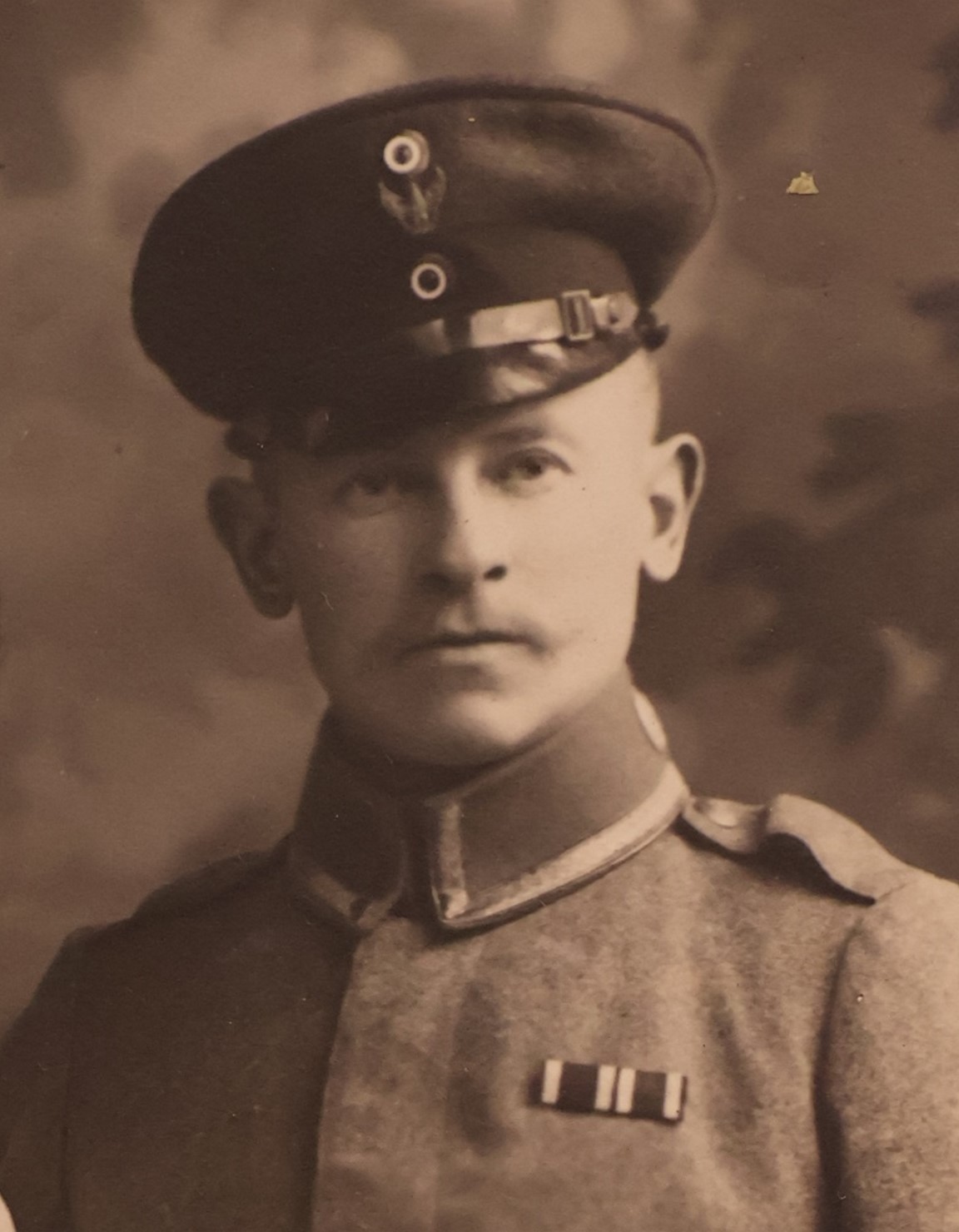
Editor’s introduction
One account – three (or four?) versions | Otto Zoberbier (1887–1974) – a biography | Otto Zoberbier’s memoirs as historical document | The memoirs as another example of a ‘war as journey’ narrative | Open questions, guesses, remarks, hypotheses | Differences between ²OZ and WZ | Notes | Condensed Timeline
One account – three (or four?) versions
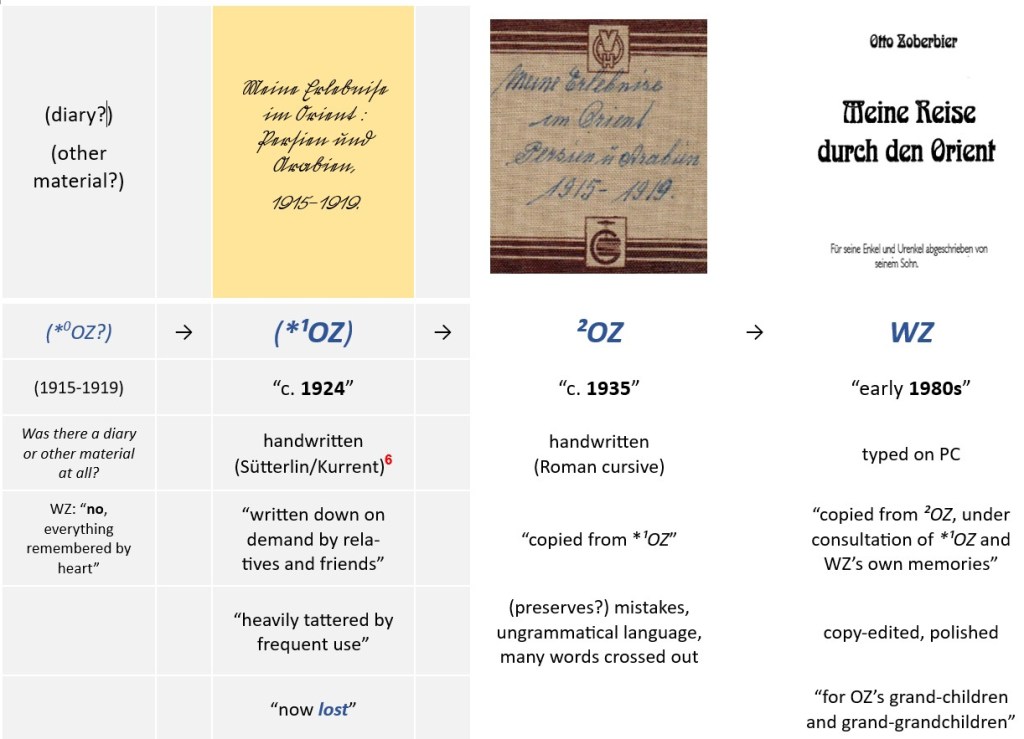
Apart from this introduction, this edition contains three, and indirectly perhaps even four, versions of one text – the war-time memoirs of sergeant Otto Zoberbier, a German officer who did his military service during the First World war in Mesopotamia as part of the German Asia Corps, from December 1915 to March 1919. We do not know whether the first version (*¹OZ [1] throughout), presumably written down some years after Zoberbier’s return – Otto’s son, Werner, thinks it must have been around 1924[2] –, built on a diary or made use of notes, letters, postcards, or other material, as this first version is lost (or has at least not surfaced so far). What is preserved instead is a second version (German: “Zweitschrift”, ²OZ), probably penned “around 1935”, according to Werner’s estimation,[3] at a time when the first version had already become tattered from frequent use. Almost half a century later, son Werner, now retired, produced a third version (WZ) in which he retyped and copy-edited his father’s handwritten text on a computer (one of the first of its time, it seems).[4] This website contains both, the “Zweitschrift” (²OZ) and Werner’s version (WZ), in a parallel edition, in addition to a facsimile of ²OZ and a (richly annotated) English translation of WZ. The texts of ²OZ and WZ are provided because they often differ – more or less considerably – from each other: the ‘raw’ and rather colloquial, in many places also ungrammatical language of ²OZ (see below, “Differences”) was ‘polished’ by Werner in WZ; he also frequently shortened ²OZ passages in order to summarize slightly repetitive content, or re-ordered elements of ²OZ to produce a smoother flow; moreover, on many occasions, Werner’s copy-edited version is longer and richer in details than his father’s handwritten text, a fact that Werner explains as (a) due to his constant parallel consultation of the ‘very original’ tattered *¹OZ sheets, which at the time still were extant and which he claims to have had in front of him; (b) sometimes, he says, he also added details he remembered from his father’s repeated ‘story-telling’ sessions.[5]
Otto Zoberbier (1887–1974) – a biography[6]
Friedrich August Otto Zoberbier was born on 14 June 1887 in Zesch, a village of approximately eighty inhabitants located in the Zossen district (Mark Brandenburg, 50 km south of Berlin) as the youngest of three children. His father was one of the richest farmers in the village and the mayor of Zesch, and the family lived on a farm.
In Zesch, Otto attended school (which only had one class where all students from 1st to 8th grade were taught) for eight years. He was a good student and wanted to become a teacher, and it was planned to transfer him to a grammar school (Gymnasium). However, when Otto was ten years old his mother died unexpectedly, and the “grammar school project” was canceled.
In 1901, on finishing 8th grade, 14-year-old Otto moved to Berlin to live with the family of his brother August, who was working there as a beer driver. Otto was accepted for an apprenticeship as a postal clerk, which he had chosen for himself. The apprenticeship lasted three years, after which he was taken on in the postal service. He started out as a simple postman, then became a registered mail carrier (Geldbriefträger, “money postman”) and later made a career leap to the railway mail service, where he became head of a post office (equivalent to a branch manager today). He had his own area of responsibility with a railway carriage that was practically a mobile post office. In this mail car, packages and letters were sorted directly. As part of a train the wagon either drove from Berlin to Marienburg (then East Prussia, passing through the Polish corridor) or directly eastward from Berlin via Küstrin to Benschen, where it stayed on the Polish side. From there, he regularly brought Polish sausage, loved by his family.
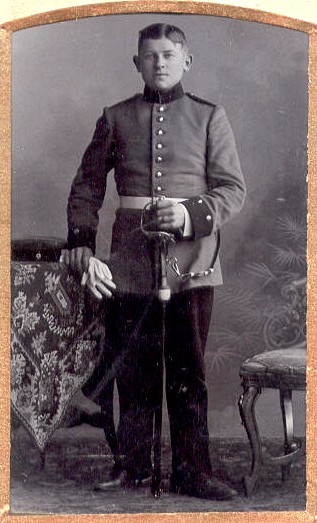
After completing his apprenticeship, Otto was conscripted for three years of military service [Fig. 2] (and was granted leave from the post office for this period).
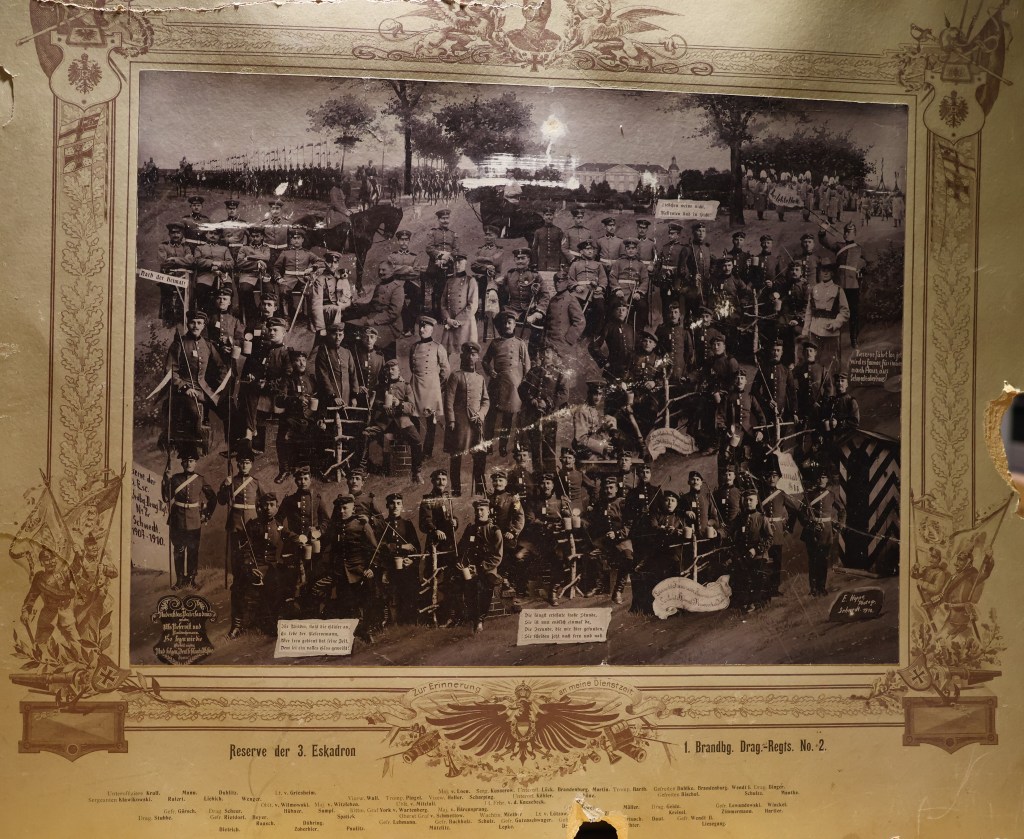
He applied to join the Schutztruppen‑ (‘Protective Troops’) Corps in German South-West Africa, but was not accepted due to insufficient height (1.57 m). Instead, he was called up to the Schwedter Dragoons, a mounted unit (also called light cavalry) [Fig. 3].
After completing his military service, he returned to Berlin in 1908, where he continued working for the post office.
At the beginning of the war in 1914, Otto was drafted into the German army, where he served as a Wachtmeister in the cavalry (equivalent to a Feldwebel ‘sergeant’ in the infantry). He was initially deployed in France but then volunteered for service in the “Orient” – and was accepted. Together with a group of thirty, he left Berlin on December 11, 1915, then twenty-eight years old. [This is where the memoirs start.]
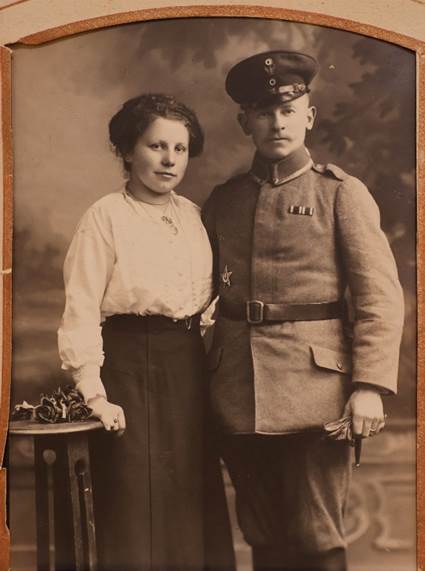
During his time in the “Orient”, Otto had about six weeks of leave and managed to extend it by an additional two weeks, during which he stayed with his sister in Zesch, who had meanwhile taken over the farm from their parents and was running it. During this leave, he met his future wife, 18-year-old Erna Jänicke [Fig. 4], who was visiting her sister Helene in Zesch. After the end of the war in 1919, Otto returned to Berlin. [= End of memoirs].
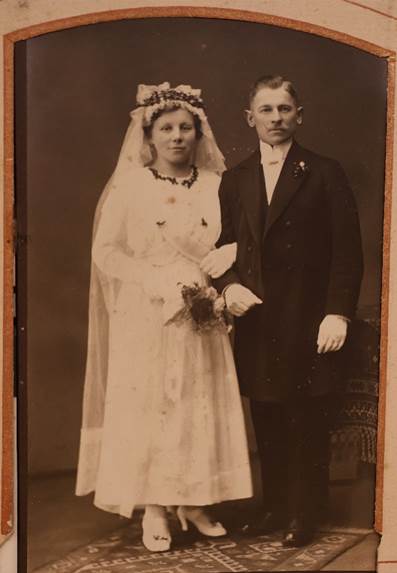
Otto and Erna were married on October 22, 1919 [Fig. 5], and lived in Berlin-Köpenick for a short time afterwards. Otto had resumed his work at the railway post office, which was located at the Schlesischer Bahnhof. The couple moved approximately every second year, as Erna was not happy with the rented flats. By this time, the couple had two sons: Werner, born on February 1, 1921 [i.e., the copy-editor of the memoirs], and Günter, born on August 8, 1922. The two boys spent many vacations in Zesch and enjoyed the exchange/interaction within the family, especially with their cousins.
Otto’s sister, who now ran the Zoberbier farm with her husband, sold parcels of land, and it had been agreed that August and Otto would be considered in the proceeds and paid out. Otto used this money to buy a plot of land in Berlin-Grünau for his family, and in the summer of 1936, shortly before the Olympics in Berlin, the family moved into the new house, at which time Otto was 49 years old.
At the beginning of World War II, Werner and Günter were conscripted into the Wehrmacht, with the younger falling in Luxembourg a few weeks before the end of the war in 1945. Otto continued to work as a railway official and head of a post office wagon. After the war, he had two jobs in Berlin, one in the eastern part of the city and one in the western part. He retired as a senior inspector and received a monthly pension of 420 East Marks, as their house was located in East Berlin. Shortly afterwards, the couple decided to move to the “West”, i.e., the Federal Republic of Germany, to join their son Werner. As a result of the move, the couple suddenly received 2000 “West Marks” per month.
They initially moved into a rental apartment in Dornstadt, about 10 km north of Ulm. With increasing physical limitations, they decided to move to another flat with the option of assisted living in Ulm-Böfingen. There Otto passed away on June 26, 1974, aged 87. He never really felt at home in the West. His wife then moved to a retirement home in Dornstadt, where she blossomed. She passed away shortly before her 89th birthday on March 16, 1987.
Otto Zoberbier’s memoirs as historical document
Otto Zoberbier’s memoirs are not a unique document of its kind – there are many others of the genre that have survived, both in private collections and state archives.[7] Yet they offer details that might be interesting for historians of the German Mesopotamia campaign, as well as for ‘lays’, in several respects. The “journey” that is covered in the memoirs started on the 11th of December 1915 when Otto Zoberbier’s group took the train from Berlin to İstanbul (“Constantinople”), and ended on the 29th of March 1919 when they returned to Berlin (after a longer trip on a cargo steamer, from İstanbul via the Mediterranean, Gibraltar, the Bay of Biscay, the Channel, Rotterdam, and Hamburg, where they disembarked). During the fourty months that lay between these two dates, Zoberbier and his fellow soldiers served as part of the German “Orient Group”, the so-called Pasha Army,[8] that collaborated with the Turkish military, as Germany was an ally of the Ottoman Empire, then already under Young Turk rule. The memoirs include a report about an excursion to Damascus and Baalbek in late 1917 as well as about a prolonged duty leave in spring 1918. The reader/listener learns a lot about ‘traveling’ to, from, and in the Middle East, on the “Orient Express” (Balkan route), the Anatolian railway (Haydarpaşa – Konya), and the “Baghdad railway” (Konya – Aleppo – [Baghdad], under construction, see Fig. 17, below) and the challenges of daily life as a soldier behind the frontlines and in the German and Turkish back areas (Etappen). Zoberbier was never sent directly to the front, and even when he had to stay in a military hospital for several weeks his report says almost nothing about combats, casualties, the many wounded, etc. At the centre of the narrative are his Erlebnisse, i.e., what he saw and lived through, his observations, experiences, and ‘adventures’ as a leader of smaller transport units in charge of logistic missions. Typically these consisted of caravans that had to transfer animals (camels, horses, mules, donkeys), weapons, equipment, food, and/or money, from one back area to another, advancing or, later, retreating along the Euphrates or Diyālà rivers and often through the desert or other difficult terrain (e.g., the Pāṭāq pass on the border between Ottoman Iraq and the Persian Empire). On their way, the group not only had to master the often highly demanding topographic and climatic conditions (rain and muddy ‘roads’ in winter, extreme heat and humidity in summer, with concomitant malaria attacks and widespread typhoid), but also came in contact with locals and learnt something about their language, religion (e.g., Yezidis in the Sinjār region), manners and customs, e.g., eating and drinking habits, or Bedouin hospitality. Moreover, they became eyewitnesses of (parts of) the Armenian genocide.[9] Endured hardship and observed cruelty taken apart, much of the report reads (and was certainly also meant to sound) like exciting adventure stories, funny or impressive anecdotes, and an informative touristic journal providing useful and amazing knowledge about foreign, ‘exotic’ countries and peoples. Thus, we learn about Bedouin tribes who are known for their unexpected and cruel attacks; about the ‘heroic’ acquisition of alcohol at the front for which an Austrian daredevil earned a bravery medal (²OZ 40-41 / WZ 8a); or the German-run hotels and hostels in İstanbul, Aleppo, and Baghdad, and the types of entertainment available in these cities (including concert gardens, where Austrian or Arab ladies’ bands were performing), and at what price, including a ‘currency converter’.[10] Wherever Zoberbier came he found German or Austrian ‘expats’ with whom they did sightseeing, strolled the basars, went to restaurants and bars, had enjoyable evening gatherings, or celebrated the Emperor’s birthday, with good food, wine, and beer. On Christmas, they would often even receive parcels from their families back in Germany (an interesting detail in itself, as it shows how well the military mail, Feldpost, was organised). For interaction with the locals, they had picked up some basic Turkish or Arabic, but mostly relied on their Turkish subordinates and/or interpreters, some of them ‘Palestine Germans’, who spoke Arabic and Turkish “fluently”, as they had grown up in (then still Ottoman) Palestine as members of some German (religious) community who had settled there in the course of the late 19th century.[11] Every now and then there was even time for hunting – welcome occasions for Zoberbier to report about his prey and his orderly’s or the locals’ acclaim of his marksmanship and their admiration for his rifle. In this and other contexts, the reader also gets a fair idea about an average German’s view of the ‘Orientals’. Typically, the Turkish orderlies are described as loyal servants; the local population, especially in remote and/or mountainous areas, is mostly interested in the Germans’ rifles and keeps asking kaç kuruş “How much?”; Bedouins are said to be cunning and potentially dangerous, but one can feel safe as their guests and enjoy their hospitality; the Turkish army appears as ill-equipped and badly trained, lacking also discipline, the jandarma units as cruel and pitiless; and Arab workers (generally labeled with the Turkish word, hamale) are lazy, don’t have a work ethic and therefore constantly need strict supervision. As we may learn from Reichmann’s study of German attitudes towards their ‘Oriental’ allies during the First World War (“Tapfere Askers”, 2009), Zoberbier’s ‘colonialist’ view is all but exceptional for its time.
For the reader’s / user’s convenience, a condensed timeline of the period covered by the memoirs is availabe here.
The memoirs as an example of ‘war as journey’ narrative
As already mentioned above, despite all hardship and observed cruelties, Otto Zoberbier’s account of his experiences in the Middle East during the First World War abounds in the description of picturesque landscapes, pleasant trips, interesting sights, marvelous encounters, and narratives about how enjoyable life was even under the conditions of war. As a matter of course, the text owes this general trait partly to its post-war audience back home: as the account of a ‘storyteller’ who used to entertain family members, friends and acquaintances on social occasions, his stories would have lost much of their appeal to the listeners had he included more war-specific, ‘boring’ military data, which probably also would have meant descriptions of horrible suffering, death, and brutality, and perhaps even a general questioning of the ‘meaning of the whole’, the inhumanity of war as such, etc. On the other hand, military service in the East did indeed differ considerably from what soldiers went through in the Western war theatre, and there is no reason to disbelieve Zoberbier when he, on countless occasions, rejoices about how beautiful life in X was; that he would very much have wished to stay longer in Y; and what a pity it was that they had to leave Z.[12] It seems that there was good reason for him to see it this way: he and his comrades often had ample time to spend, which they used to visit places of interest,[13] enjoy each other’s company,[14] go hunting,[15] or embark on touristic excursions (combining the pleasant with the useful);[16] moreover, there was good food as well as wine and beer.[17] As a result, Zoberbier often felt as comfortable as “at home”.[18] This was certainly quite the opposite of the traumatic industrial-scale slaughter and futile trench warfare that soldiers experienced at the Western Front. The Mesopotamian campaign neither knew such massive battles as those at Verdun and the Somme, nor the use of poison gas, and there was much less heavy artillery and tanks, nor the ongoing threat of enemy fire. The ‘pace of war’ was also slowed down significantly due to the immense logistical challenges (long supply lines, poor infrastructure, harsh environmental conditions). Rates of disease and disease-caused deaths may have been higher in the East than those in the West, due to poorer sanitary conditions; but these were non-battle ‘injuries’ and casualties.
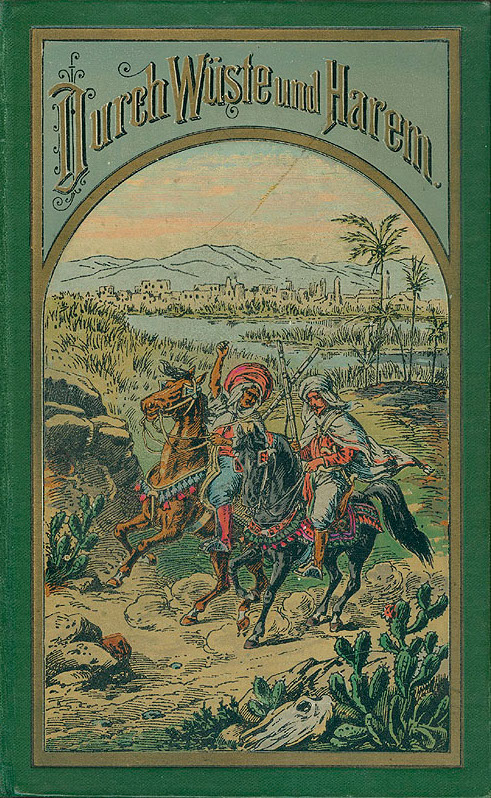
Moreover, as Oliver Stein demonstrated in his study of many similar ‘war as travel’ narratives that all share the same general upbeat tone (Stein 2016), the fact that the soldiers served in the ‘Orient’, i.e., the quasi-mystical land of the Bible and The Thousand and One Nights, made it easier for them to endure all kinds of hardship because the mere fact of ‘being there’, in this ‘magical’ region, was in itself tantamount to a much dreamt-of fulfilment of longings. In addition to Biblical stories and The Thousand and One Nights, the image of the ‘Orient’ that was in almost everybody’s mind used to be heavily influenced by the reading of Karl May’s ‘Oriental’ adventure novels[19] [Fig. 6]. Thus, Zoberbier mentions on several occasions that he had heard much about places like the Hagia Sophia, read about Nineveh in the Bible,[20] or had even written an essay at school, entitled Durch Dorngestrüpt [sic!] und Wüstensand da geht der Weg nach Canaan (“Through thorny bushes and desert sand, the road leads to Canaan”), in which Damascus featured.[21] According to Stein, such Orientalism had an enormous impact on the soldiers, as it shaped their horizon of expectations, their patterns of perception, the practices on the ground, as well as what was remembered[22] – and therefore also made them accentuate the more ‘touristic’ aspects in their accounts, as the ‘travel narrative’ frame allowed them to connect their experiences to tropes and themes that were familiar to their audience. Combined with the fact that they actually had the chance to broaden their horizons (learning new things about the Middle East, seeing Biblical landscapes and historical sites, acquiring knowledge about places, people, food, cultures, religions, etc.), and with the relatively greater freedom they experienced due to the distance from home, the frequent moving around, and often a higher degree of own responsibility and discretion (in many situations, they were – and had to be – their own masters), the positive predisposition made it easier for them to repress the memory of war cruelties, cope with heavy suffering, regulate their emotions and mitigate traumatic experiences (such as witnessing the onslaught of the Armenians) – not the least because they knew that, on coming home, they would have exotic and thrilling ‘Oriental’ stories to tell. One more aspect of ‘Orientalism’, not mentioned by Stein, that may additionally have contributed to generally ‘higher spirits’ than the state of depression observed at the Western front, might also have been the fact that the ‘Orientals’ with whom the German soldiers came in contact, always were their subordinates, employed workers, or members of the generally poor local population, a fact that could support or confirm a sense of racial superiority.
Open questions, guesses, remarks, hypotheses
A close reading of the text(s) and a comparison of its two extant versions as well as the attempt to take into account other, extra-textual material provided by Otto Zoberbier’s grandson Manfred from boxes he found in his father’s (i.e., Otto’s son Werner’s) house, and from interviews, raises some questions about the consistency of Werner’s version of the text history.
b. 14 June 1887
Author of *¹OZ and ²OZ
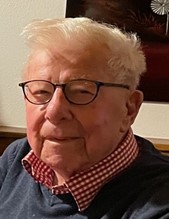
b. 1 Feb. 1921
copy-editor of WZ

b. 1951
helped to provide all kinds of documents
Fig. : Three generations of Zoberbiers
Very often, the data provided in ²OZ and WZ for dates, places, persons, prices, etc., are so detailed and precise that it is hard to conceive that Otto Zoberbier did not make use in his memoirs of some diary kept during the service or other written or printed material (letters or postcards sent home or received from there, private notes, lists, reference works, maps, etc.), material that could have helped him remember all the data with such a precision. Son Werner and grandson Manfred would nevertheless not exclude that their father/grandfather was indeed capable of producing the data with all its exactitude even years after his return from Mesopotamia. They underline that they knew him as a person who possessed a very sharp memory and that they themselves inherited this gift from him. But still, the data given in the texts are detailed to such a degree that I would dare to doubt this in spite of the relatives’ assertions. Rather, I would assume that the (alleged) first version of the memoirs, i.e., the lost *¹OZ, was compiled with the help of a diary or similar material (*0OZ).
Moreover, as anyone with a fair knowledge of German will easily notice, the text of the so-called “Zweitschrift” (i.e., ²OZ, given below in both transcript and original facsimile) is full of misspellings,[23] ungrammatical language, crossed-out passages and other emendations (see below for some random examples), and it does not show any structuring headings or paragraphs; rather, it is written as one single monolithic ‘block’ from beginning to end. The latter feature can perhaps be explained by the fact that, possibly, paper was scarce at the time of writing (in the early/mid-1930s?) and that it therefore may have been important to avoid unnecessary blank space. This aspect notwithstanding, would someone who makes the effort to copy a tattered first version not try to seize the opportunity to produce a cleaner and more correct version? Why should Otto have reproduced in his second version all (or at least many of) the shortcomings of the first? Was his knowledge of current orthographic rules and of ‘higher’ German not sufficient to do so? He had had eight years of schooling in his home village, then three more years of apprenticeship as a postal clerk, then worked for many years in the senior postal service, which, I would assume, included some office work and correspondence in the written language of the day. Therefore, it seems that either the level of education of a senior post official at the time was considerably lower than I would tend to assume, or the “Zweitschrift” was not produced by Otto himself but someone else, less educated than him (who?), or – a daring hypothesis – the “Zweitschrift” was possibly not a copy but the very original, an “Erstschrift” (perhaps composed using various loose sheets or other material). In this case, son Werner’s account of the history of the text as given in the “Epilogue” to WZ (made almost half a century after ²OZ) and in a recent interview (made again four decades later) would not be correct. But why, then, should Werner remember that (the now “lost”) *¹OZ was written in old German hand-writing (Sütterlin/Kurrent[24]) and claim that he himself had both *¹OZ and ²OZ in front of him when he produced the typoscript version (WZ)?
Following up on the latter question: Was the (now “lost”) *¹OZ really available to Werner when he “copied” from and revised ²OZ ? Why didn’t he mention this in the “Epilogue” then? And why did the alleged ‘very original’ *¹OZ not survive the time following the copying although the decades from the early 1980s until today were certainly less troubled than those of the Second World War and the difficult post-war years, during which Otto and his family moved frequently, ultimately even from Eastern Germany to “the West”? Should Werner simply have thrown the tattered *¹OZ away? If so, why did he not remember this?
On another note, it seems slightly strange that the memoirs do not mention Otto’s engagement to his later wife, Erna, although this event must have taken place in spring 1918 when he was on duty leave. Otto’s son Werner thinks this might be due to the fact that his father probably thought such a private matter did not fit the genre of war memoirs or the general character of an ‘Orient travelogue’. Werner may have a point here; yet, Otto does mention that, during his leave, he spent a good time with family and friends and that, “on the penultimate day of my regular leave, I went to the theatre in Berlin with my bride [!] and my relatives” (WZ 18a). So, there was a “bride” – at least in the WZ version; in ²OZ, the passage has no counterpart, it was added by Werner in WZ. But we do not know why. Was it in *¹OZ (which he says had in front on him and consulted every now and then) or did he add it from his own memory? However this may be, even if it featured in *¹OZ or was added from his memory, why not mention the engagement itself but only a theatre evening with the “bride” and family? – Berit Thorbjørnsrud, a former colleague of mine, thinks the neglect of the financé/future wife is to be explained by the simple fact that women did not count much in a still highly patriarchal society and that, therefore, Erna was simply not worth to be mentioned more prominently.
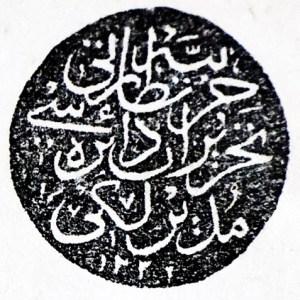
Similarly strange is the fact that Otto’s grandson, Manfred, found a rather spectacular-looking document in the souvenir boxes kept in Werner’s house: a “War Medal on the Red Ribbon/Banner” (ḳırmızı şeritli ḥarb medalyăsı) awarded to Otto Zoberbier by none other than “War Minister” (Ḥarbīye nāẓiri) Enver Paşa, for “good service” (ḥüsn-i ḫidmat) “in the 1332–33 war” (see Fig. 9).[25]
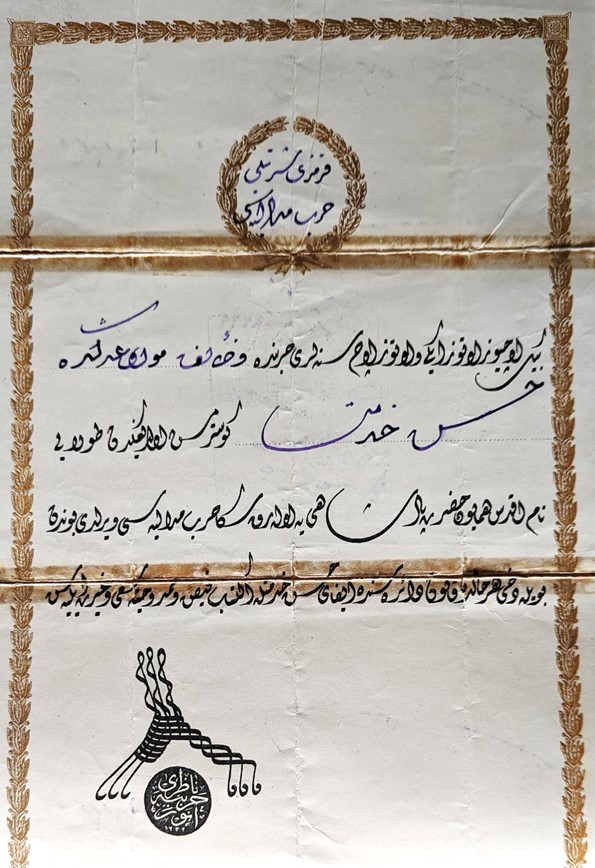
As beautiful as this document is, it is full of mysteries. First, why is it not mentioned in Otto’s “travelogue” at all? Did he disregard it because it was a more or less insignificant standard award (as Werner thinks)? – Second, there is a mismatch of dates. According to the memoirs, Otto stayed in İstanbul for two weeks in early 1916 (on his way to Mesopotamia) and for another three weeks in January/February 1918 (traveling back to Berlin, on duty leave). The document is not dated; however, the year given in the document as “end” (nih[āyet]) of “Ōtō Čōbĕrbiyĕ”’s service, is “1917” – for the stay-over in 1916, this is still too far in the future; and for the one in 1918, it seems too late (though not completely inconceivable). – Moreover, the start (bid[āyet]) of his service in the “German Iraq group – 2nd Dragoons” (ʿırāḳ almān ġrubı – drāġōn 2) is given as “1907”, i.e., long before the outbreak of WW II and the beginning of the German-Ottoman alliance. Perhaps, it is meant to indicate the beginning of Otto’s service in the 2nd Dragoon regiment of Schwedt (see biography), but if so, it is still not correct (as his service there lasted from 1905 to 1908). – Forth, while the beginning-and-end years are given according to the Christian calender, the war in which Otto shall have demonstrated “good service”, is given according to the Islamic calendar: the “1332–33 war”. – Fifth, which war could that be? The Islamic year 1332 AH started in December 1913 CE, and 1333 AH ended in October 1915 CE. Given that Zoberbier’s service in the Ottoman Empire did not start earlier than with his arrival in İstanbul in December 1915, and that he was still working at his post office between 1908 and the outbreak of the war, there is no overlapping between the dates given in the “war medal” and those of the actual biography (as remembered by his son Werner)
| ḳırmızı şeritli ḥarb medalyăsı | War medal with red ribbon/banner |
| Biñ üçyüz otuz iki ve otuz üç senĕleri ḥarbında veẓāʾif mevāḳiʿid..ñde (?) ḥüsn-i ḫidmat göstermiş oldığġıdan ṭolayı nām-i aḳdas-i hümāyūn ḥażret-i pādşāhīya olăraḳ saña ḥarb medalyăsı verildi. Bundan böyle daḫi her ḥālde (vuḳūf?) dāʾirĕsinde īfā-yi ḥüsn-i ḫidmetle iktisāb-i ḳabż … (?) saʿy ve ḫayret eyleyĕsin | On account of the good service you have demonstrated in operational functions (locations of deployment?) in the 1332-33 war you are [herewith and] in the Holy Imperial name of His Majesty the Padishah granted this war medal. From now on and in any case, you are entitled to claim (?) at, and enjoy from, the Information Ministry (?) the payment (?) for your good services. |
| Ḥarbīye nāẓiri Enver | Minister of War Enver |
Fig. 10: The “War medal” awarded to Otto Zoberbier by Enver Paşa – transliteration and translation[26]
Differences between ²OZ and WZ
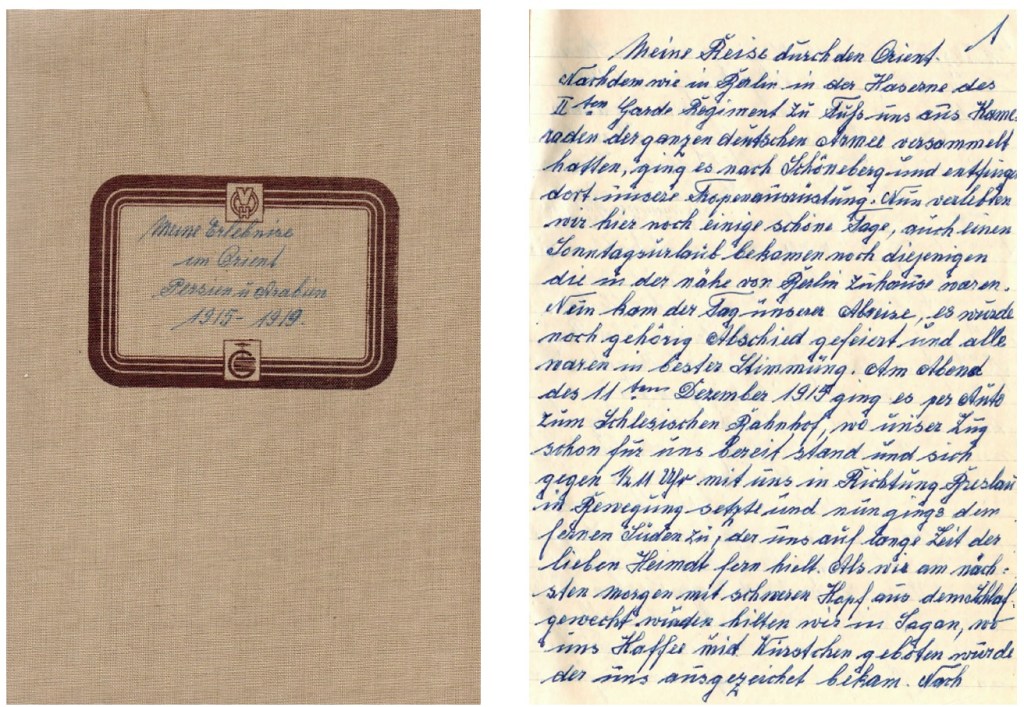
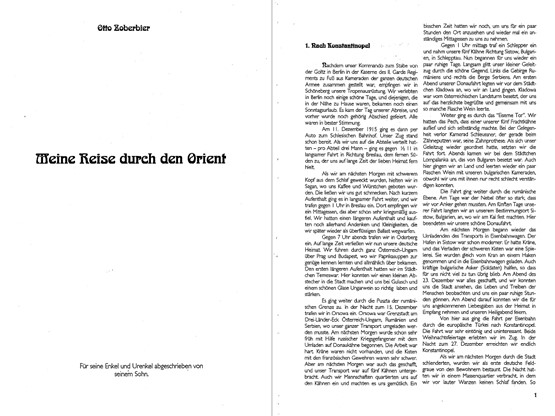
As already mentioned above, the latest version of the memoirs, Werner Zoberbier’s typoscript (WZ), is not simply a verbatim copy of the underlying “Zweitschrift”, Otto Zoberbier’s allegedly second manuscript (²OZ). The son also made some modifications to the text he ‘copied’ from:
► ²OZ has two titles: on the cover of the booklet, it says Meine Erlebnis[s]e im Orient : Persien und Arabien 1915–1919, while on p. 1, the one and only heading is Meine Reise durch den Orient. Thus, the manuscript remains ambivalent with regard to genre attribution. While the term Erlebnisse (literally, “things one has lived”, i.e., seen, experienced, gone through, including a touch of adventure) underlines the character of narrated ‘experiences’ and ‘adventures’, Reise simply means “travels, journey, trip”. For the new, copy-edited WZ version, Werner decided to stick to the more ‘touristic’ Reise.
► Werner divided the text in 13 numbered chapters with headings[27] and inserted paragraph breaks. In contrast, ²OZ consists of only one unstructured, ‘amorphous’ text block. The text simply continues in the same line even if a major shift of content or topic occurs.
► ²OZ is written in a rather ‘raw’ language. Werner polished this thoroughly. His editing included an adaptation of punctuation and spelling to modern standard orthography and a frequent rephrasing (see below), noticeably raising the text’s general linguistic level.
► Quite often, also the length of content units differs. Werner’s version (WZ) sometimes summarizes the text of ²OZ. At other times it rearranges the sequence of told events (probably to produce a better flow). Not seldom it also leaves out parts of ²OZ (either to avoid repetition, or for reasons one may speculate about;[28] see above, pp. xiii, section “Open questions, …”). On yet other occasions, WZ is richer in details than ²OZ.[29] These are the instances where Werner says he added the data either from the – then allegedly still extant but now lost – ‘very first’ version, *¹OZ, or from what he, Werner, himself remembered from his father’s stories. Here, too, one may speculate about the reliability of these explanations: If *¹OZ still existed in the 1980s, why was it lost afterwards (while other pertinent souvenirs, like the group picture [Fig. 3] or war medal survived safely in some boxes [Fig. 7–Fig. 10])? How well had Werner preserved details of his father’s oral accounts in his memory a decade after the latter’s death? Otto died on June 26, 1974, aged 87, and when Werner sat down to copy-edit the handwritten ²OZ booklet it was in the early or mid-1980s after his own retirement.
As for (c), the orthographic and linguistic ‘shortcomings’ are too extensive as to discuss them comprehensively here. They may be worth a study in its own right, as Otto’s German in ²OZ shows features of what could be called “Middle German”, in analogy to the term “Middle Arabic” which signifies a linguistic level somewhere between ‘low’ (colloquial, dialectal) register on the one end, and standardized ‘high’ style on the other end. The following list was made on the basis of a random selection of text from the middle of ²OZ (pages 50–65). As compared to the corresponding renderings in WZ (given in parentheses), the passage from the manuscript displays the following phenomena:[30]
► ‘missing’ (or irritating) punctuation (esp. commas):
► no quotation marks at all:
…bei mir Barschausch (Feldwebel) Batt Batt (Enten) (…bei mir [und riefen]: “Barschausch (Feldwebel), batt batt (Enten)!”)<64>; und sagte was haben sie denn da geschossen, ist ja ein Luchs<64> (und sagte: “Was haben Sie denn da geschossen, [das] ist ja ein Luchs!”);
► apposition unmarked:
sein … Mittag (–) Huhn mit Reis (–) verzehren<50>;
► new main clause with new subject unmarked:
mein erster Gang zur Etappe (,) und hier erfuhr ich…<50>; … aufgebrochen (,) und durch gings…<52>; … gab es hier nicht (,) und noch waren wir nicht…<53>; vor allen Technische Formationen (,) und so wurde…<57>; holen würden (,) und das half (,) und die meisten nahmen die Arbeit wieder auf (,) und so konnten wir… im Trocknen (.) Der Europäische Winter…<61>; …gab, daß Fell… (gab. Das Fell…)<62> (new sentence); das [Fell] der Füchse [ist] besser (,) und in Bagdad zahlten sie…<62>; aufgehängt, als dann… (aufgehängt. Als dann…)<64>; … waren… die Araberjungs im Wasser (,) und jeder wollte der erste sein (,) und derjenige…<65>;
► beginning/end of subordinate clause not marked:
bat er mich (,) ob ich nicht…<51>; Ba-ku-ba (,) wo…<53>; sah (,) das(s)<62>; manchen (,) der<62>; Eines Tages (,) als ich…<63>; an der Stelle (,) wo<64>; nach Bagdad (,) um… Einkäufe zubesorgen<65>; derjenige (,) der die Enten brachte (,) bekam…<65>; Hühner hatten wir… (,) und traf mal ein größerer Transport ein (,) schlachteten wir selbst<65>;
► enumeration of equal parts of speech not separated by comma:
legte an (,) Zielte und Schoß<64>;
► ‘superfluous’ punctuation:
der Angeschossen war, und Blutspuren hinterließ<62> (…war und…; comma inserted although there is no change of subject);
► capitalisation of verbs:
[ich] Ritt (ritt)<50>; Rastete (rastete)<50>; zu Retten (retten)<51> ; [wir] Maschirten (marschierten)<52>; mich Untersuchen (untersuchen)<55>; dafür Sorgen (sorgen), daß<56>; Retten (retten)<57>; Jagden (jagten)<58>; Streikten (streikten)<60>; und Schoß (schoß/ss)<63, 64>; (um) zu Jagen (jagen)<62>; Zielte (zielte)<64>;
► un‑ (or no) capitalisation
► of verbal nouns: ein trinken (Trinken) aus der Feldflasche<53>; alles zureden (Zureden)<61>; beim abziehen (beim Abziehen)<64>; zum trocknen (Trocknen)<61>;
► of other nouns:
vermerk (Vermerk)<60>; ende (Ende) April<61>; ende (Ende) Oktober… anfang (Anfang) November<61>; vor eintritt (vor Eintritt)<61>; zum trocknen (Trocknen)<64>;
► capitalisation of adjectives and adverbs:
Abends (abends)<50, 54, 57>; Nachts (nachts)<50, 52>; Unterwegs (unterwegs)<51>; ein Deutscher (deutscher) Arzt<54>; war immer Warm (warm)<55>; einigermaßen Wohl (wohl)<56>; Sauber (sauber)<56, 57>; Technische (technische)<57>; Fingerhocher (fingerhoher)<57>; Telefonisch (telefonisch)<58>; Häuslich (häuslich )<58>; Türkische (türkische)<58>; Angeschossen (angeschossen)<62>; Kilometerweit (kilometerweit)<62>; Wertlos (wertlos)<62>; Verpflegt (verpflegt)<62>; Arabischen (arabischen)<63>; Trocken (trocken)<64>; Wertvoller (wertvoller)<64>; Wöchentlich (wöchentlich)<65>;
► separation of prefix from main verb:
zurück kam (zurückkam)<50, 64>; zurück gelegt (zurückgelegt)<52>; zurück gehende (zurückgehenden)<52>; auseinander zuschlagen (auseinanderzuschlagen)<58>;
► separation of compound elements:
Maultier Karawane (Maultierkarawane or Maultier-Karawane)<51>; ein gewalt Marsch (Gewaltmarsch)<53>; Stab arzt (Stabsarzt)<54>; die Araber Jungs (Araberjungs)<64>;
► no space between “zu” and following infinitive or other elements:
zuheiß (zu heiß)<52>; zudenken (zu denken)<52>; zuende (zu Ende)<52>; zugehen (zu gehen)<52>; zulöschen (zu löschen)<53>; zuschmecken (zu schmecken)<55>; zurechnen<57> (zu rechnen); zuverdienen<59> (zu verdienen); zuverschwinden (zu verschwinden)<60>; zuverlaßen (zu verlassen)<61>; zubesorgen (zu besorgen)<65>;
► old (dated) spelling:
Todt (Tod)<53>, Brodt (Brot)<60>;
► non-standard/unorthographic spellings:
-i- instead of ‑ie- or ‑ih-: erschin (erschien)<60>; im (ihm)<62>;
-k- instead of ‑ck-: Rükweg (Rückweg)<50>; schmekt(e) (schmeckt(e))<52, 55>; Bakofen (Backofen)<52>;
-n- instead of ‑nn-: konte (konnte)<51>;
-nn- instead of ‑n-: mann (man)<57>;
-ß- instead of ‑s-: weiterreißte (weiterreiste)<50>; daß (das) Baden<55>; ausgelaßtet (ausgelastet)<56>; daß (das) gab<60>; daß (das) Fell<62, 64>; daß (das) dauerte aber<63>;
-ß- instead of ‑ss-: verlaßen (verlassen)<62>; und Schoß (schoss)<63>;
-s- instead of ‑ß- or ‑ss‑: ein bischen (bißchen / bisschen)<55, 60>; Fleisigen (Fleißigen)<59>; auser (außer)<60>; sah (,) das (dass)<62>;
-ff- instead of ‑f-: öffters<64> (öfters);
► ‘etymological’ spelling: Jagden (jagten)<58>;
► defective spelling (probably due to Berlin pronunciation):
beschäftig (beschäftigt)<59>; Tonfeife (Tonpfeife)<59>; Furch (Furcht)<60>; mein (meinen) vermerk<60>; Nadem (Nachdem)<61>; sichbar (sichtbar)<61>; in ein (einen) Sack<64>; bewältig (bewältigt)<65>; mindesten (mindestens)<65>;
► rare forms: ordendlich (ordentlich)<51>; zusehens (zusehends)<55>
► foreign words / terminology:
Lazareth (Lazarett)<51, 53, 54, 56> (perh. under the influence of “Nazareth”); das Maschiren (Marschieren)<52>, [wir] Maschirten (marschierten)<52>; Alluminium (Aluminium)<53>; Generalkomando (…kommando)<56>; Euphrath (Euphrat)<57>;
- ungrammatical forms / phrasings:
ein Deutscher Arzt und \der/[31] (deutscher Arzt, der) mit Tropenk[r]ankheiten vertraut war<54>; meine Zeit (ich) war nicht ausgelaßtet<56>; des Frühjahr (Frühjahrs)<56> (genitive case ending dropped); War ein Transport per Schachturen (Kähne) angekommen, (so) wurden (sie) hier entladen<57> (subject of main clause suppressed); die Schachturen auseinander zuschlagen daß uns der Türkische Etappenoffizier verweigerte und Posten aufstellte (… auseinanderzuschlagen, was uns… verweigerte; er stellte Posten auf)<58> (new main clause with identical subject drawn into a subordinate clause, merging the two); alle… \liegende/[32] (liegenden) Steine<61>; Nun fing für mich wieder die gute Zeit an (,) und (ich) ging viel Jagen<62> (1st-person subject of new main clause “ging viel jagen” assumed to be already mentioned in preceding sentence, therefore dropped, though 1st person “I” does not appear in the subjective nominative case ich there but in the accusative mich, dependent on preposition für); waren… bei mir zu Jagen (um zu jagen or zum Jagen); die Begleitmannschaft wurde von uns Verpflegt (,) und (wir) zahlten für den Tag 5 Piaster<62> (as in preceding: 1st person subject of new sentence remains unmentioned, as it is felt to be there already, although it only appeared in a dependent case, after a preposition); von Araber… eingerieben (vom Araber or von den Arabern)<64>;
► blending present and past participle:
angekommende (angekommene) Europäer<51>; aus den angekommenden (angekommenen or ankommenden) Schachturen<58>;
► Berlinisms, esp. accusative case instead of dative (or vice versa):
lief ich den (dem) Hauptmann Jordan in die Hände<51>; in Zelte (Zelten) aus Rohrgeflecht<57> (in is used with locative meaning here); in 4-5 Tage (Tagen)<59>; bei den Araber (Arabern)<60>; konnte jeden (jedem) vertrauen<60>; \daß/[33] (Dem) wollten sie nicht nachkommen<61>; ließen wir die (den) übrigen sagen<61>; auf den (dem) Euphrat<64>; von unseren (unserem) Araber<65>;
► colloquialisms:
ob ich nicht könnte […] gehen (nicht […] gehen könnte)<51> (word order); überwältig (bewältigt)<53>; und durch gings (und [schon] ging es druch)<52>; hier liegenbleiben (liegenzubleiben) bedeutete…<53> (colloquial infinitive); trotsdem (obwohl / obgleich) es sehr gut war<54> (use of adverb trotzdem as subordinate particle); Stabsarzt der sich die größte Mühe gab, und ich für ihn (und für den ich… ) ein Rätsel war<55>; dafür (davor) Retten<57>; Fingerhocher Sand<57> (fingerhoher Sand or Sand fingerhoch); die Schachturen auseinander zuschlagen daß (, was) uns der Türkische Etappenoffizier verweigerte<58>; auser der Zeit (außerhalb der (gewohnten) Zeit(en))<60>; daß gab ein bischen Furch (das machte/erzeugte ein wenig Angst, das schreckte ein bisschen ab)<60>; zum trocknen \liegende/[34] (daliegenden / ausgelegten) Steine<61>; Trotsdem (Obwohl/Obgleich) ich ein guter Schütze war<62>; machen sich die ersten Wolken sichbar (bemerkbar or erscheinen die ersten Wolken)<61>; ließen wir die übrigen sagen, wenn sie nicht sofort die Arbeit wieder aufnehmen würden, würden wir uns vom anderen Dorf die Arbeiter holen (den übrigen sagen, dass wir, wenn sie die Arbeit nicht sofort wieder aufnähmen, uns vom anderen Dorf die Arbeiter holen würden)<61> (subordination simplified, no written-language consecutio tempora)
As for (d), i.e., Werner’s cuttings or additions, they too are too numerous as to be discussed in full in this Introduction, and it may therefore suffice here with some samples.
► Summaries and rearrangement of sequence of told events (probably to produce a better flow): Compare, for example, the two versions below and find which bite of information is given where!
| ²OZ 89–90 | WZ 16b |
| Hier in Aleppo ließ es sich leben, allerlei Abwechselung, es waren zwei Konzert-gärten, in den eine Östreichische Damen-kapelle und in den andern eine Arabische Damenkapelle spielte, wo wir auch oft zu Gast waren. Auch auf der deutschen Etappe gabs eine schöne Flasche <facs. 90> Deutsches Bier, daß allerdings 2.60 Mark kostete, sonst ritten wir viel in der Um-gegend Spazieren und genossen die schöne Zeit in vollen Zügen. Wir waren im Tier-depot fünf Deutsche, und hatten unsere eigne Küche und auch unseren eignen Koch, der uns schon auf der Etappe in Redwanje betreut hatte. | Hier ließ es sich leben. Wir waren im Depot fünf deutsche Kame-raden. Jeder hatte sein eigenes Reitpferd, und abends, wenn es angenehm kühl wurde, machten wir unsre Spazierritte, was andere deutsche Kameraden nicht konnten und worum sie uns sehr benei-deten. Wir hatten unsere eigene Küche mit einem eigenen Koch. In der Freizeit genossen wir das Stadtleben. Es gab in der Stadt zwei Konzertgärten. In dem einen spielte eine österreichische, in dem anderen eine arabische Damenkapelle. Hier gingen wir oft hin. Doch merkte ich sehr schnell, dass das Leben hier viel teurer war. Wir brauchten hier zwar auf nichts zu verzichten, aber mein während der Transporte durch die Wüste Zusammengespartes wurde langsam weniger. Es gab auf der deutschen Etappe sogar deutsches Bier, allerdings für 2,60 Mark die Flasche. Da reichte selbst unsere Tropenzulage von sechs Mark nicht aus, um es oft zu genießen. |
| (English:) Life was good here in Aleppo, with all kinds of variety, there were two concert gardens in which an Austrian ladies‘ band played and in the other an Arab ladies’ band, where we were often guests. At the German back area, you could also have a nice bottle of <facs. 90> German beer, but it cost 2.60 marks, other-wise we rode a lot in the neighbourhood and enjoyed the beautiful time to the full. We were five Germans in the animal depot, and had our own kitchen and also our own cook, who had already looked after us at the back area in Redwanje. | (English:) It was a good place to live. Five Germans were working in the depot. Each of us had his own riding horse, and in the evenings, when it was pleasantly cool, we went for our rides. Other German comrades couldn’t do that and envied us for it. We had our own kitchen, with our own cook. In our free time we enjoyed the city life. There were two concert gardens in the city. An Austrian ladies’ band played in one of them, and an Arab ladies’ band in the other. We often went there. But I soon realised that life here was much more expensive. There wasn’t anything we had to do without, but the money I had saved up during our transports through the desert was slowly dwindling. You could even buy German beer in the German back area, but it cost 2.60 marks a bottle. Even our tropical allowance of six marks was not enough to be able to enjoy it often. |
► Omissions:
WZ 0 has nothing where ²OZ has “1 Garde Ulanen [:] 2 Mann” – probably left out erroneously.
For some reason, WZ 6a leaves out a whole passage from ²OZ 29–30 where Zoberbier describes the difficulties the group encountered when trying to cross a slippery bridge. The police came and helped, but a comrade lost some sugar and his rifle to the waters of the Tigris river. No obvious reason why Werner should have omitted this entertaining episode.
Compared to ²OZ 93, a paragraph on page WZ 17b is less detailed. OZ gives “Zigeunerbaron oder Schweinefürst” as examples of the nice pieces performed by an Austrian theatre group that he used to enjoy in İstanbul while waiting for the permission to continue his trip (on duty leave in early 1918) and that an entry ticket cost “35 Piaster or sieben Mark”. In contrast, WZ only mentions the title Zigeunerbaron (“Gypsy Baron”, by Johann Strauss II) while dropping Schweinefürst (actually, the “Pig Farmer” is just a role in Gypsy Baron), and instead of giving the prices for the entry fees, says that he and his comrades “sometimes ate in a restaurant, but that was expensive because the prices had risen considerably in the two years since I had been here” (… aßen wir auch mal in einem Speiserestaurant, doch das ging ins Geld, denn die Preise waren in den beiden Jahren, seit ich hier war, ständig angestiegen).
► Additions, modifications, etc.
WZ 4b misreads ²OZ 20 “Hedjasbahn” for “Hedschrabahn”.
WZ 4b wrongly has “Am 26. Januar” instead of correct ²OZ 21 “Am 26ten Februar”.
WZ 4b misreads “Asabatschi” instead of correct ²OZ 22 “Arabatschi”.
WZ 12a corrects ²OZ 64 “12-15 Mark” to (arithmethically more convincing) “12 bis 16 Mark”.
Further down in WZ 12a, where the memoirs say something about the breadth of the Euphrates river, Werner feels he should modify ²OZ 65 “mindesten[s] 500 Meter” (at least 500 m) to “500 m bis 600 m” – here, Werner obviously felt the data should be less vague, so he limited it and made it slightly more concrete.
WZ 13a adds a passage (about a “German comrade, the son of the court photographer from Metz”): he “was also buried in the local cemetery. He had been commanded along with us as a photographer to the von der Goltz staff. In Tarsus we had celebrated the Emperor’s birthday together. We were told that he had pitched a tent on his shakhtoor to protect himself from the sun and heat, and that when a storm came and the shakhtoor capsized, he tried to save his precious photographic equipment from his tent and then drowned with the shachtur.” – Where did Werner take this from? From *¹OZ or from what he himself remembered from his father’s stories?
WZ 14b narrows down the number of sandgrouse killed by Otto “with one shotgun” from ²OZ 79 “bis zu acht” (up to eight) to a more modest “bis zu fünf” (up to five).
Reporting about an excursion through dangerous terrain where the group had to reckon with attacks from “bold, brazen” Bedouins, WZ 16a adds two informations to ²OZ: (a) “From time to time, one of our grooms would disappear” (Von Zeit zu Zeit verschwand dann einer unserer Pferdepfleger), and, (b) (after mentioning that the Germans would strike back after each Bedouin attack with punitive raids, supported by aeroplanes – which has its parallel in ²OZ 87): “So far I had always been lucky, my transports had never been raided. Another, much larger caravan was attacked near Tigkrit, and the cousin of our interpreter, also a Palestine German, was killed” (Bisher hatte ich immer Glück, meine Transporte sind nie überfallen worden. Eine andere, viel größere Karawane wurde bei Tigkrit angegriffen, und der Vetter unseres Dolmetschers, ebenfalls ein Palästinadeutscher, war gefallen.) – It is not clear where these two additions come from.
On page WZ 16b, two whole paragraphs are added: “Nachdem ich länger dort war, hatte ich inzwischen Leute in anderen Stellen kennengelernt. Ein Feldwebel, der irgendeine Ausgabestelle unter sich hatte, zeigte sich bei Gelegenheit erkenntlich, wenn er mal mit einem unserer Pferde ausreiten durfte. / Wir wurden auch von unserem arabischen Tieraufkäufer eingeladen, bei dem es schon europäischer zuging, denn es wurde schon mit Messer und Gabel gegessen. Und auch der Alkohol fehlte nicht” (Having lived in Aleppo for a while, I had met people in other departments posts too. A sergeant who was in charge of some sort of issuing office showed his appreciation when he was allowed occasionally to borrow one of our horses for a ride. / From time to time we were also invited by our Arabian animal buyer, who already had adopted a European lifestyle – we used knife and fork for eating. And we were even served alcohol to drink). – I cannot see any obvious reason why Otto added this passage, and the source of the surplus information is as unclear as in the other examples.
According to ²OZ 100, the Germans left Aleppo “Am vierzehnten” (on the fourteenth, sc. October 1918), WZ 19a corrects this into “Am 16. Oktober”.
WZ 19a corrects obviously wrong ²OZ 101 “Ismir” to “Izmid”, the correct name of the city the train stopped in on the way from Konya to İstanbul.
WZ 19a misreads ²OZ 103 “Kattekoe” as “Hattekoc” (initial H and K looking quite similar in Otto’s handwriting, as also final e and c), which makes it even more difficult to identify the actual place – Kadıköy!
WZ 20a adds the information that all German soldiers who could not find a place on one of the ships going back to Germany were transported to the islands “Haki” and “Princepo” – no corresponding information in ²OZ (should have been ²OZ 105).
Stephan Guth, Oslo, May 2024
Notes to Editor’s Introduction
[1] I am using an asterisk, “ * “, to indidate that the document does not exist any longer and that there can be some doubts regarding its actual existence (see below, “Questions, …”, pp. xiii ff.).
[2] Interview with Werner Zoberbier, conducted with him by his son, Manfred, and Susanne Mortier, Easter 2024.
[3] Ibid.
[4] The text’s history thus shows some similarity to what, for instance, Ruben Gallé says about German private Georg Steinbach’s memoirs which he edited for the Memoria series: “The original diary, written on the basis of letters and earlier notes, is dated March 1920. Though it has unfortunately not been preserved, there are several bound copies which my grandfather Albert Gallé prepared and which form the basis of this publication. A collector and archivist in every respect, he considered it his duty to document and preserve our family history” – Gallé, ed. 2017, 8. From Werner Zoberbier’s “Epilogue” (here serving in lieu of a Foreword, see below) to his father’s memoirs it is clear that he felt guided by a similar motive to save the document from oblivion and preserve it for posterity.
[5] Interview with Werner Zoberier (as in note 2). – Given that son Werner was already more than 103 years old when Manfred and Susanne interviewed him on Easter 2024, his account of the text history may not be completely reliable. Personally, I don’t think that the ‘original’ version (*¹OZ) was still available to Werner. Many other of his father’s things have survived in boxes in the house where Werner retyped and copy-edited the “Zweitschrift” (²OZ); so why should *¹OZ have been lost only then, after the copy-editing? Thrown away because it was tattered and had become useless? Wouldn’t Werner have remembered and mentioned that he threw it away? Another indicator of the non-existence of *¹OZ at the time of copy-editing is the fact that Werner did not mention it as extant in his “Epilogue” to the copy-edited version (see below, p. 3).
[6] This section is a (slightly shortened) English translation of the summary, written up by Susanne Mortier (partner of Otto Zoberbier’s grandson Manfred), of an interview she had with Otto Zoberbier’s son Werner (then 103 years old) on February 2, 2024, about his father’s life. I am using a different font to signal that this section is not from my own pen.
[7] In the present booklet, I will on many occasions refer to (1) Ruben Gallé’s edition (2017) of private Georg Steinbach’s memoirs about his stay in İstanbul in 1918 (memoria, vol. 3), (2) Oliver Stein’s study of numerous similar “travel” documents (Stein, “Orientfahrten”, 2016), and (3) Jan Christoph Reichmann’s dissertation (Münster 2009) about German views of the Ottoman allies (both Arab and Turk) – see Bibliography.
[8] Cf. Gallé, ed. 2017, 5.
[9] Cf. ²OZ 24-25 / WZ 5a, where Otto remembers that they were abhorred by the cruelty of the Turkish gendarmes and tried to help “as far as we could” by offering what they could afford from their own food; but they also felt unable to prevent the Armenians’ destiny. ²OZ even tries to see a positive aspect in their, the witnesses’, impotence: helping the victims would only have prolonged their suffering and inevitable death (the passage ²OZ 25 saying helfen konnten wir ih[nen] wenig, verlängerten nur dadurch noch ihre Qual “we couldn’t help them [anyway], but in doing so only prolonged their torment” is missing from WZ). – A comparison with other similar reports shows that Zoberbier’s and his comrades’ feelings and attitudes were rather typical of how German eyewitnesses at the time reacted to what they observed, cf. Reichmann’s analysis of comparable documents (see below, English edition, footnote 100).
[10] The ‘valuta exchange rate’ emerging from Zoberbier’s memoirs remains stable throughout: 1 piaster = 20 Pfg (Pfennigs = 0,20 German Marks); 5 piasters = 1 Mark; 20 piasters = 1 medjidi = 4 Marks. For 1 piaster the soldiers would get 6 eggs (WZ 5a); for 2-2½ piasters (40-50 Pfg) they would buy 1 chicken (WZ 5a) or sell a fox skin on a Baghdad market (WZ 12a); 5 piasters (1 Mark) was the regular payment to Arab locals for 1 day of unskilled work, and the same amount was asked for from newly arrived troops in the Riḍwāniyya back area (close to Baghdad) for a decent meal (WZ 12a); a four-course meal at the German-run Hotel Franzow in Baghdad would cost 8 piastres (1.60 Marks) (WZ 6a), while a bottle of beer in the German back area in Aleppo had become as expensive as 2.60 Marks (13 piasters) when the war was nearing its end (WZ 16b), i.e., more than two fifths of a soldier’s usual tropical allowance (which amounted to 6 Marks, or 1.5 medjidi, or 30 piasters) (ibid.); thus, the price at which you could sell a lynx skin on a Baghdad market – 3-4 medjidis (= 12-16 Marks) – was a veritable fortune (WZ 12a).
[11] Cf. ²OZ 22, 28, 48 / WZ 4b, 5b, 9a, 16a. For more about the group, see below, footnote 50 to the English edition.
[12] Some examples: (on Constantinople/İstanbul) “How we have lived here and wished it could always stay like this” (Wie haben wir hier gelebt und wünschten es mochte immer so bleiben, ²OZ 6) / “How we have lived and revelled here!” (Wie haben wir hier gelebt und geschwelgt!, WZ 2a); [how sad it was] “to say good-bye to this place where we had spent so many unforgettably beautiful hours” (von hier Abschid nehmen, in der wir so viele unvergeßliche schöne Stunden verlebt hatten, ²OZ 8); (on Pozantı, a stop on the Anatolian railway): “Here I spent some beautiful days that will remain in my memory forever” (Hier verlebte ich nun wieder einige schöne Tage die mir ewig in Erinnerung bleiben werden, ²OZ 10); (on Aleppo): “Here … life began again in a way we couldn’t have wished for better… How we lived here! There was no end to partying” (Hier … begann wieder ein Leben, wie wir es uns nicht besser wünschen konnten… Wie haben wir hier gelebt…! das Feiern nahm kein Ende, ²OZ 20-21); (on Pāyṭāq, Persia): “Here we lived really well” (Hier lebten wir wirklich gut, ²OZ 40); (on Riḍwāniyya, Iraq): “we really enjoyed life here” (wir lebten hier sehr gut, ²OZ 65); (in Aleppo again): “I had the best time here… It was good to live here… we enjoyed the good times to the full” (Hier… verlebte ich die schönste Zeit… Hier… ließ es sich leben… wir genossen die schöne Zeit in vollen Zügen, ²OZ 89-90).
[13] E.g., when they arrived in Sistov, Bulgaria: “Now we could treat ourselves to a few quiet hours again, take a look at the city, and experience the life and hustle and bustle…” (Nun konnten wir uns wieder ein paar ruhige Stunden gönnen, uns die Stadt ansehen und… das Leben und Treiben… miterleben, ²OZ 5); then in İstanbul/Constantinople: “We had to report in every day on the back area, but then we had time off and enough time to see and get to know the city” (Wir mußten uns ja jeden Tag auf der Etappe melden, hatten dann aber Frei und noch genügend Zeit um uns die Stadt an zusehen und kennen[zu]lernen, ²OZ 6-7) | “There was no duty” (Dienst gab’s nicht, WZ 2a). Touristic highlights in İstanbul were not only the Hagia Sophia, the covered basar, and the Bosphorus, but also a visit (on invitation of German sailors they met in the city) to the SMS Göben (see note 64 to the English text below), “a magnificent ship 186 metres long, the large turrets with their 28 cm guns, was a unique experience for us field greys. We were also shown and explained everything that civilians never got to see” (ein herrliches / Schiff von 186 Meter länge, die großenGeschütztürmen mit ihren 28 cm Geschützen, war für uns Feldgrauen ein einmaliges Erlebnis. Es wurde uns auch alles gezeigt und erklärt, was Civilpersonen nie zusehen bekamen, ²OZ 7-8). When Zoberbier came to İstanbul/Constantinople for the first time in December 1915 / January 1916, he had two and a half weeks until his departure for Anatolia; at the second occasion (when he was on duty leave), he had almost three weeks (waiting for a train and permission to travel on to Berlin); and even at the third occasion (when the city was already occupied by the British, French and Italians and the group was kept in custody in Kadıköy after their arrival on Nov. 18, 1918), they were allowed to move around freely and could go sightseeing and shopping for almost two months. On the way to the eastern front, Zoberbier had almost four weeks in Aleppo (February 1916), and six days in Baghdad (March 1916). In summer/early fall 1916, after a long stay at the military hospital, slowly recovering from a disease, he spent several weeks in Baghdad again; and went he was based in Aleppo, he had another three and a half months there (October 1917 to mid-January 1918) and then again (after return from duty leave) almost half a year. As already mentioned above, while in Aleppo, he used the opportunity of a transport going to the Biqāʿ valley for an excursion to Baalbek and Damascus, and when they once had a trip to Mosul (in spring 1917), it was only natural to go and see the ruins of Nineveh and Jonah’s tomb (²OZ 74-75 / WZ 14a).
[14] (In Tarsos): “Two Austrian comrades… were also accommodated in the same hotel… Here…, we celebrated Kaiser’s birthday with the [F]arnow family… The area is marvellous, with the Mediterranean to the south and the snow-capped peaks of the Taurus Mountains to the north” (Im selben Hotel waren auch zwei österreichische Kameraden untergebracht… Hier… feierten wir bei der Familie [F]arnow Kaisers Geburtstag… Die Gegend ist herrlich, im Süden das Mittelmeer und im Norden die schneebedeckten Gipfel des Taurus-Gebirges, WZ 4a); (in Aleppo): “the many Germans who lived here … invited us often” (die vielen Deutschen die hier Wohnten… luden uns öfter ein, ²OZ 20-21).
[15] See ²OZ 42/ WZ 8a, ²OZ 62 / WZ 11b, ²OZ 63-64 / WZ 11b-12a, ²OZ 79 / WZ 14b, ²OZ 80 / WZ 15a, ²OZ 82 / WZ 15a, ²OZ 85.
[16] E.g., when he accompanied a transport to the Biqāʿ Valley to see Baalbek and Damascus.
[17] (In İstanbul/Constantinople): “The food was excellent and the drinks no worse” (daß Essen war vorzüglich und die Getränke nicht schlechter, ²OZ 6); (in Aleppo): “the good food, the good wine” (die gute Verpflegung, der gute Wein, ²OZ 20); “We also used to have a nice bottle of German beer at the back area… We had our own kitchen and our own cook” (Auch auf der deutschen Etappe gabs eine schöne Flasche… Wir hatten unsere eigne Küche und auch unseren eignen Koch, ²OZ 89-90); “We… weren’t missing anything here… and lived like a pig in bacon. In the evenings we often had a lift to the concert garden to enjoy a bottle of wine or a glass of rakı” (wir… brauchten eigentlich nichts entbehren… und lebten wie die Made in Speck. Abends ließen wir uns öfters zum Konzertgarten fahren, um bei einer Flasche Wein oder bei einen Glase Racki zu verbringen, ²OZ 91).
[18] Even in the farthest place he ever got during his “journey” – Pā(y)ṭāq in Persia – he says he “settled down [as if] at home” (ließ mich Häuslich nieder, ²OZ 40).
[19] Karl Friedrich May (1842–1912) “is best known for his novels of travels and adventures”. He was, and still is, “one of the best-selling German writers of all time, with about 200,000,000 copies sold worldwide”. “For the novels set in America, May created the characters of Winnetou, the wise chief of the Apaches, and Old Shatterhand, Winnetou’s white blood brother. Another series of novels were set in the Ottoman Empire. In these, the narrator-protagonist, Kara Ben Nemsi, travels with his local guide and servant Hadschi Halef Omar through the Sahara desert to the Near East, experiencing many exciting adventures. […] With few exceptions, May had not visited the places he described, but he compensated successfully for his lack of direct experience through a combination of creativity, imagination, and documentary sources including maps, travel accounts and guidebooks, as well as anthropological and linguistic studies. […] Non-dogmatic Christian values play an important role in May’s works.” Among the best-known titles are those of the six novels of the so-called Orient Cycle , i.e., Durch Wüste und Harem (“Through desert and harem”), Durchs wilde Kurdistan (“Through wild Kurdistan”), Von Bagdad nach Stambul (“From Baghdad to Stambul”), In den Schluchten des Balkan (“In the ravines of the Balkans”), Durch das Land der Skipetaren (“Through the land of the Shqipetars”), Der Schut (“The Shût”) (individual novels since 1879, assembled in the Orient Cycle in 1892). “May had a substantial influence on […] the German population […]. The popularity of his writing, and his (generally German) protagonists, are seen as having filled a lack in the German psyche, which had few popular heroes until the 19th century. His readers longed to escape from an industrialised, capitalist society […]. May ‘helped shape the collective German dream of feats far beyond middle-class bounds’” – https://en.wikipedia.org/wiki/Karl_May (as of May 5, 2024).
[20] As such, the places Zoberbier and others got the chance to see formed part of the “Holy Land”, even though this term “needs some specification”, as Zorgati 2021, 331 n.9, rightly observes. Zoberbier never advanced as far south as to the ‘heartland’ of this ‘holy’ region (Judea, Samaria, Galilea, and the Land of the Philistines). Yet, even places like Damascus or Nineveh, which only were of “third rate importance” in the “order of holiness” that Europeans had in mind (described in Ben-Arieh 1989), nevertheless exercised a quasi-magic fascination. (Second in this “order of holiness” ranked eastern Palestine and the Negev.) For a critical examination of the term “Holy Land”, see also Whiting 2007. – In contrast to mainstream tourism to the “Holy Land”, Zoberbier does not seem to have been driven by religious motives, and his report never mentions scenes of praying in a group at “Biblical” places, as other travelogues would do (see, e.g., those examined in Løvlie 2021).
[21] ²OZ 90-91 / WZ 16b.
[22] Cf., in this context, also Ruben Gallé’s remark that private Georg Steinbach (who took “prolonged walks” through Istanbul between June and November 1918) were driven by an “urge to explore” (Gallé, ed. 2017, 6) which he sees very much “influenced by the clichés of the Orient that prevailed at the time in Germany and Europe. It was as an exotic place of longing characterized by sensuality and decadence” (ibid.): “For all of them, the Orient was a strange and yet, at the same time, a fairy-tale world. It was a world of exotic spices, smells, colors, and sounds. ‘It is already dim – a beautiful evening. People are returning home from work. Water sellers drive their cask-laden donkeys. It is all so new to me, so strange, and yet so charming. Memories from my boyhood are awakened at the point where the imagination vividly seizes the mythical Orient’” – Gallé, ed. 2017, 6, quoting from Steinbach’s memoirs, ibid. 21 / facs. 13.
[23] It is true that orthography was not yet as standardized then as it is today. But still, compared with the spelling used in contemporary printed texts, ²OZ looks very ‘half-educated’.
[24] See above, note 6.
[25] A similar (though still more ornate) müḥārebe medalyăsı (fighting/combat medal) is reproduced in Veltzke 2014, 332: a “Mecīdīye Order 3rd Class” awarded in 1917 to Major Klein (whom Veltzke’s book is about) for “good services in Baghdad and Persia”. Cf. the text of Zoberbier’s medal, transliterated and translated below.
[26] Many thanks to Benjamin Weineck, Heidelberg, who helped me decipher the Dīwāni script and guess the meaning of what is said here. There seem to be some misspellings (mevāḳ̣iʿid..ñde, oldığġıdan), and the last line is very difficult to read due to text damage from folding the document.
[27] These are: “1. Towards Constantinople”, “2. Across the Taurus Mountains”, “3. On the Way to Baghdad”, “4. Baghdad”, “5. New Destination: Persia”, “6. Back in Baghdad”, “7. On the Euphrates”, “8. Retreat”, “9. New Job: Caravan Guide”, “10. Aleppo (end-Sept 1917 – Jan 1918)”, “11. Duty Leave”, “12. Retreat and End of the War”, “13. Coming Home”.
[28] We have already mentioned above the fact that, in connection with the Armenian genocide, WZ added a phrase that is missing from ²OZ (see note 10) omitted, while both versions remain tacit about the engagement with Erna Jänicke (see p. xv, #(4).
[29] See ibid. – WZ mentions the bride at least once while ²OZ neglegts her completely.
[30] Page numbers in ²OZ are given between superscript brackets: <…> .
[31] “\…/” marks subsequent insertion, typically raised above the line.
[32] Dto.
[33] Dto.; “daß” is not the subordinating particle here, but a (misspelt) demonstrative “das” in the accusative case.
[34] Subsequent insertion.
 Sergeant Otto Zoberbier’s "Travels in the Orient: Persia and Arabia, 1915–1919"